How to Correctly Identify Inflection Points
TL;DR
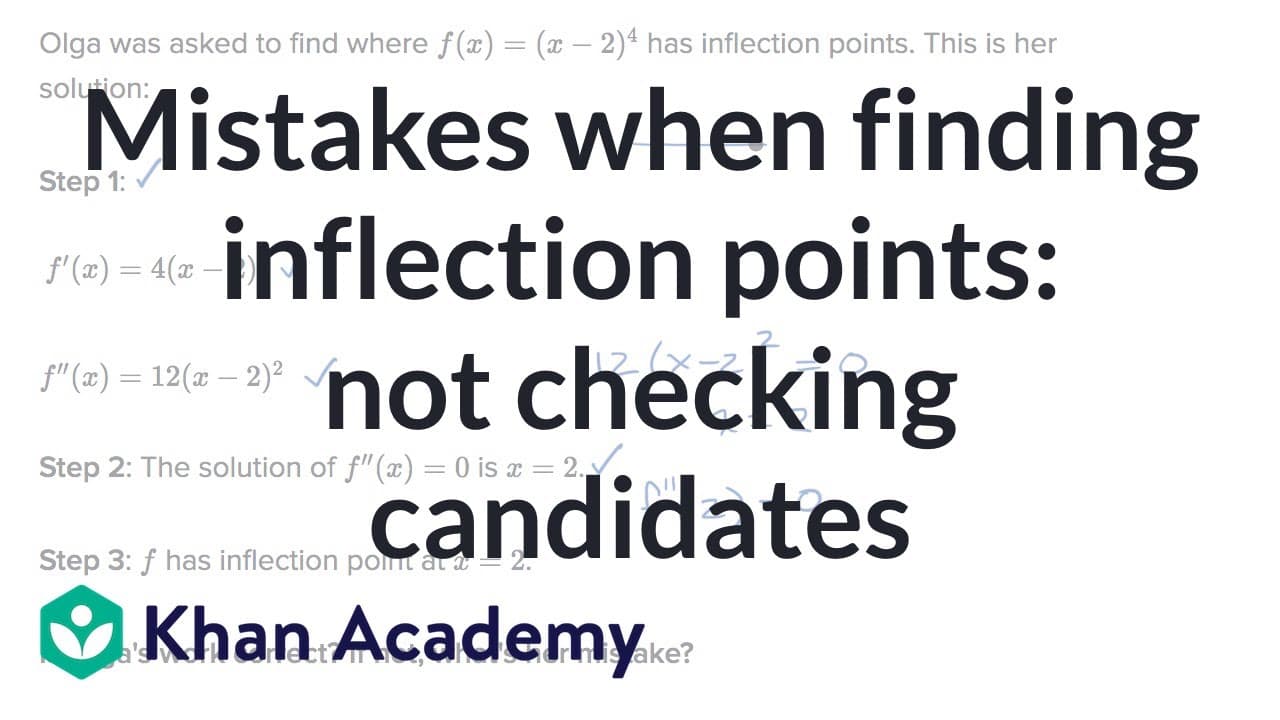
To determine if an inflection point exists at x equals two, you must evaluate the sign of the second derivative on either side of that point. Olga incorrectly concluded that there is an inflection point solely because the second derivative is zero there. Since the second derivative remains positive on both sides, there is actually no inflection point at x equals two.
Transcript
- [Instructor] Olga was asked to find where f of x is equal to x minus two to the fourth power has inflection points. This is her solution. So we look at her solution and then they ask us, is Olga's work correct? If not, what's her mistake? So pause this video and see if you can figure this out. Alright, let's just follow her work. So here, she's t... Read More
Key Insights
- ❓ Olga correctly finds the first and second derivatives.
- 👈 She identifies the critical point correctly as x equals two.
- 👈 However, she mistakenly concludes that there is an inflection point at x equals two based solely on the fact that the second derivative is zero at that point.
- 😥 To determine if there is an inflection point, the change in concavity must be tested by analyzing the sign of the second derivative on both sides of the critical point.
- 👈 In this particular case, the sign of the second derivative remains positive on both sides of x equals two, indicating that there is no inflection point at that point.
- ❓ Therefore, Olga's conclusion is incorrect.
- 😥 An inflection point occurs when the second derivative changes signs as you move from values less than the critical point to values greater than the critical point.
Install to Summarize YouTube Videos and Get Transcripts
Explore YouTube Video Summarizer or Get YouTube Transcript Extractor
Questions & Answers
Q: What did Olga do correctly in her solution for finding inflection points?
Olga correctly found the first and second derivatives of the function and correctly determined that x equals two is a critical point.
Q: What is Olga's mistake in her approach to finding inflection points?
Olga's mistake is concluding that there is an inflection point at x equals two solely based on the fact that the second derivative is zero at that point. She fails to test for concavity change by analyzing the sign of the second derivative on both sides of x equals two.
Q: How does one determine if there is an inflection point at a given point?
To determine if there is an inflection point at a given point, one must check if the sign of the second derivative changes as you move from values less than the given point to values greater than the given point. If the signs do not change, there is no inflection point.
Q: Can inflection points occur when the second derivative is zero?
Inflection points can occur when the second derivative is zero, but the second derivative being zero at a point does not guarantee the presence of an inflection point. The change in concavity must be checked for to confirm the existence of an inflection point.
Summary & Key Takeaways
-
Olga attempts to find inflection points by finding the first and second derivatives of the given function.
-
She correctly finds the first and second derivatives, and determines that x equals two is a critical point.
-
However, she incorrectly concludes that there is an inflection point at x equals two based solely on the fact that the second derivative is zero at that point.
Read in Other Languages (beta)
Share This Summary 📚
Summarize YouTube Videos and Get Video Transcripts with 1-Click
Try YouTube Summary with ChatGPT & Claude or YouTube Transcript Generator
Explore More Summaries from Khan Academy 📚



Summarize YouTube Videos and Get Video Transcripts with 1-Click
Try YouTube Summary with ChatGPT & Claude or YouTube Transcript Generator