How to Make Denatonium Benzoate, the Most Bitter Chemical
TL;DR
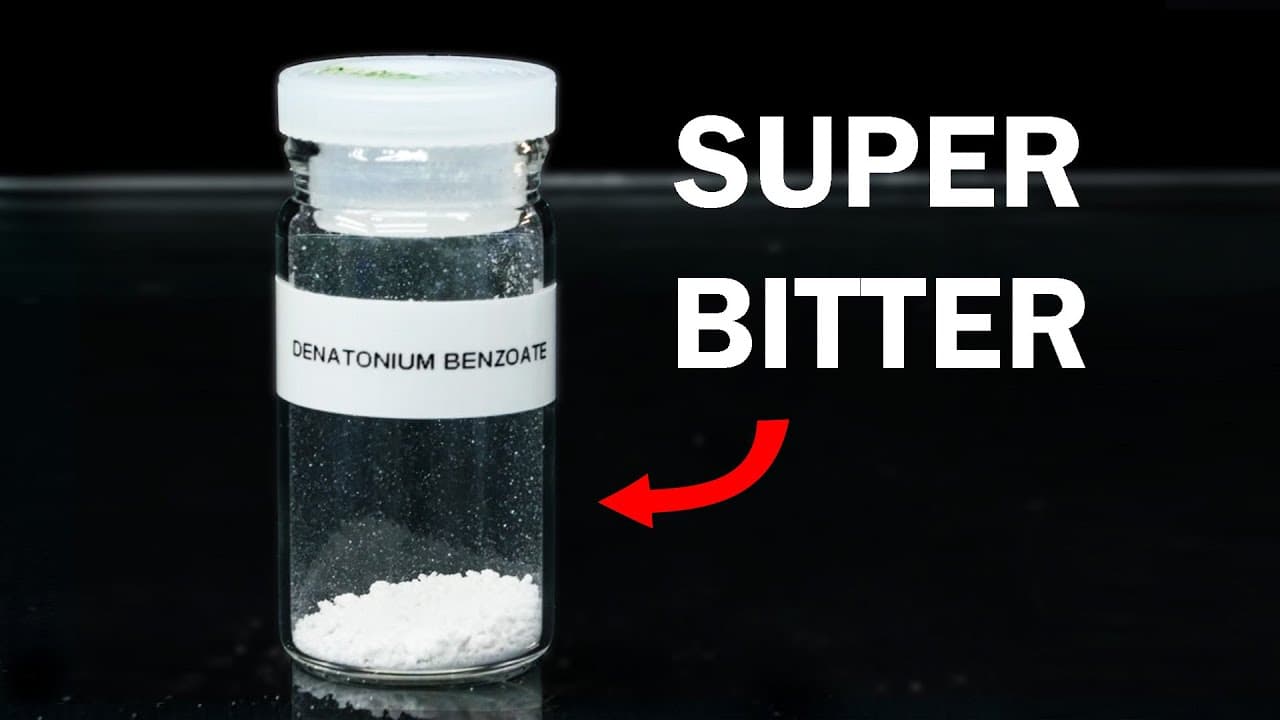
Denatonium benzoate, sold under the brand name Bitrex, is a super-bitter compound made by reacting lidocaine with benzyl chloride to form denatonium chloride, then combining it with benzoic acid. In this synthesis 2.5 g of lidocaine and 1.76 g of benzyl chloride are heated near 80°C for about 24 hours. It is so potent that a trace on the maker's fingers left a bitter taste for over two days and even transferred through playing cards. Read on for the full step-by-step chemistry.
Transcript
today we're going to be making a little bit of denatonium benzoate which is a super bitter compound one of the common brand names of it is bit Trek's and it's basically just used to make things bitter so it's commonly included in various chemicals and alcohols that you really shouldn't be drinking like methanol or paint thinner it also has some nic... Read More
Key Insights
- ❓ Denatonium benzoate is a bitter compound commonly used in various chemicals and products that should not be consumed.
- ❓ The compound is made through a nucleophilic aliphatic substitution reaction between lidocaine and benzyl chloride.
- ❓ Denatonium benzoate has unique properties, including its ability to transfer bitterness to other objects and surfaces.
- 🛩️ The yield of denatonium benzoate in the synthesis process can vary, but even a small amount can have a potent effect.
- ❓ The synthesis process involves multiple steps, including washing out unreacted starting materials and isolating the denatonium benzoate product.
- ❓ Acetone is used as a solvent in the synthesis process and can dissolve both benzoic acid and denatonium hydroxide.
- 👅 Denatonium benzoate is highly unpleasant when ingested, even in small amounts, and can leave a lingering bitter taste.
Install to Summarize YouTube Videos and Get Transcripts
Explore YouTube Video Summarizer or Get YouTube Transcript Extractor
Questions & Answers
Q: What is denatonium benzoate (Bitrex)?
Denatonium benzoate is an extremely bitter compound whose common brand name is Bitrex. It is used simply to make things taste bitter, so it is added to chemicals and alcohols you should not drink, such as methanol and paint thinner. It also has useful applications, like special nail polish that deters nail biting.
Q: How is denatonium benzoate synthesized?
It is made from three ingredients carried over from previous videos: benzoic acid, lidocaine, and benzyl chloride. Lidocaine is first reacted with benzyl chloride to form denatonium chloride, which is later converted to denatonium benzoate using benzoic acid. The specific amounts used were 2.5 grams of lidocaine, 1.76 grams of benzyl chloride, about 10 milliliters of toluene, 1 gram of sodium hydroxide, and 1 gram of benzoic acid.
Q: What are the reaction conditions for making denatonium chloride?
2.5 grams of lidocaine and about 6 milliliters of distilled water are added to a 25 milliliter round bottom flask fitted with a cold water condenser. The mixture is heated in an oil bath to around 80 degrees Celsius, then 1.76 grams of benzyl chloride is added. The reaction is left heated and stirring near 80 degrees for about 24 hours.
Q: How does the nucleophilic aliphatic substitution reaction work?
Chlorine is more electronegative than carbon, so it pulls shared electrons toward itself and leaves the carbon with a slight positive charge. The nitrogen of lidocaine is nucleophilic, meaning it has a free lone pair of electrons it wants to donate, so it attacks that partial positive charge on the benzyl chloride and forms a bond. The chlorine then pops off and becomes the counter ion for the positively charged nitrogen, substituting the chlorine and producing denatonium chloride.
Q: What is the Menshutkin reaction?
The Menshutkin reaction is the general name for reacting a tertiary amine with a halogenated alkane to produce a quaternary ammonium salt. Here, lidocaine's nitrogen is tertiary with three substituents and carries no charge, while the product's nitrogen is quaternary with four substituents and is positively charged with a chloride counter ion. The mechanism can proceed by either an SN1 or SN2 route.
Q: What role do toluene and acetone play in the process?
After the 24-hour reaction, about five milliliters of toluene is added and mixed, then pipetted off to wash out unreacted starting materials, since both lidocaine and benzyl chloride dissolve in toluene while the salt product does not. Acetone is used as a solvent later in the process because it can dissolve both benzoic acid and denatonium hydroxide.
Q: How bitter and long-lasting is denatonium benzoate?
It is extraordinarily bitter, so much so that after getting a little on his fingers the maker could not eat food with his hands for more than two days despite thorough washing. The bitterness even transferred from his fingers to playing cards and then to a friend's mouth. Only a tiny amount is needed to produce a strong, lingering bitter taste that clings to surfaces and other objects.
Summary & Key Takeaways
-
Denatonium benzoate is a super bitter compound used in various chemicals and products, including nail polish.
-
The compound is made by reacting lidocaine with benzyl chloride through a nucleophilic aliphatic substitution reaction.
-
The final product, denatonium benzoate, is highly bitter and can have lasting effects on taste even when small amounts are ingested.
Read in Other Languages (beta)
Share This Summary 📚
Summarize YouTube Videos and Get Video Transcripts with 1-Click
Try YouTube Summary with ChatGPT & Claude or YouTube Transcript Generator
Explore More Summaries from NileRed 📚
Summarize YouTube Videos and Get Video Transcripts with 1-Click
Try YouTube Summary with ChatGPT & Claude or YouTube Transcript Generator