Crown Ethers With SN2 Reactions
TL;DR
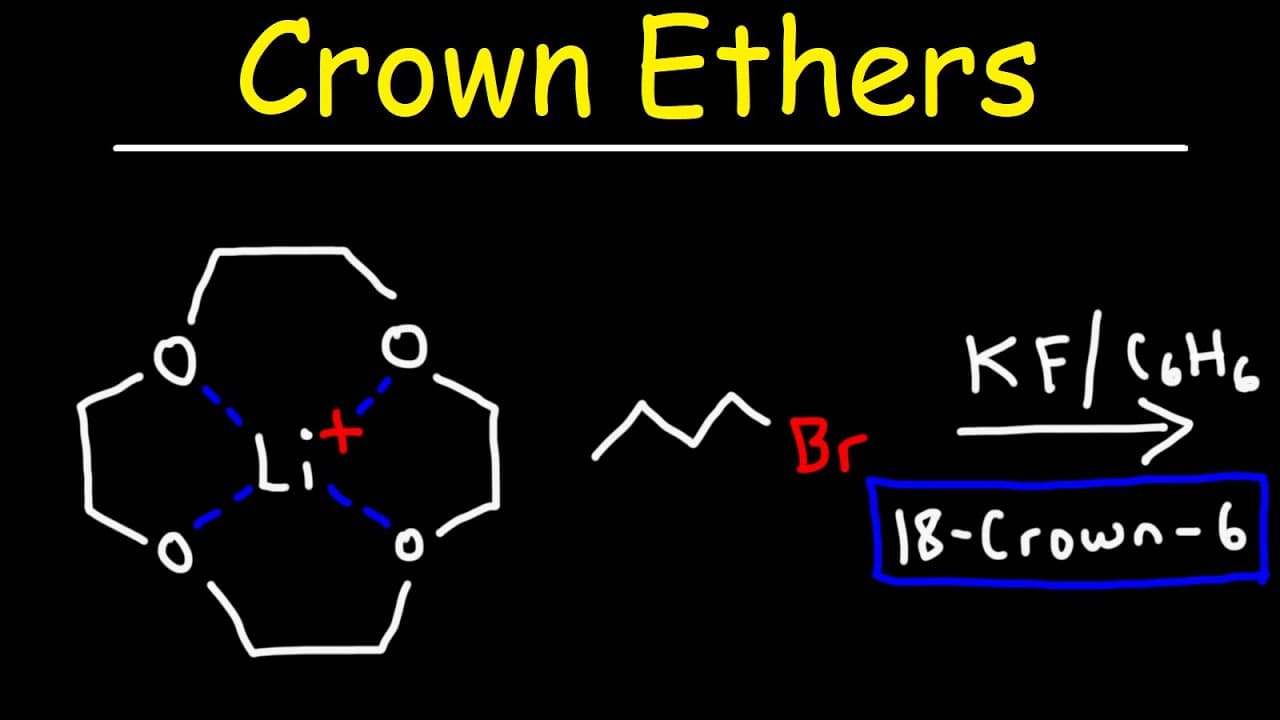
Crown ethers are cyclic polyethers that can solvate metal cations, increasing the solubility of ionic compounds in organic solvents and enhancing nucleophilic reactions.
Transcript
in this lesson we're going to talk about Crown ethers what exactly is a crown ether Crown ethers are cyclic polyethers they're cyclic they form like a ring structure and they're composed of many ether functional groups and the reason why they're called Crown eaters because they kind of look like a crown so let me give an example of one type of crow... Read More
Key Insights
- 🤲 Crown ethers are cyclic polyethers with a ring-like structure composed of multiple ether functional groups.
- 🫀 Different crown ethers are named based on the total number of atoms and the number of oxygen atoms in the molecule.
- 🍹 Crown ethers solvate metal cations, such as lithium, sodium, potassium, and cesium ions, by utilizing their negatively charged oxygen atoms.
- 🤘 By solvating metal cations, crown ethers enhance the solubility of ionic compounds in organic solvents.
- 🤲 Crown ethers can be used in organic reactions, particularly in SN2 reactions, to enhance the abilities of nucleophiles.
- 🤲 The solubility of potassium fluoride, an ionic compound, can be increased in nonpolar organic solvents like benzene by using crown ethers.
- 👻 Crown ethers help to maintain charge balance and allow nucleophiles to react with the substrate, resulting in the formation of a reaction product.
Install to Summarize YouTube Videos and Get Transcripts
Explore YouTube Video Summarizer or Get YouTube Transcript Extractor
Summary & Key Takeaways
-
Crown ethers are cyclic polyethers composed of multiple ether functional groups, resembling a crown, and they increase solubility in organic solvents.
-
They are named based on the total number of atoms (X) and the number of oxygen atoms (Y), such as 12-Crown-4 and 15-Crown-5 ethers.
-
Crown ethers solvate metal cations, such as lithium, sodium, potassium, and cesium ions, by attracting them with the negatively charged oxygen atoms.
Read in Other Languages (beta)
Share This Summary 📚
Summarize YouTube Videos and Get Video Transcripts with 1-Click
Try YouTube Summary with ChatGPT & Claude or YouTube Transcript Generator
Explore More Summaries from The Organic Chemistry Tutor 📚
Summarize YouTube Videos and Get Video Transcripts with 1-Click
Try YouTube Summary with ChatGPT & Claude or YouTube Transcript Generator