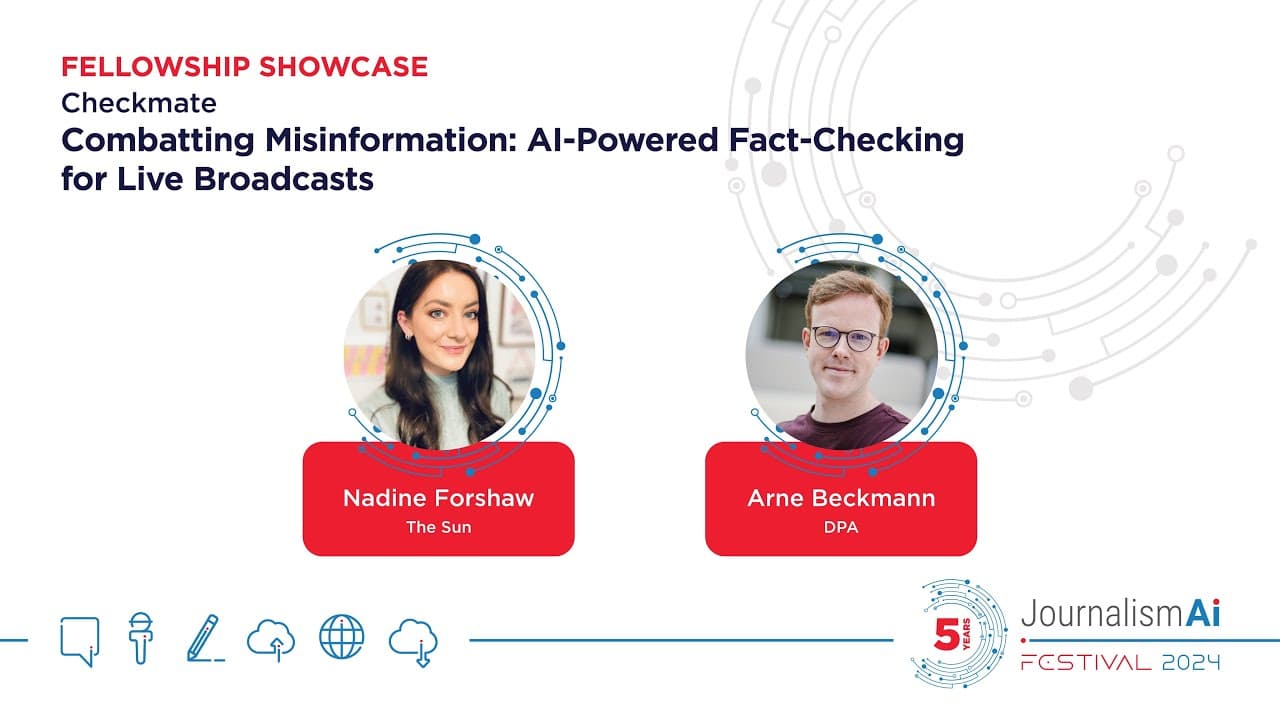
Combatting Misinformation: AI-Powered Fact-Checking for Live Broadcasts
TL;DR
Checkmate uses AI to fact-check live broadcasts in real-time.
Transcript
this team is Checkmate which is a collaboration between DPA which is the German press agency the times in the Sun from news UK data critica from Mexico and the BBC uh Checkmate is a tool that can identify claims in real time on live stream broadcast and today to talk to us more about the project we have Nadine and AR and I'm going to hand i... Read More
Key Insights
- Checkmate is a collaborative project involving multiple international news agencies, aiming to streamline the fact-checking process during live broadcasts.
- The tool identifies claims in real-time, highlights them, and searches for relevant sources to verify the accuracy of these claims.
- Checkmate's development involved initial user research to understand journalists' needs, emphasizing accuracy over speed in transcription.
- The tool uses a 30-second delay in transcription to ensure accuracy and allows for the integration of various transcription services.
- Checkmate employs generative AI to extract factual statements from sentences and cross-references these with internal and external databases.
- The project faced challenges such as estimating task durations and technical limitations but received positive feedback from initial users.
- Future improvements for Checkmate include expanding the claims database, adding more sources, and addressing user feedback on feature requests.
- Checkmate is not fully automatic; it assists journalists by highlighting claims but leaves the final editorial judgment to human editors.
Install to Summarize YouTube Videos and Get Transcripts
Explore YouTube Video Summarizer or Get YouTube Transcript Extractor
Questions & Answers
Q: What is the main purpose of Checkmate?
Checkmate is designed to assist journalists by providing real-time fact-checking during live broadcasts. It identifies claims made during these broadcasts and verifies them by searching for relevant sources, thus streamlining the fact-checking process and allowing journalists to focus on editorial judgment.
Q: How does Checkmate ensure the accuracy of its transcriptions?
Checkmate uses a 30-second delay in its transcription process to ensure accuracy. This delay allows the system to integrate different transcription services and ensures that the transcription is as precise as possible, meeting the priority of accuracy over speed as indicated by initial user research.
Q: What role does generative AI play in Checkmate?
Generative AI in Checkmate is used to extract factual statements from sentences transcribed during broadcasts. It identifies claims within these sentences and cross-references them with internal databases and external sources like Google Fact Check Explorer to verify their accuracy.
Q: What challenges did the development team face?
The development team faced challenges such as underestimating task durations, technical limitations, and a bug with the transcription service Assembly AI. These challenges required adjustments in project scope and collaboration with transcription service developers to resolve issues.
Q: How has user feedback influenced the future of Checkmate?
User feedback has been overwhelmingly positive, with journalists expressing interest in using Checkmate for future work. This feedback has guided the development team to consider expanding the tool's claims database, adding more sources, and incorporating requested features to improve its utility.
Q: Is Checkmate a fully automatic fact-checking tool?
No, Checkmate is not fully automatic. It assists journalists by identifying claims and providing sources for verification, but the final editorial judgment remains with human editors. This ensures that the nuanced decision-making process remains in the hands of experienced journalists.
Q: What are the future plans for Checkmate?
Future plans for Checkmate include expanding its feature set, improving the claims database, and integrating more sources as requested by users. The development team aims to transition Checkmate from a proof of concept to a reliable tool for newsrooms, enhancing its capabilities based on user feedback.
Q: How cost-effective is the use of Open AI in Checkmate?
The use of Open AI in Checkmate has proven to be more cost-effective than anticipated. During the development phase, the cost was under $100 for a six-month period, despite sending multiple sentences with context to Open AI for analysis, indicating efficient use of resources.
Summary & Key Takeaways
-
Checkmate is an AI-powered tool designed to assist journalists in fact-checking live broadcasts by identifying and verifying claims in real-time. The tool uses a combination of transcription services and generative AI to highlight claims and provide relevant sources for verification.
-
Developed collaboratively by news agencies like DPA and BBC, Checkmate aims to address the labor-intensive nature of fact-checking, particularly during significant events like elections. Initial user feedback has been positive, with journalists expressing interest in using the tool for future work.
-
Challenges during development included technical limitations and task estimation issues. Future plans for Checkmate involve expanding its capabilities, incorporating more user-requested features, and improving its database of sources to enhance its utility for newsrooms.
Read in Other Languages (beta)
Share This Summary 📚
Summarize YouTube Videos and Get Video Transcripts with 1-Click
Try YouTube Summary with ChatGPT & Claude or YouTube Transcript Generator
Explore More Summaries from PolisLSE 📚

Summarize YouTube Videos and Get Video Transcripts with 1-Click
Try YouTube Summary with ChatGPT & Claude or YouTube Transcript Generator