What Does the Double-Slit Experiment Reveal About Reality?
TL;DR
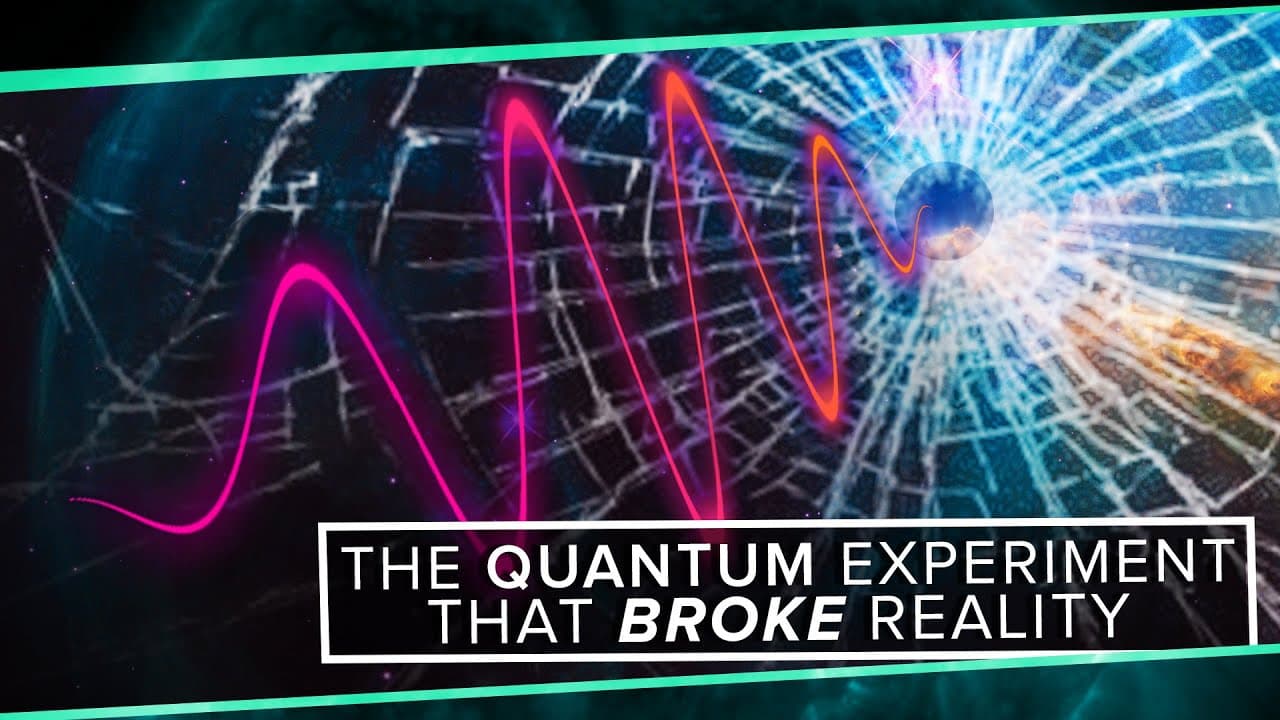
The double-slit experiment demonstrates that quantum particles like photons and electrons exhibit wave-particle duality, creating interference patterns even when fired one at a time. This suggests that particles pass through both slits as waves, collapsing into a defined state only upon observation. The experiment challenges classical intuitions about reality, highlighting the probabilistic nature of quantum mechanics.
Transcript
[MUSIC PLAYING] MATTHEW O'DOWD: This episode is supported by The Great Courses Plus. One of the strangest experimental results ever observed has got to be that of the single particle double-slit experiment. It's one of the most stunning illustrations of how the quantum world is very, very different from the large-scale world of our physical intuiti... Read More
Key Insights
- The double-slit experiment demonstrates the wave-particle duality of quantum entities, revealing that particles like photons and electrons exhibit both wave and particle characteristics.
- Individual particles, when passed through slits one at a time, eventually form an interference pattern, suggesting they traverse both slits simultaneously as waves before collapsing into a particle state.
- The wave function in quantum mechanics describes the probabilistic wave-like distribution of a particle's possible properties, central to understanding quantum behavior.
- The Copenhagen interpretation posits that particles exist in a state of pure possibility until observed, causing the wave function to collapse into a defined state.
- Quantum mechanics challenges classical intuition, suggesting that reality at the quantum level is fundamentally probabilistic and not deterministic.
- The double-slit experiment has been conducted with not just photons and electrons but also larger molecules like buckyballs, indicating the universality of quantum behavior.
- Quantum mechanics offers various interpretations, including the Copenhagen and many-worlds interpretations, each providing different perspectives on the nature of reality.
- The experiment underscores the non-locality and interconnectedness of quantum phenomena, where potential realities influence each other to determine outcomes.
Install to Summarize YouTube Videos and Get Transcripts
Explore YouTube Video Summarizer or Get YouTube Transcript Extractor
Questions & Answers
Q: What is the significance of the double-slit experiment?
The double-slit experiment is significant because it reveals the wave-particle duality of quantum entities, such as photons and electrons. It demonstrates that these particles can exhibit both wave-like and particle-like behavior, depending on how they are observed. This experiment challenges classical physics and has profound implications for our understanding of reality at the quantum level.
Q: How does the interference pattern form in the double-slit experiment?
The interference pattern forms when particles like photons or electrons pass through two slits and create a pattern of alternating light and dark bands on a screen. This occurs because the particles behave like waves, with peaks and troughs that constructively and destructively interfere with each other. Even when particles are fired one at a time, the pattern emerges, indicating that each particle travels through both slits as a wave before collapsing into a particle state upon detection.
Q: What is the wave function in quantum mechanics?
In quantum mechanics, the wave function is a mathematical description of the quantum state of a system. It provides information about the probabilities of a particle's various properties, such as position, momentum, and energy. The wave function represents the wave-like distribution of these properties and is central to predicting the behavior of quantum systems. When a measurement is made, the wave function collapses, and the particle's properties become definite.
Q: What does the Copenhagen interpretation suggest about quantum particles?
The Copenhagen interpretation suggests that quantum particles exist in a state of pure possibility, described by the wave function, until they are observed. Upon observation, the wave function collapses, and the particle assumes a definite state with specific properties. This interpretation implies that reality at the quantum level is fundamentally probabilistic and that the act of measurement plays a crucial role in determining the outcome.
Q: How does the double-slit experiment challenge classical intuition?
The double-slit experiment challenges classical intuition by demonstrating that particles can exhibit both wave-like and particle-like behavior. In classical physics, objects are expected to behave deterministically, with well-defined properties. However, the experiment shows that quantum entities can exist in multiple potential states simultaneously, only assuming definite properties upon measurement. This probabilistic nature of quantum mechanics contradicts the deterministic view of classical physics.
Q: What are some other interpretations of quantum mechanics besides the Copenhagen interpretation?
Besides the Copenhagen interpretation, there are several other interpretations of quantum mechanics. The many-worlds interpretation suggests that all possible outcomes of a quantum event actually occur, with each outcome existing in a separate, parallel universe. Another interpretation is the pilot-wave theory, which posits that particles have definite trajectories guided by a pilot wave. These interpretations offer different perspectives on the nature of reality and the role of observation in quantum mechanics.
Q: How has the double-slit experiment been conducted with larger particles?
The double-slit experiment has been conducted with larger particles, such as electrons, atoms, and even molecules like buckyballs. These experiments have shown that the interference pattern, characteristic of wave behavior, can be observed even with relatively large and complex particles. This indicates that the principles of quantum mechanics, including wave-particle duality and the probabilistic nature of quantum states, apply universally, regardless of the size of the particles involved.
Q: What role does the wave function play in the probabilistic nature of quantum mechanics?
The wave function plays a central role in the probabilistic nature of quantum mechanics. It provides a comprehensive description of all possible states of a quantum system, including the probabilities of a particle's various properties. The wave function's probabilistic nature means that quantum mechanics does not predict specific outcomes but rather the likelihood of different outcomes. This probabilistic framework is fundamental to understanding quantum behavior and contrasts with the deterministic predictions of classical physics.
Summary & Key Takeaways
-
The double-slit experiment is a cornerstone of quantum mechanics, illustrating the dual wave-particle nature of quantum entities. It shows that particles like photons and electrons can create an interference pattern, suggesting they pass through both slits simultaneously as waves before collapsing into a particle state.
-
Quantum mechanics uses the concept of a wave function to describe the probabilistic nature of particles. The Copenhagen interpretation suggests that particles exist in a state of possibility until observed, at which point the wave function collapses, and the particle's properties become definite.
-
This experiment reveals the challenges quantum mechanics poses to classical intuition, emphasizing its probabilistic nature. Various interpretations, such as the Copenhagen and many-worlds theories, attempt to explain the underlying reality, highlighting the complex and interconnected nature of quantum phenomena.
Read in Other Languages (beta)
Share This Summary 📚
Summarize YouTube Videos and Get Video Transcripts with 1-Click
Try YouTube Summary with ChatGPT & Claude or YouTube Transcript Generator
Explore More Summaries from PBS Space Time 📚

Summarize YouTube Videos and Get Video Transcripts with 1-Click
Try YouTube Summary with ChatGPT & Claude or YouTube Transcript Generator