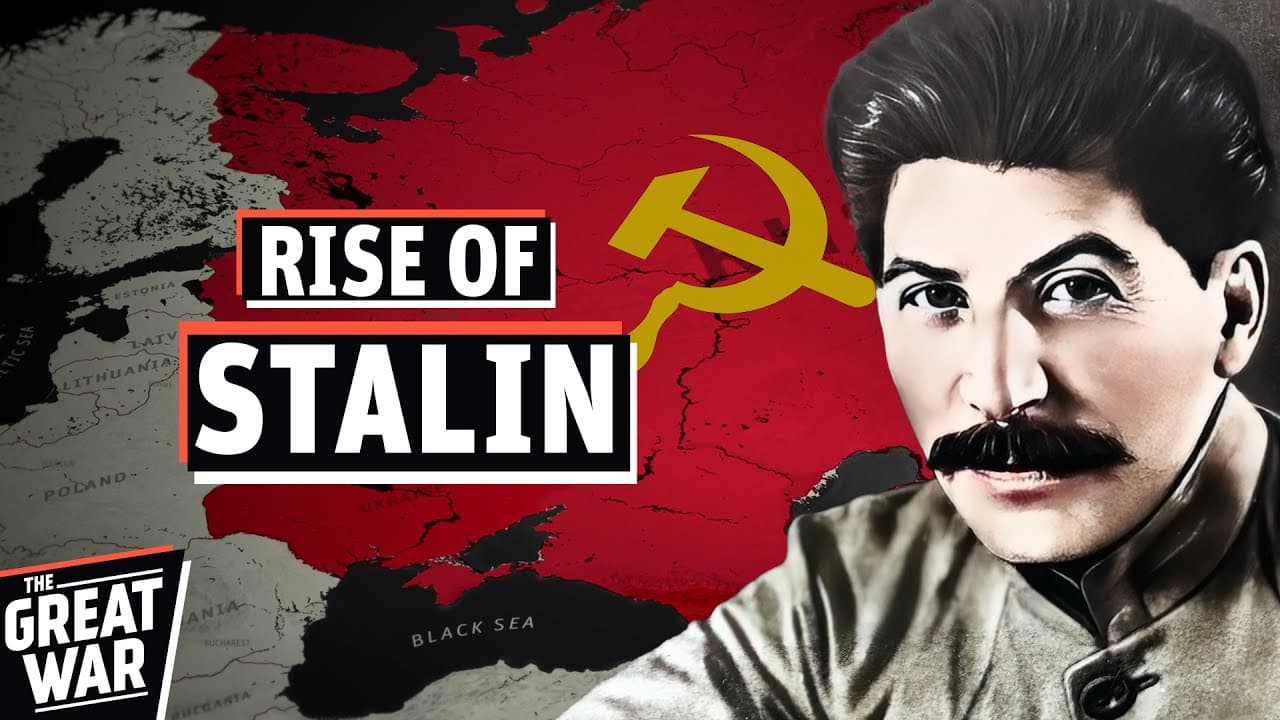
How Did Stalin Rise to Power After the Russian Civil War?
TL;DR
Joseph Stalin emerged as the leader of the Soviet Union following the Russian Civil War, overcoming internal party struggles and rivals like Leon Trotsky. As Lenin's health declined, Stalin used his roles within the Communist Party to consolidate power, eventually establishing a centralized Soviet state in 1922. His rise marked the beginning of a new era for the Soviet Union.
Transcript
In 1922, the Bolsheviks have emerged triumphant from a long and murderous civil war against their enemies. The time had come to cement the revolution in the form of a new state that would guarantee the future of Communism in a new Soviet empire, and spread it around the world. But the Communist Party is not united: its leaders do not trust each oth... Read More
Key Insights
- Joseph Stalin rose to power by leveraging his positions within the Communist Party during Lenin's declining health.
- The Bolshevik Red Army defeated the White movement and other anti-Bolshevik forces by 1922, ending the Russian Civil War.
- Stalin was initially underestimated by Lenin, who appointed him to roles with limited authority.
- Lenin's health issues created a power vacuum, intensifying the struggle between Stalin and Trotsky.
- Stalin's role as General Secretary allowed him to build a network of loyalists within the party.
- The Treaty on the Formation of the USSR was signed in December 1922, uniting Soviet republics under a centralized state.
- Stalin's political maneuvering included forming alliances and later turning against former allies like Zinoviev and Kamenev.
- The final phases of the civil war saw the Bolsheviks consolidating control over remote regions like the Far East and Yakutia.
Install to Summarize YouTube Videos and Get Transcripts
Explore YouTube Video Summarizer or Get YouTube Transcript Extractor
Questions & Answers
Q: How did Joseph Stalin rise to power after the Russian Civil War?
Joseph Stalin rose to power by strategically using his position as General Secretary to build a network of loyal supporters within the Communist Party. During Lenin's declining health, Stalin maneuvered through internal party struggles, forming alliances and later turning against them. His ability to consolidate power and suppress opposition allowed him to emerge as the leader of the Soviet Union.
Q: What was the outcome of the Russian Civil War?
The Russian Civil War concluded with the Bolshevik Red Army defeating the counter-revolutionary White movement and other anti-Bolshevik forces by 1922. This victory allowed the Bolsheviks to consolidate power and establish the Soviet Union, uniting various Soviet republics into a centralized state under communist rule.
Q: What role did Lenin's health play in the power struggle within the Communist Party?
Lenin's declining health created a power vacuum within the Communist Party, intensifying the struggle for leadership between Joseph Stalin and Leon Trotsky. As Lenin became less involved in party affairs, Stalin used the opportunity to consolidate power, build alliances, and position himself as Lenin's successor, ultimately outmaneuvering Trotsky.
Q: What was the significance of the Treaty on the Formation of the USSR?
The Treaty on the Formation of the USSR, signed in December 1922, was significant as it marked the consolidation of Bolshevik control and the creation of a centralized Soviet state. It united various Soviet republics, including the Russian SFSR, Ukrainian SSR, Byelorussian SSR, and Transcaucasian SFSR, under a single political entity, laying the foundation for the Soviet Union.
Q: How did Stalin use his role as General Secretary to gain power?
As General Secretary, Stalin used his administrative position to appoint loyalists to key party posts, effectively building a network of supporters. This role allowed him to control party decisions, suppress opposition, and gradually consolidate power, ultimately enabling him to dominate the Communist Party and become the leader of the Soviet Union.
Q: What challenges did the Bolsheviks face in consolidating power after the civil war?
After the civil war, the Bolsheviks faced challenges such as internal party struggles, regional independence movements, and the need to rebuild the war-torn economy. They also had to manage foreign relations and suppress remaining anti-Bolshevik forces in remote regions like the Far East and Yakutia, while establishing a centralized Soviet state.
Q: What were the key factors in Stalin's consolidation of power?
Key factors in Stalin's consolidation of power included his strategic use of the General Secretary position to build a network of loyalists, his ability to form and dissolve alliances with other Bolshevik leaders, and his skill in navigating the internal party dynamics during Lenin's declining health. These actions allowed him to suppress opposition and emerge as the leader of the Soviet Union.
Q: How did the Bolsheviks deal with opposition during and after the civil war?
During and after the civil war, the Bolsheviks dealt with opposition through military force, political maneuvering, and repressive measures. They defeated the White movement and other anti-Bolshevik forces, suppressed peasant uprisings, and used the Cheka secret police to eliminate dissent. These actions helped consolidate their power and establish a centralized Soviet state.
Summary & Key Takeaways
-
By 1922, the Bolsheviks had won the Russian Civil War, defeating the White movement and other anti-Bolshevik forces. As Lenin's health declined, internal power struggles intensified, with Joseph Stalin eventually emerging as the leader of the Soviet Union. His strategic use of party roles and alliances enabled him to outmaneuver rivals like Trotsky.
-
The formation of the USSR in December 1922 marked the consolidation of Bolshevik power, uniting various Soviet republics under a centralized state. Stalin's rise was facilitated by his position as General Secretary, which he used to build a loyal network and suppress opposition, setting the stage for his long rule.
-
Despite Lenin's criticisms of Stalin's leadership qualities, Stalin managed to consolidate power by exploiting party dynamics and forming strategic alliances. His eventual control over the Communist Party allowed him to dictate the direction of the Soviet Union, leading to the establishment of a totalitarian regime.
Read in Other Languages (beta)
Share This Summary 📚
Summarize YouTube Videos and Get Video Transcripts with 1-Click
Try YouTube Summary with ChatGPT & Claude or YouTube Transcript Generator
Explore More Summaries from The Great War 📚
Summarize YouTube Videos and Get Video Transcripts with 1-Click
Try YouTube Summary with ChatGPT & Claude or YouTube Transcript Generator