How To Read Feynman Diagrams
TL;DR
Learn the basics of Feynman diagrams, deciphering particle interactions via squiggly lines, particle properties, and conservation rules.
Transcript
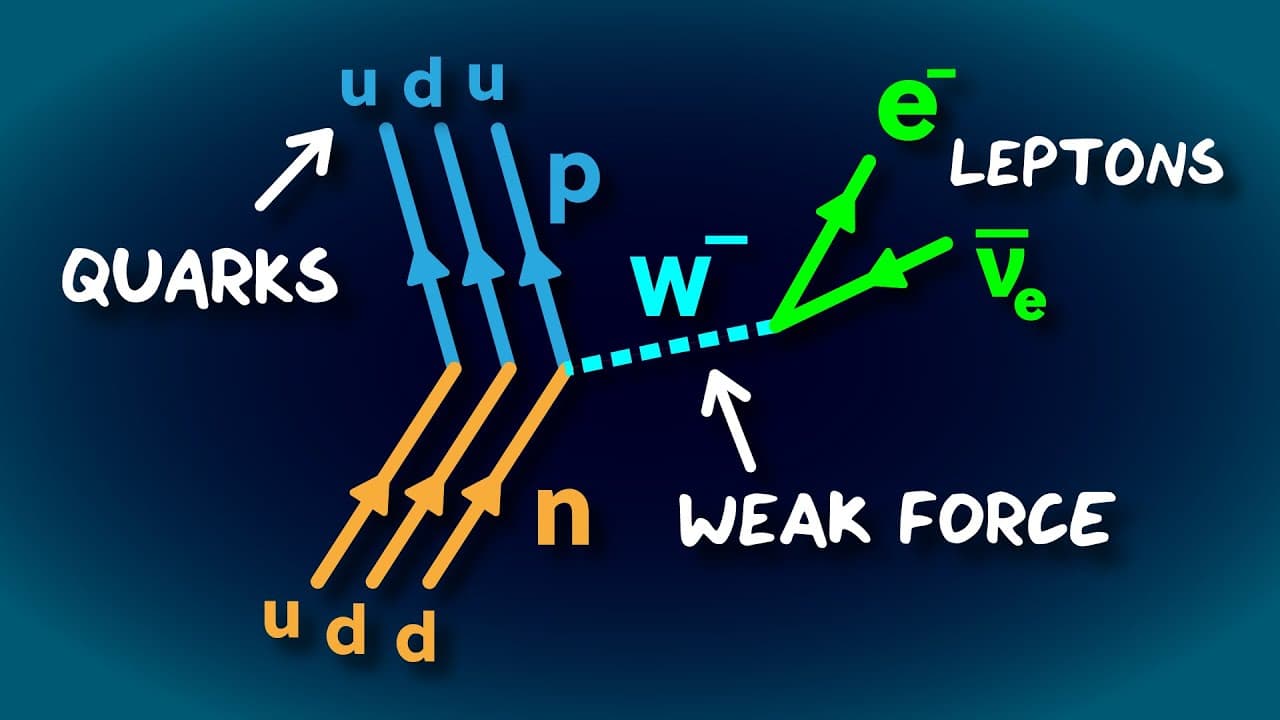
Hi how you doing? I’m going to teach you how to make sense of Feynman diagrams, know what all the squiggly lines mean, and work out if they are representing a valid particle interaction or if they are defying the laws of physics. Ugh. A Feynman diagram is a picture of what happens when particles interact with each other. Particles go i... Read More
Key Insights
- 🫥 Feynman diagrams visually represent particle interactions through lines and arrows in space and time.
- 🫥 Understanding Feynman diagrams involves knowledge of particle properties, conservation rules, and the meaning of lines and arrows.
- 🫥 Squiggly lines in Feynman diagrams represent fundamental particles like fermions and bosons with specific properties and interactions.
- 🏛️ Vertices in Feynman diagrams are the building blocks of interactions, orienting differently to represent various interactions and momentum changes.
- ⚾ Feynman diagrams can be used to analyze particle interactions, determining the validity of interactions based on conservation rules and particle properties.
- ❓ Feynman diagrams illustrate the fundamental particles of the Universe, including fermions and bosons with distinct properties and interactions.
- 🫥 Verbally explaining Feynman diagrams involves detailing particle interactions through lines representing particles moving in space and time.
Install to Summarize YouTube Videos and Get Transcripts
Explore YouTube Video Summarizer or Get YouTube Transcript Extractor
Questions & Answers
Q: What do Feynman diagrams visually represent?
Feynman diagrams visually represent particle interactions, showing particles traveling through space and time with lines and arrows indicating various particles and interactions.
Q: What are the key components necessary to understand Feynman diagrams?
Understanding Feynman diagrams requires knowledge of particle properties, conservation rules, and the meaning of lines and arrows in the diagrams representing particles and interactions.
Q: How do the orientation of vertices in Feynman diagrams affect the interpretation of interactions?
The orientation of vertices in Feynman diagrams impacts the interpretation of interactions as different orientations showcase different particle interactions and momentum changes.
Q: How can Feynman diagrams be used to analyze particle interactions?
Feynman diagrams can be analyzed to determine the validity of particle interactions by following conservation rules, understanding particle properties, and interpreting the interactions depicted within the diagrams.
Summary & Key Takeaways
-
Feynman diagrams depict particle interactions, with lines representing particles traveling through space and time.
-
Understanding Feynman diagrams involves knowing the meaning of lines and arrows, particle properties, and conservation rules.
-
Squiggly lines in Feynman diagrams represent fundamental particles like fermions and bosons that make up the Universe.
Read in Other Languages (beta)
Share This Summary 📚
Summarize YouTube Videos and Get Video Transcripts with 1-Click
Try YouTube Summary with ChatGPT & Claude or YouTube Transcript Generator
Explore More Summaries from Domain of Science 📚


Summarize YouTube Videos and Get Video Transcripts with 1-Click
Try YouTube Summary with ChatGPT & Claude or YouTube Transcript Generator