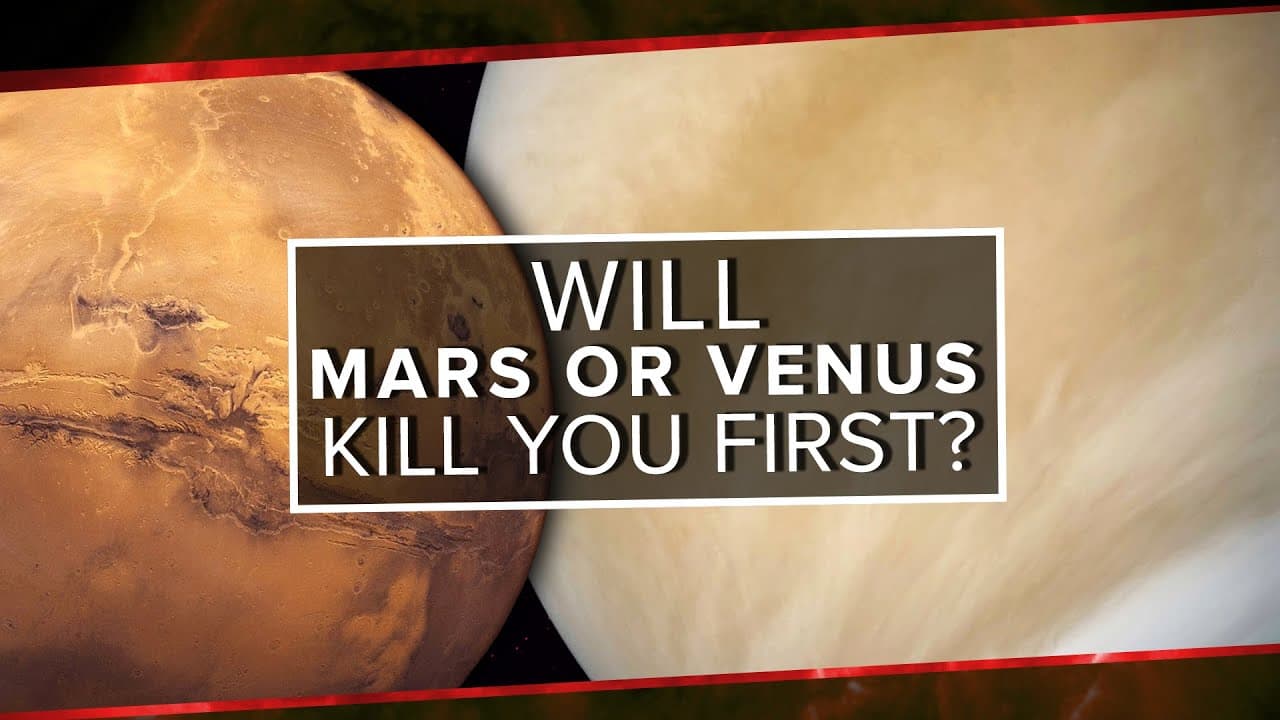
Will Mars or Venus Kill You First?
TL;DR
Mars and Venus pose unique challenges for human colonization.
Transcript
[MUSIC PLAYING] If we want to get to the stars, we don't have to learn how to live on other planets. Mars and Venus look tempting, but both are capable of killing you in so many interesting ways. The surface of planet Earth is an unusual place. It's the only patch of the universe that we know of that won't kill you almost instantly. Wow, how ridicu... Read More
Key Insights
- Mars' small size and lack of a strong magnetic field make it difficult to maintain a stable atmosphere, leading to extremely low atmospheric pressure.
- Exposure to Mars' low pressure can cause ebulism, where bodily fluids boil, leading to unconsciousness and death without proper protection.
- Radiation from solar wind and cosmic rays poses a significant risk on Mars, increasing cancer risk for long-term colonists.
- Venus' surface is inhospitable due to extreme pressure and temperature, but cloud cities at 50 km altitude offer a more viable option.
- Venus' atmosphere provides some protection against radiation, though it lacks a magnetic field like Earth's.
- Both planets require significant technological advancements in habitat shielding to ensure long-term human survival.
- Mars' longer travel time and higher radiation exposure during the journey pose additional challenges compared to Venus.
- Despite the challenges, both Mars and Venus offer unique opportunities for human colonization and exploration.
Install to Summarize YouTube Videos and Get Transcripts
Explore YouTube Video Summarizer or Get YouTube Transcript Extractor
Questions & Answers
Q: What are the main challenges of colonizing Mars?
Mars presents several challenges for colonization, including its thin atmosphere and lack of a magnetic field, which result in low atmospheric pressure and high radiation exposure. These conditions necessitate advanced technology for habitat shielding and protection against radiation. Additionally, the low gravity and long travel time further complicate colonization efforts.
Q: How does the atmosphere of Venus compare to that of Mars?
Venus' atmosphere is much thicker than Mars', providing some protection against cosmic radiation. However, the surface conditions are extreme, with high pressure and temperatures. At 50 km altitude, conditions are more manageable, allowing for potential cloud cities. In contrast, Mars' atmosphere is thin and unable to shield against radiation effectively.
Q: What is ebulism, and how does it affect humans on Mars?
Ebulism occurs when bodily fluids start to boil due to low atmospheric pressure, such as on Mars. This can cause severe bloating and the formation of gas bubbles in the blood, leading to unconsciousness and death if not addressed quickly. Proper suits and pressurized habitats are essential to prevent this condition during Mars exploration.
Q: How does radiation exposure differ between Mars and Venus?
Mars' thin atmosphere and lack of a magnetic field expose colonists to significant radiation from solar wind and cosmic rays, increasing cancer risk. Venus, despite lacking its own magnetic field, benefits from a thick atmosphere that provides better radiation protection, especially at higher altitudes where cloud cities could be established.
Q: What are the travel time differences between Mars and Venus?
Traveling to Mars typically takes around six months, whereas a trip to Venus is shorter, taking about three months. This difference in travel time affects the logistics and planning of missions, with Mars requiring more resources and preparation to handle the extended journey and associated radiation exposure.
Q: What potential solutions exist for radiation protection on Mars?
To protect against radiation on Mars, colonists could use thick shielding materials like water, food, or waste products. Developing a small, heavily shielded bunker for coronal mass ejections is also feasible. Long-term solutions will require advancements in material science to create effective and sustainable shielding for habitats.
Q: How does Venus' potential for cloud cities impact colonization plans?
The concept of cloud cities at 50 km altitude on Venus offers a viable colonization option, avoiding the extreme surface conditions. At this altitude, temperatures and pressures are more manageable, and the thick atmosphere provides some radiation protection. This approach requires developing technology for floating habitats and acid-resistant materials.
Q: What are the advantages of Earth's environment compared to Mars and Venus?
Earth's environment is uniquely suited for human life, with a stable atmosphere, magnetic field, and optimal pressure and temperature conditions. In contrast, Mars and Venus present significant challenges, including extreme temperatures, pressures, and radiation exposure, necessitating advanced technologies and protective measures for human survival.
Summary & Key Takeaways
-
Mars and Venus present unique challenges for human colonization, with Mars' low pressure and radiation risks and Venus' extreme surface conditions and acid clouds.
-
Mars' lack of a magnetic field and thin atmosphere increase radiation exposure, while Venus offers potential for cloud cities at safer altitudes.
-
Technological advancements in habitat shielding and protection are crucial for long-term survival on either planet, with significant differences in travel time and conditions.
Read in Other Languages (beta)
Share This Summary 📚
Summarize YouTube Videos and Get Video Transcripts with 1-Click
Try YouTube Summary with ChatGPT & Claude or YouTube Transcript Generator
Explore More Summaries from PBS Space Time 📚



Summarize YouTube Videos and Get Video Transcripts with 1-Click
Try YouTube Summary with ChatGPT & Claude or YouTube Transcript Generator