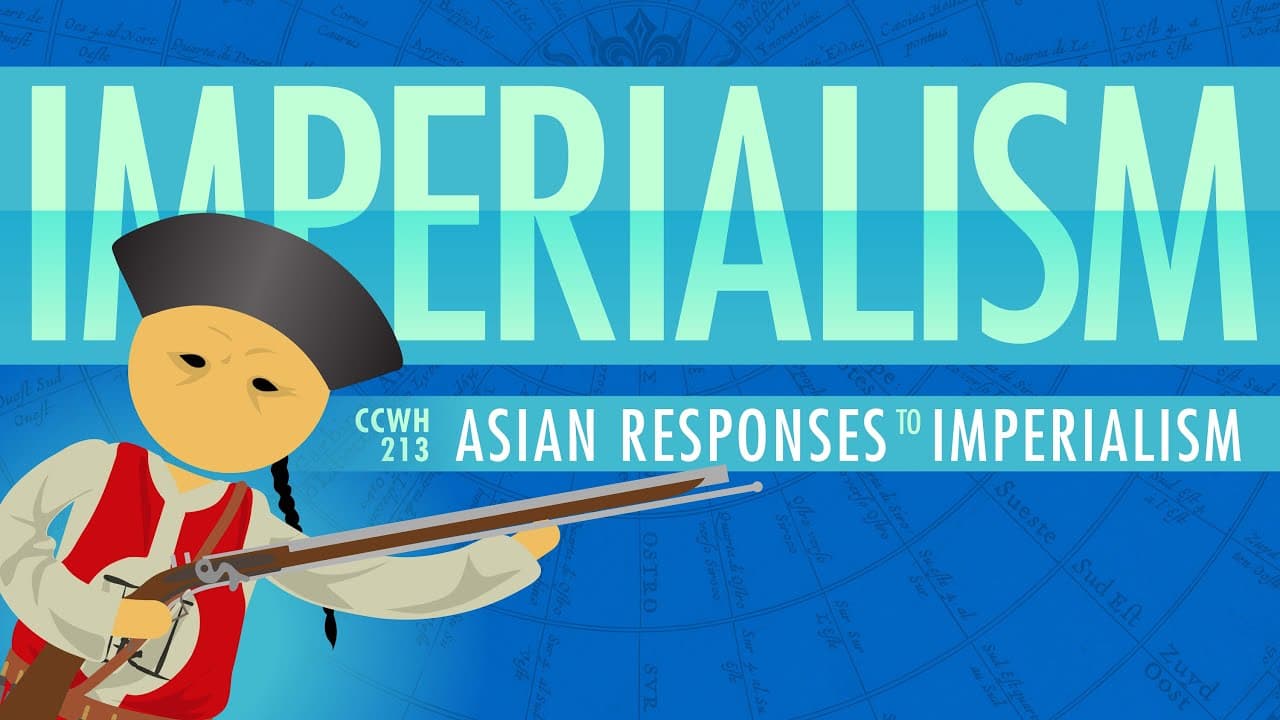
Asian Responses to Imperialism: Crash Course World History #213
TL;DR
Explores Asian intellectuals' responses to European imperialism.
Transcript
Hi, I'm John Green, this is Crash Course World History, and today we're going to return to our old friend, the rise of the west. Ugh, Mr Green, we know. The west rose, we've talked about this a million times. Yeah, me from the past, I'm sympathetic to your position, but the thing is, this is a big deal in world history circles, and today, we are go... Read More
Key Insights
- European imperialism in Asia began earlier than the late 19th century, with events like the Opium Wars in China marking significant moments of humiliation.
- Asian intellectuals, like Al-Afghani, Liang Qichao, and Tagore, recognized the need to respond to Western dominance and sought ways to integrate beneficial Western practices into their societies.
- Al-Afghani advocated for Muslims to see themselves as a nation, emphasizing the importance of national education and cultural unity.
- The failure of reforms like the Tanzimat in the Ottoman Empire and self-strengthening in China suggested that Western models were not always suitable for Asian contexts.
- Japan's successful modernization was initially seen as a model by other Asian intellectuals, but its imperial expansion complicated its role as an example.
- Some Asian thinkers, like Gandhi and Tagore, critiqued Western materialism and emphasized the need for spiritual and cultural integrity.
- Despite adopting some Western practices, many Asian intellectuals ultimately turned to their own traditions for strength and reform.
- The Treaty of Versailles and World War I reinforced skepticism towards Western liberal democracy among Asian intellectuals, leading to alternative approaches like pan-Asianism.
Install to Summarize YouTube Videos and Get Transcripts
Explore YouTube Video Summarizer or Get YouTube Transcript Extractor
Questions & Answers
Q: How did Asian intellectuals initially respond to European imperialism?
Asian intellectuals initially responded to European imperialism by recognizing the technological and organizational superiority of the West. They advocated for reforms that included adopting Western models of military organization and education. Figures like Al-Afghani and Chinese reformers called for increased focus on science and philosophy to strengthen their societies against Western dominance.
Q: What role did Japan play as a model for Asian intellectuals?
Japan's successful modernization, characterized by industrialization and centralization, was initially seen as a model by Asian intellectuals. It demonstrated that modernization could be achieved while maintaining cultural identity. However, Japan's subsequent imperial expansion complicated its role as a model, as it mirrored the very imperialist practices that other Asian nations sought to resist.
Q: Why were some Asian intellectuals critical of Western materialism?
Asian intellectuals like Gandhi and Tagore were critical of Western materialism because they believed it lacked spiritual freedom and social harmony. They argued that Western civilization's focus on money and power was inherently destructive. These thinkers emphasized the need for spiritual wisdom and cultural integrity, suggesting that the East could offer valuable alternatives to Western materialism.
Q: What were some of the challenges faced by Asian reformers in adopting Western models?
Asian reformers faced challenges in adopting Western models due to deeply ingrained cultural and historical traditions. In China, for example, the long-standing Confucian education system made it difficult to adopt Western educational and organizational models. Additionally, the failure of reforms like the Tanzimat in the Ottoman Empire highlighted the complexities of integrating Western practices into non-Western societies.
Q: How did World War I influence Asian perspectives on Western democracy?
World War I and the Treaty of Versailles reinforced skepticism towards Western liberal democracy among Asian intellectuals. The war's outcome, which resembled pre-war imperialism, led many to question the effectiveness and sincerity of Western democratic ideals. This skepticism prompted some Asian thinkers to explore alternative political models, including pan-Asianism and authoritarianism, as means to resist Western dominance.
Q: What alternative approaches did Asian intellectuals explore in response to imperialism?
In response to imperialism, some Asian intellectuals explored alternative approaches like pan-Asianism and pan-Arabism, envisioning large political conglomerates that could transcend European dominance. Others turned to their own cultural and religious traditions for strength, with figures like Al-Afghani advocating for Islamic reform and Liang Qichao promoting the idea of a strong, authoritarian state.
Q: How did Al-Afghani view the role of Islam in resisting Western imperialism?
Al-Afghani saw Islam as a potential catalyst for change and reform against Western imperialism. He believed that modernization should come from within Islamic society, emphasizing that the Qur'an contained calls for reform. Al-Afghani argued that attacking religion weakened the moral fabric of society and that Islam could provide the moral and spiritual foundation necessary for resisting Western dominance.
Q: What was Tagore's critique of Western civilization?
Tagore critiqued Western civilization for its focus on materialism, power, and exploitation. He argued that Western modernity lacked spiritual freedom and social harmony, warning that it needed to be tempered by the spiritual wisdom of the East. Despite acknowledging the scientific achievements of the West, Tagore emphasized the destructive nature of Western civilization's materialistic pursuits.
Summary & Key Takeaways
-
The video explores how Asian intellectuals responded to European imperialism, focusing on figures like Al-Afghani, Liang Qichao, and Tagore. They recognized the West's dominance and considered adopting certain Western practices while emphasizing their own cultural strengths.
-
Japan's modernization was initially admired by Asian intellectuals, but its imperial expansion complicated its role as a model. Intellectuals like Gandhi critiqued Western materialism, highlighting the need for spiritual and cultural integrity.
-
Skepticism towards Western liberal democracy grew after World War I, leading some Asian thinkers to explore alternative approaches like pan-Asianism, while others turned to their own traditions for reform and strength.
Read in Other Languages (beta)
Share This Summary 📚
Summarize YouTube Videos and Get Video Transcripts with 1-Click
Try YouTube Summary with ChatGPT & Claude or YouTube Transcript Generator
Explore More Summaries from CrashCourse 📚




Summarize YouTube Videos and Get Video Transcripts with 1-Click
Try YouTube Summary with ChatGPT & Claude or YouTube Transcript Generator