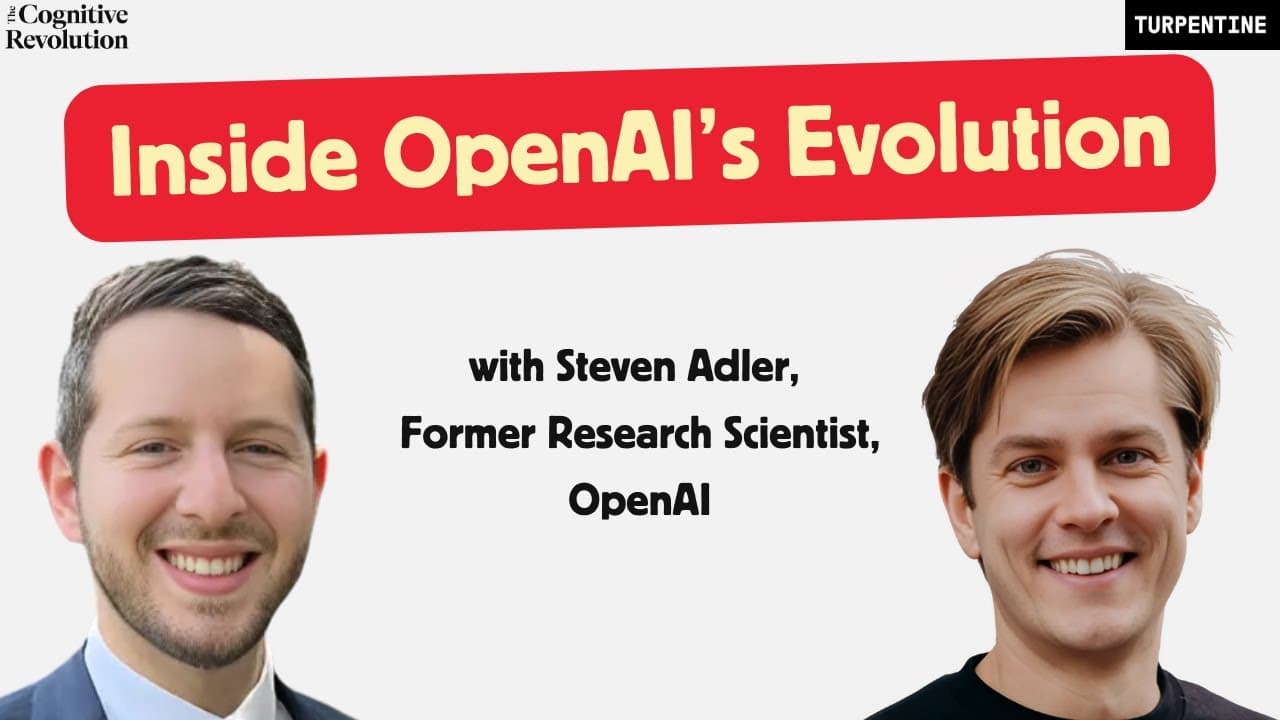
What Is OpenAI's Identity Crisis? Insights from Steven Adler
TL;DR
OpenAI's transition from nonprofit to for-profit has sparked debate about its mission and control. Former employee Steven Adler discusses OpenAI's history, the cultural shifts, and the implications of AI governance. He highlights the need for transparent safety evaluations and responsible AI development, emphasizing the importance of maintaining nonprofit control for the benefit of humanity.
Transcript
Hello and welcome back to the cognitive revolution. Today my guest is Steven Adler, former research scientist at OpenAI, author of a new Substack, Steven Adler.substack.com on how to make AI go better, and one of the 12 former OpenAI employees who recently filed an amicus brief to the Elon Musk versus OpenAI lawsuit, arguing that OpenAI's nonprofit... Read More
Key Insights
- OpenAI's transition from nonprofit to for-profit has raised concerns about its mission and control.
- Steven Adler emphasizes the importance of maintaining nonprofit control for the benefit of humanity.
- OpenAI's cultural shifts include a move towards more closed information sharing within the company.
- Adler discusses the importance of transparent safety evaluations and responsible AI development.
- The launch of GPT-4 marked a significant step in AI capabilities, raising questions about safety and governance.
- OpenAI leadership faces challenges in balancing innovation with safety and ethical considerations.
- The Anthropic split highlighted internal disagreements about the commercialization and deployment of AI technologies.
- Adler suggests that personhood credentials could play a role in addressing AI-related identity and security challenges.
Install to Summarize YouTube Videos and Get Transcripts
Explore YouTube Video Summarizer or Get YouTube Transcript Extractor
Questions & Answers
Q: What is OpenAI's identity crisis about?
OpenAI's identity crisis revolves around its transition from a nonprofit to a for-profit organization, raising concerns about its mission and control. The debate centers on whether OpenAI should remain under nonprofit control to ensure that its developments benefit all of humanity, as opposed to being driven by shareholder interests.
Q: Why did the Anthropic split occur?
The Anthropic split occurred due to internal disagreements within OpenAI about the commercialization and deployment of AI technologies. Some employees felt that OpenAI was moving too quickly towards commercialization without sufficient consideration of the ethical and safety implications, leading to a group breaking away to form Anthropic.
Q: What are personhood credentials and why are they important?
Personhood credentials are a proposed solution to address AI-related identity and security challenges. They aim to provide a way to verify that an online entity is a real person, which is crucial in a world where AI agents can mimic human behavior. This verification is important for maintaining trust and security in digital interactions.
Q: How has OpenAI's internal culture changed over time?
OpenAI's internal culture has shifted towards more closed information sharing, with tighter controls on who has access to certain information. This change reflects the company's growth and the increasing complexity of managing sensitive AI developments. The cultural shift also includes a focus on balancing innovation with safety and ethical considerations.
Q: What role does safety evaluation play in AI development?
Safety evaluation is crucial in AI development to ensure that AI technologies are deployed responsibly and ethically. Transparent safety evaluations help identify potential risks and mitigate them before deployment. They are essential for maintaining public trust and ensuring that AI developments benefit society as a whole.
Q: What challenges does OpenAI leadership face?
OpenAI leadership faces challenges in balancing the drive for innovation with the need for safety and ethical considerations. They must navigate complex geopolitical and business dynamics while ensuring that AI developments align with the company's mission to benefit humanity. This requires careful decision-making and transparent communication with stakeholders.
Q: How did the launch of GPT-4 impact OpenAI?
The launch of GPT-4 marked a significant step in AI capabilities, raising questions about safety and governance. It highlighted the need for robust safety evaluations and transparent communication about AI capabilities. The launch also emphasized the importance of maintaining nonprofit control to ensure that AI developments align with OpenAI's mission to benefit humanity.
Q: What is the significance of maintaining nonprofit control at OpenAI?
Maintaining nonprofit control at OpenAI is significant because it ensures that the company's mission to benefit all of humanity remains the primary focus. Nonprofit control helps prevent shareholder interests from driving AI developments, which could lead to decisions that prioritize profit over ethical and safety considerations. This control is crucial for ensuring that AI technologies are developed and deployed responsibly.
Summary & Key Takeaways
-
OpenAI's transition from a nonprofit to a for-profit organization has sparked debate about its mission and control. Former employee Steven Adler shares insights into OpenAI's history, cultural shifts, and the implications of AI governance. He emphasizes the importance of maintaining nonprofit control to ensure that AI developments benefit humanity and highlights the need for transparent safety evaluations and responsible AI development.
-
Steven Adler discusses the cultural and ethical disagreements within OpenAI, particularly around the commercialization and deployment of AI technologies. The launch of GPT-4 marked a significant step in AI capabilities, raising questions about safety and governance. Adler suggests that personhood credentials could play a role in addressing AI-related identity and security challenges.
-
OpenAI leadership faces challenges in balancing innovation with safety and ethical considerations. Adler emphasizes the importance of transparent safety evaluations and responsible AI development, highlighting the need for nonprofit control to ensure that AI technologies benefit all of humanity. The Anthropic split and the launch of GPT-4 are key events that illustrate the internal dynamics and cultural shifts within OpenAI.
Read in Other Languages (beta)
Share This Summary 📚
Summarize YouTube Videos and Get Video Transcripts with 1-Click
Try YouTube Summary with ChatGPT & Claude or YouTube Transcript Generator
Explore More Summaries from Cognitive Revolution "How AI Changes Everything" 📚

Summarize YouTube Videos and Get Video Transcripts with 1-Click
Try YouTube Summary with ChatGPT & Claude or YouTube Transcript Generator