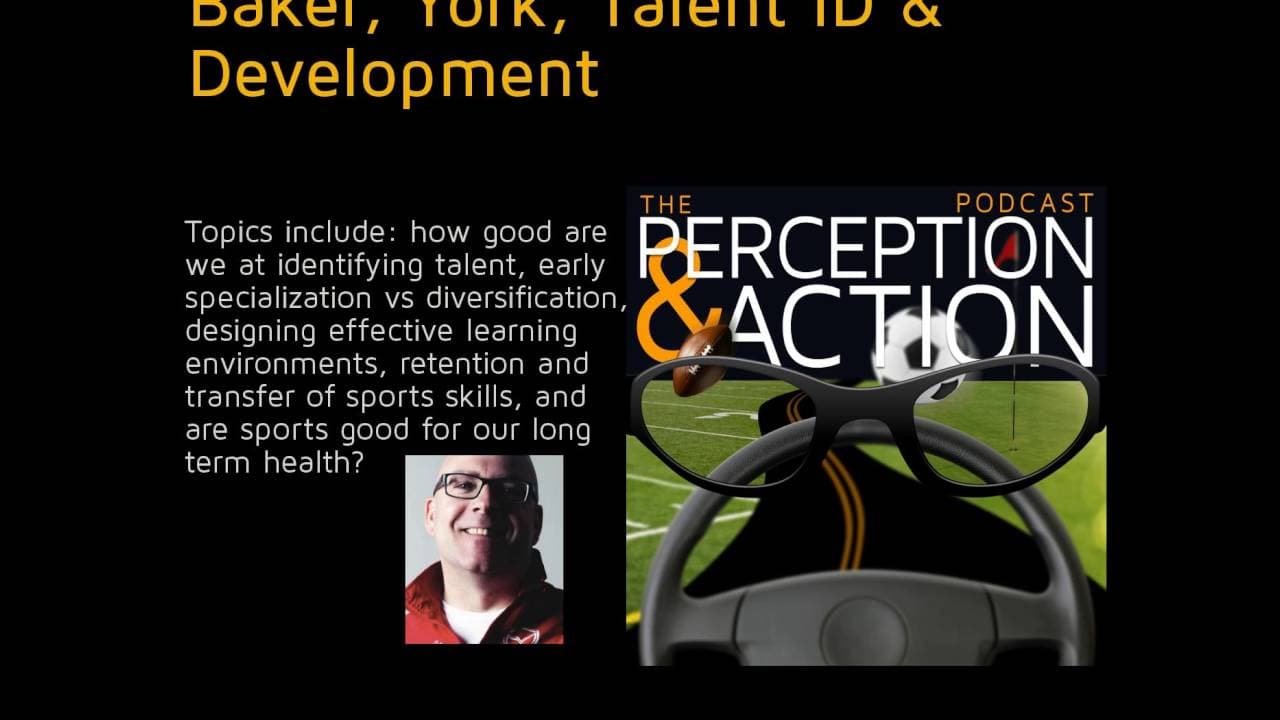
37A – Interview with Joe Baker, York, Talent ID & Development
TL;DR
Exploring talent identification, development, and health in sports.
Transcript
this is Rob Gray from ASU and perception action.com today on the perception and action podcast my interview with Joe Baker professor in the school of Kinesiology and health science at York University in Canada hi everyone welcome to the perception and action podcast where I discuss how psychological research can be applied to improving performance ... Read More
Key Insights
- Joe Baker discusses the challenges and inefficiencies in identifying sports talent early, emphasizing that professional drafts are often inaccurate predictors of future success.
- Research indicates that early specialization in sports may not be as beneficial as diversification, though the current sports system makes diversification challenging.
- The relative age effect persists in sports, where older athletes in the same cohort often have advantages, though younger athletes who persevere may develop superior skills.
- Left-handed athletes may have an advantage in sports due to perceptual unfamiliarity, but increased exposure to left-handed opponents can mitigate this advantage.
- Sibling dynamics and family environments significantly influence athletic development, with younger siblings often benefiting from older siblings' experiences.
- The transfer of skills between sports is possible, particularly when sports share similar cognitive and perceptual demands, suggesting potential for talent transfer programs.
- Master athletes maintain skills through practice and strategic adaptations, highlighting the importance of continuous engagement in sports for skill retention.
- Elite athletes generally enjoy better long-term health and longevity, though the reasons are multifaceted, including genetics, lifestyle, and socioeconomic factors.
Install to Summarize YouTube Videos and Get Transcripts
Explore YouTube Video Summarizer or Get YouTube Transcript Extractor
Questions & Answers
Q: How effective are professional sports drafts in predicting future success?
Professional sports drafts are generally poor predictors of future success. Joe Baker's research indicates that even drafts that occur later in an athlete's development, such as those in professional leagues, have a limited ability to accurately identify future stars. The NBA performs slightly better than others, but overall, the correlation between draft position and career success is weak, highlighting the challenges in talent identification.
Q: What is the current stance on early specialization versus diversification in sports?
Joe Baker's research supports the idea that diversification in sports is more beneficial than early specialization. Diversification allows athletes to develop a broad range of skills and maintain intrinsic motivation. However, the current sports system often makes it difficult for athletes to diversify, particularly for those from lower socioeconomic backgrounds, as year-round training programs dominate many sports.
Q: What is the relative age effect, and how does it impact sports talent development?
The relative age effect refers to the advantages that older athletes within the same age cohort often have over their younger peers. This effect is persistent in sports, with older athletes generally being more successful. However, Baker's research suggests that younger athletes who persevere through the development process may ultimately develop superior skills, indicating a nuanced impact of the relative age effect.
Q: How do left-handed athletes gain an advantage in sports, and can this be mitigated?
Left-handed athletes often have an advantage in sports due to perceptual unfamiliarity, as most athletes are right-handed. This unfamiliarity can give left-handed athletes a performance edge. However, Baker's research shows that increased exposure to left-handed opponents, such as through video training, can mitigate this advantage by improving athletes' ability to anticipate left-handed actions.
Q: What role do family dynamics play in athletic development?
Family dynamics, particularly sibling relationships, play a significant role in athletic development. Baker's research indicates that younger siblings often benefit from having older siblings who serve as role models and pave the way for their sports participation. Additionally, having parents who were high-performing athletes can create an environment conducive to high athletic achievement.
Q: Is it possible to transfer skills between different sports?
Yes, skill transfer between sports is possible, especially when sports share similar cognitive and perceptual demands. Baker's research has shown that pattern recognition abilities can transfer between sports like field hockey and basketball but not with sports like netball. This suggests that talent transfer programs could be effective, particularly in facilitating transitions for athletes who do not reach elite levels in their initial sports.
Q: How do master athletes maintain their skills as they age?
Master athletes maintain their skills through continuous practice and strategic adaptations. Baker's research shows that while aging leads to some skill decline, the extent is often minimal, and athletes can compensate by improving accuracy or changing strategies. Continuous engagement in sports is crucial for skill retention, emphasizing the importance of practice throughout an athlete's life.
Q: What are the long-term health benefits of being an elite athlete?
Elite athletes generally enjoy better long-term health and increased longevity compared to the general population. The reasons for this advantage are multifaceted, including superior genetics, healthier lifestyles, and better access to healthcare. However, Baker notes that the quality of life in later years is also important, as long-term health is not solely about lifespan but also about maintaining a high quality of life.
Summary & Key Takeaways
-
Joe Baker, a professor at York University, explores the complexities of sports talent identification, emphasizing the challenges in predicting future sports stars. His research highlights the inefficiencies of professional drafts and the persistent relative age effect, suggesting that younger athletes who persevere may develop superior skills.
-
The debate between early specialization and diversification is prominent, with Baker advocating for diversification despite systemic barriers. He also explores the advantages of left-handed athletes and the influence of family dynamics on athletic development, emphasizing the role of older siblings in shaping younger athletes' careers.
-
Baker's research extends to the transfer of skills between sports and the retention of skills in master athletes. He finds that elite athletes generally enjoy better health and longevity, though the reasons are complex. His ongoing studies aim to bridge the gap between scientific research and practical coaching applications.
Read in Other Languages (beta)
Share This Summary 📚
Summarize YouTube Videos and Get Video Transcripts with 1-Click
Try YouTube Summary with ChatGPT & Claude or YouTube Transcript Generator
Explore More Summaries from Rob Gray 📚
Summarize YouTube Videos and Get Video Transcripts with 1-Click
Try YouTube Summary with ChatGPT & Claude or YouTube Transcript Generator