How to Determine the Equivalence of Finite Automata
TL;DR
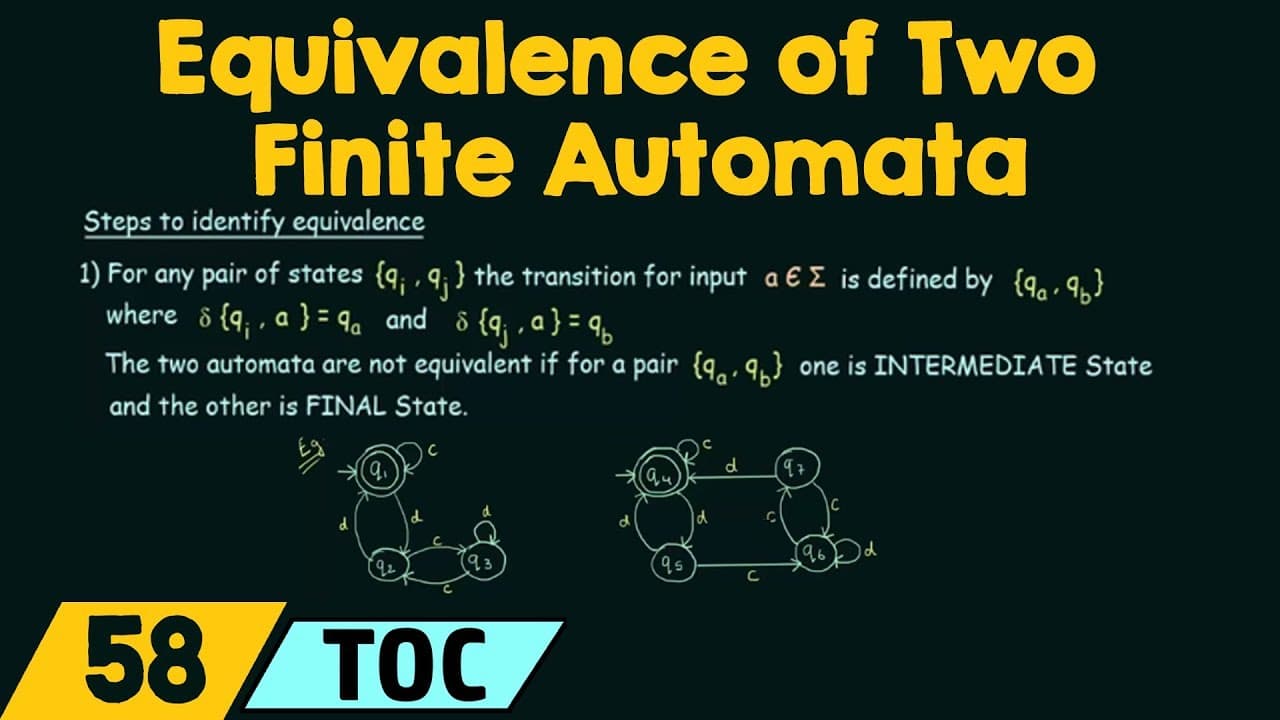
To determine if two finite automata are equivalent, examine the state transitions for each input pair. If all corresponding states are either both final or both intermediate, the automata are equivalent. The video illustrates this process with a detailed example of two automata.
Transcript
in this lecture we will be studying about equivalence of two finite automata which means said given two finite automata how do you recognize or how do you identify whether these two given finite automata are the same or not and what do we mean by same or equivalent by same or equivalent we mean that the two automatic perform the same kind of functi... Read More
Key Insights
- ⚾ Equivalence of two finite automata is determined based on the types (final, intermediate) of the pairs of states obtained from their transitions for each input.
- ❓ The initial state must be the same as the final state in both automata for them to be equivalent.
- ✅ Checking the transitions for all pairs of states is necessary to conclude the equivalence.
Install to Summarize YouTube Videos and Get Transcripts
Explore YouTube Video Summarizer or Get YouTube Transcript Extractor
Questions & Answers
Q: What does it mean for two finite automata to be equivalent?
Two finite automata are considered equivalent if they perform the same function, meaning they accept the same languages.
Q: How are the transitions of pairs of states used to determine equivalence?
By examining the transitions of pairs of states for each input in both automata, we can determine whether they have the same type (final or intermediate) or different types, which indicates their equivalence.
Q: What condition must be met for two automata to be considered equivalent based on their initial states?
If the initial state is a final state in one automaton, it must also be a final state in the other automaton for them to be equivalent.
Q: What happens if one state in a pair is an intermediate state and the other is a final state?
If one state is an intermediate state and the other is a final state in a pair, the automata are not considered equivalent.
Key Insights:
- Equivalence of two finite automata is determined based on the types (final, intermediate) of the pairs of states obtained from their transitions for each input.
- The initial state must be the same as the final state in both automata for them to be equivalent.
- Checking the transitions for all pairs of states is necessary to conclude the equivalence.
- If any pair has one state as an intermediate state and the other as a final state, the automata are not equivalent.
Summary & Key Takeaways
-
The lecture explains the steps to identify the equivalence of two finite automata, which involves analyzing the transitions of pairs of states for each input in both automata.
-
If the pairs of states have the same type (either both final or both intermediate), the automata are considered equivalent.
-
The lecture provides an example of two automata and demonstrates how to apply the steps to determine their equivalence.
Read in Other Languages (beta)
Share This Summary 📚
Summarize YouTube Videos and Get Video Transcripts with 1-Click
Try YouTube Summary with ChatGPT & Claude or YouTube Transcript Generator
Explore More Summaries from Neso Academy 📚



Summarize YouTube Videos and Get Video Transcripts with 1-Click
Try YouTube Summary with ChatGPT & Claude or YouTube Transcript Generator