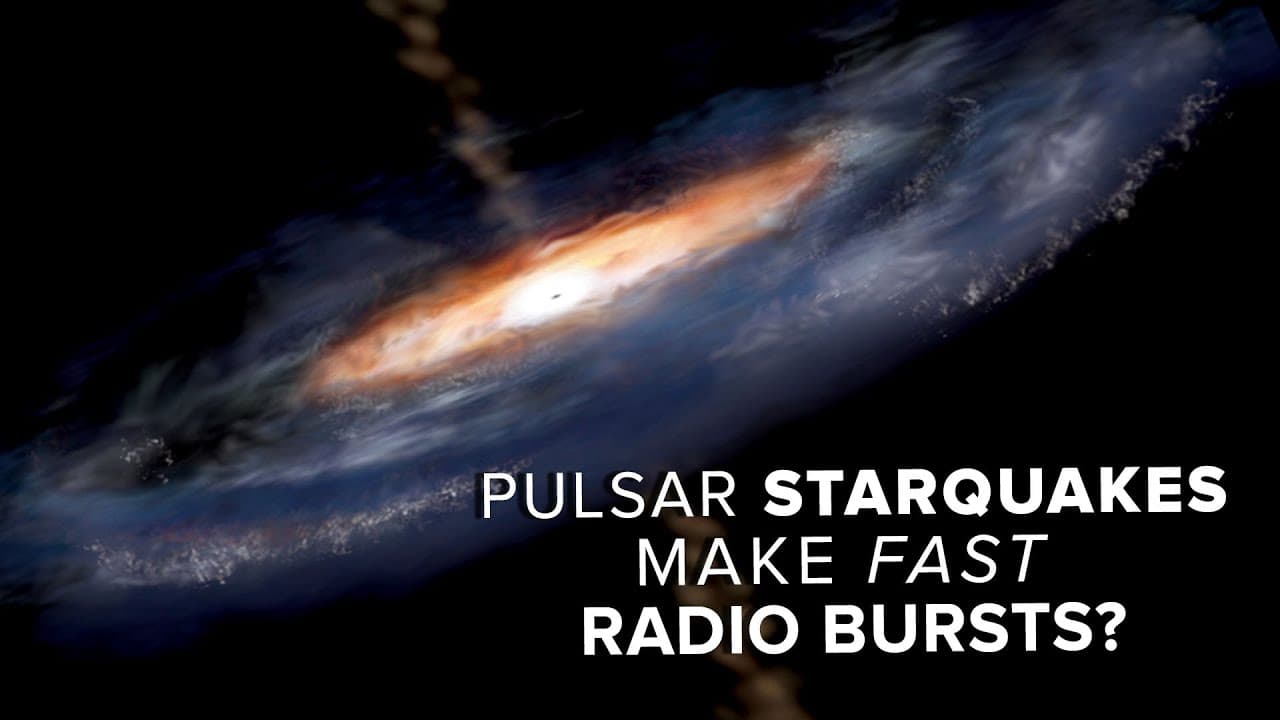
Pulsar Starquakes Make Fast Radio Bursts? + Challenge Winners! | Space Time | PBS Digital Studios
TL;DR
Fast radio bursts may originate from young neutron stars.
Transcript
[MUSIC PLAYING] It's mind-blowing how much we've been able to figure out about how our universe. But it's really, really exciting when we see something out there that has yet to be explained. Fast radio bursts are an example of that. Until recently, we had no idea what the sudden flashes of radio emission coming from mysterious events out there in ... Read More
Key Insights
- Fast radio bursts (FRBs) were initially thought to be from cataclysmic events but were found to repeat, ruling out such theories.
- FRBs are quick flashes of radio emissions lasting only a few milliseconds, suggesting an origin outside the Milky Way.
- In 2015, an FRB was traced to an elliptical galaxy 6 billion light years away, with a power output of 500 million Suns.
- The repeating nature of FRBs suggests they originate from non-destructive sources, possibly young neutron stars with intense bursts.
- The cosmic microwave background photons traveled 13.7 billion light years to reach us, corresponding to the universe's age.
- Before recombination, photons had a mean free path of 7,500 light years due to interactions with free electrons in the plasma.
- The baryonic mass of the universe is estimated at 10^53 kg, with equal numbers of protons and electrons.
- The pre-recombination universe was considered opaque despite the large mean free path due to its relative size.
Install to Summarize YouTube Videos and Get Transcripts
Explore YouTube Video Summarizer or Get YouTube Transcript Extractor
Questions & Answers
Q: What are fast radio bursts (FRBs) and where do they originate?
Fast radio bursts (FRBs) are quick flashes of radio emissions lasting only a few milliseconds, initially thought to originate from cataclysmic events. However, their repeating nature suggests they come from non-destructive sources, likely young neutron stars. These bursts are believed to originate from outside the Milky Way, as they are not predominantly seen in the galactic disc.
Q: How was the origin of a specific FRB determined?
In April 2015, astronomers successfully pinpointed the origin of a fast radio burst to an elliptical galaxy 6 billion light years away. This determination allowed scientists to calculate the FRB's power output, which was equivalent to that of 500 million Suns. This discovery was significant in understanding the immense energy associated with these bursts.
Q: What was the significance of discovering repeating FRBs?
The discovery of repeating fast radio bursts was significant because it ruled out cataclysmic events as their source. Cataclysmic events would destroy the source, making repetition impossible. Instead, the repeating nature of FRBs suggests they originate from stable, non-destructive sources, such as young neutron stars experiencing rotational glitches and starquakes.
Q: How far did the cosmic microwave background photons travel to reach us?
The cosmic microwave background photons traveled 13.7 billion light years to reach us. This distance corresponds to the age of the universe, as these photons have been traveling at the speed of light since the universe's inception. This journey reflects the vast scale and age of the cosmos, providing crucial insights into its early conditions.
Q: What challenges do photons face in the pre-recombination universe?
In the pre-recombination universe, photons faced challenges due to the presence of free electrons in the plasma. These electrons have a large scattering cross-section, making them highly effective at interacting with photons. As a result, photons had a mean free path of 7,500 light years, indicating frequent interactions and scattering before the universe became transparent.
Q: What is the baryonic mass of the universe, and how does it relate to electron density?
The baryonic mass of the universe is estimated at 10^53 kilograms, representing the mass of all protons and neutrons in the observable universe. Electrons, although much lighter, are present in equal numbers to protons. At the moment of recombination, the electron density was significantly higher, with 200 million electrons per cubic meter, compared to 0.2 electrons per cubic meter today.
Q: How is the mean free path of photons calculated in the early universe?
The mean free path of photons in the early universe is calculated by considering the electron density and the scattering cross-section of electrons. By imagining electrons as targets with a defined interaction region, we can estimate the distance a photon travels before encountering an electron. This distance, called the mean free path, was around 7,500 light years, reflecting the scattering interactions in the plasma.
Q: What was the opacity of the pre-recombination universe, and why?
The pre-recombination universe was considered opaque due to the frequent scattering of photons by free electrons, despite the large mean free path of 7,500 light years. This opacity is attributed to the relative size of the universe at that time. Although the plasma was diffuse, the frequent interactions prevented photons from traveling unimpeded, maintaining the universe's opaque state until recombination.
Summary & Key Takeaways
-
Fast radio bursts, initially thought to be from cataclysmic events, were found to repeat, suggesting a new origin theory involving young neutron stars. These intense radio emissions, lasting milliseconds, are believed to originate from outside the Milky Way, with a power output comparable to 500 million Suns.
-
The cosmic microwave background photons traveled 13.7 billion light years, reflecting the universe's age. Before recombination, the universe was filled with plasma, and photons had a mean free path of 7,500 light years due to interactions with free electrons, indicating an opaque pre-recombination universe.
-
The baryonic mass of the universe is estimated at 10^53 kilograms, with an equal number of protons and electrons. The pre-recombination universe's opacity is attributed to the large mean free path relative to its size, despite the seemingly diffuse nature of the plasma at that time.
Read in Other Languages (beta)
Share This Summary 📚
Summarize YouTube Videos and Get Video Transcripts with 1-Click
Try YouTube Summary with ChatGPT & Claude or YouTube Transcript Generator
Explore More Summaries from PBS Space Time 📚
Summarize YouTube Videos and Get Video Transcripts with 1-Click
Try YouTube Summary with ChatGPT & Claude or YouTube Transcript Generator