What Is Computer Architecture and Its Working Principles?
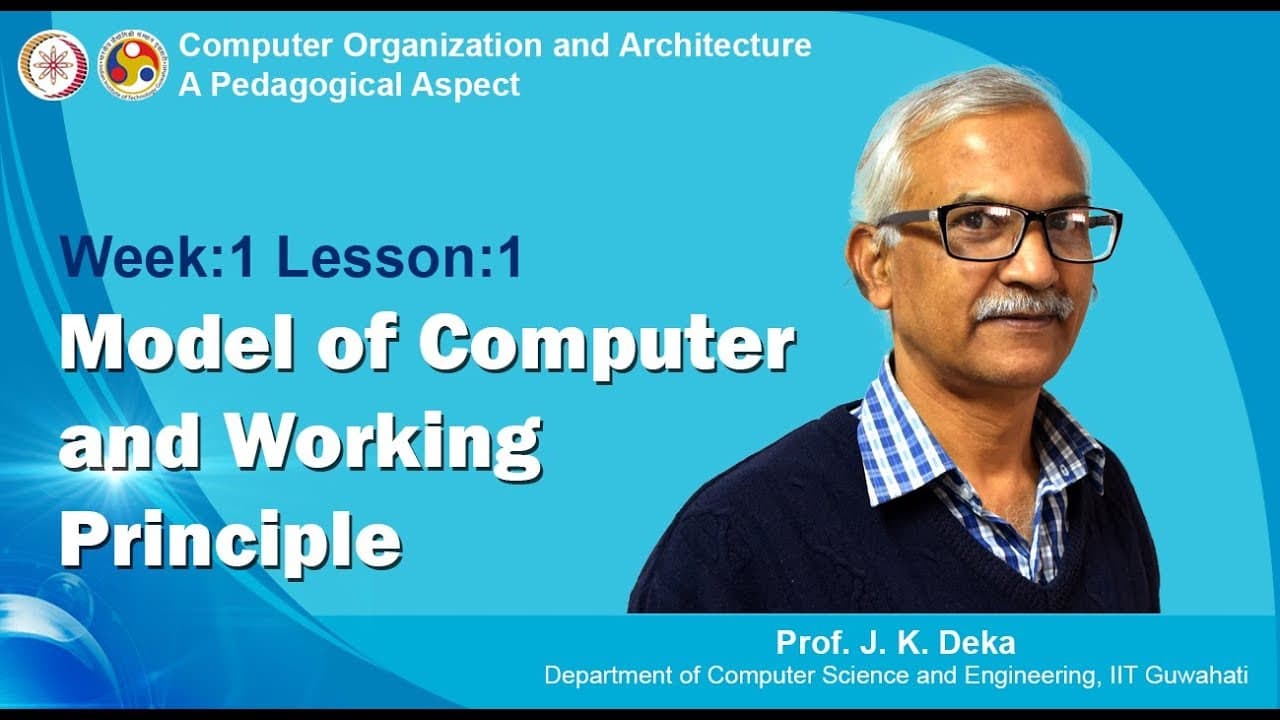
TL;DR
Computer architecture refers to the design and organization of a computer's components, focusing on the structure and function of systems. Key principles include the Von Neumann stored program concept, the role of the CPU, memory, and I/O devices, alongside teaching methods like Bloom's taxonomy, which categorizes learning objectives into cognitive, psychomotor, and affective domains.
Transcript
Ok welcome back to the course on computer organization and architecture. This is the first module of this particular course, before going to the course matters I slightly want to explain about the method of pedagogy and the outcome based learning because in this course we will follow the approach of outcome based learning. Now, first question arise... Read More
Key Insights
- 🖐️ Pedagogy and outcome-based learning play significant roles in computer education, emphasizing learner participation and practical application.
- ⚾ Bloom's taxonomy provides a framework for planning teaching and learning activities based on cognitive, psychomotor, and affective domains.
- ✋ The cognitive domain is the main focus in higher education, developing intellectual abilities and skills for problem-solving.
- 🎨 The six objectives of the course cover areas such as system design, CPU efficiency, memory and I/O module design, programming languages, and performance evaluation.
- 🦾 The history of computer architecture has evolved from mechanical and electromechanical systems to vacuum tubes, transistors, integrated circuits, and microprocessors.
- 👨💻 Intel's x86 family of processors has contributed to the advancement of computer architecture, with increased clock frequencies and code compatibility.
- 🤌 Moore's Law, predicted by Gordon Moore, states that the number of transistors per square inch on integrated circuits doubles every two years.
Install to Summarize YouTube Videos and Get Transcripts
Explore YouTube Video Summarizer or Get YouTube Transcript Extractor
Questions & Answers
Q: What is pedagogy and why is it important in computer education?
Pedagogy refers to the method and practice of teaching a subject. It is essential in computer education to ensure effective teaching and learning outcomes. By following outcome-based learning, students actively participate in the learning process.
Q: What is Bloom's taxonomy and how is it used in teaching and learning objectives?
Bloom's taxonomy is a classification of educational goals that helps in planning teaching and learning activities. It categorizes learning into cognitive, psychomotor, and affective domains. In this course, the focus is on the cognitive domain and developing thinking skills.
Q: How does outcome-based learning benefit students in computer education?
Outcome-based learning promotes learner-centric education, allowing students to actively participate and develop their intellectual abilities and skills. It enhances critical thinking, problem-solving, and decision-making skills needed in real-world situations.
Q: What are the objectives of the course in computer architecture?
The objectives include designing a computer system, efficient CPU design, memory and I/O module design, performance evaluation, programming languages, and writing assembly-level programs for problem-solving.
Summary & Key Takeaways
-
The content begins by explaining the method of pedagogy and the concept of outcome-based learning in computer organization and architecture.
-
It introduces Benjamin S Bloom's taxonomy, which is used to plan teaching and learning activities.
-
The content discusses the three domains of learning: cognitive, psychomotor, and affective, with a focus on the cognitive domain in higher education.
-
It outlines the six objectives of the course, which include designing a computer system, efficient CPU design, memory and I/O module design, and performance evaluation.
Read in Other Languages (beta)
Share This Summary 📚
Summarize YouTube Videos and Get Video Transcripts with 1-Click
Try YouTube Summary with ChatGPT & Claude or YouTube Transcript Generator