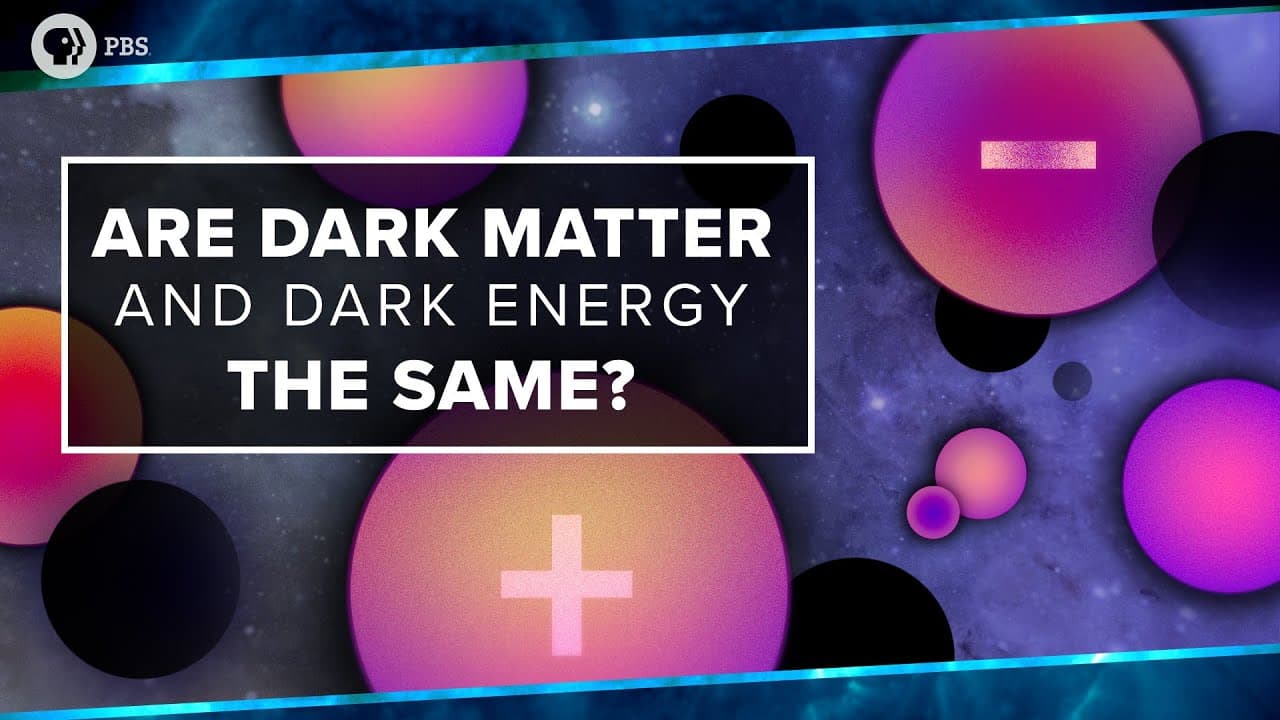
Are Dark Matter And Dark Energy The Same?
TL;DR
Dr. Jamie Farnes proposes a unifying theory for dark matter and energy.
Transcript
Astronomers are the worst at naming things. I mean seriously. Dark energy AND dark matter? Who can remember which is which. But perhaps one astronomer has just fixed it, with a theory that says perhaps actually they are they same stuff. Dr. Jamie Farnes, astrophysicist at Oxford just published a paper suggesting that both dark energy and dark matte... Read More
Key Insights
- Dr. Jamie Farnes suggests dark matter and dark energy may stem from the same phenomenon involving negative mass particles.
- Negative mass particles could continuously pop into existence, potentially explaining the effects of dark matter and dark energy.
- Farnes' theory proposes that negative masses create an anti-gravitational effect, offering a new perspective on cosmic expansion.
- The theory uses Newtonian physics to argue that interactions between positive and negative masses can explain galaxy rotation speeds.
- Farnes' model requires the continuous creation of negative masses to maintain a constant density, challenging traditional cosmological models.
- The theory suggests a negative cosmological constant, leading to a universe with different expansion dynamics than currently observed.
- Critics point out that the theory struggles to align with supernova data and cosmic microwave background observations.
- Despite theoretical challenges, Farnes' work is praised for its innovative approach and potential to inspire further research.
Install to Summarize YouTube Videos and Get Transcripts
Explore YouTube Video Summarizer or Get YouTube Transcript Extractor
Questions & Answers
Q: What is Dr. Jamie Farnes' main proposition in his paper?
Dr. Jamie Farnes proposes that both dark matter and dark energy can be explained by the existence of negative mass particles. These particles are theorized to continuously pop into existence, creating effects that account for the observed phenomena traditionally attributed to dark matter and dark energy.
Q: How does Farnes' theory explain galaxy rotation speeds?
Farnes' theory suggests that negative mass particles create a halo around galaxies. This halo interacts with the positive mass of the galaxy, leading to a repulsive force that confines the galaxy. This confinement allows galaxies to spin faster than they would if only their gravity were considered.
Q: What is the role of negative mass particles in Farnes' theory?
Negative mass particles are central to Farnes' theory, as they are proposed to create both the effects of dark matter and dark energy. These particles are thought to generate an anti-gravitational effect, contributing to the accelerated expansion of the universe and influencing galaxy dynamics.
Q: What are the theoretical challenges of Farnes' model?
Farnes' model faces challenges, such as aligning with existing observational data like supernovae and cosmic microwave background measurements. Additionally, the concept of continuously creating negative masses to maintain a constant density is a significant departure from established cosmological theories.
Q: How does the theory relate to the cosmological constant?
Farnes' theory suggests a negative cosmological constant, which implies different expansion dynamics for the universe. This contrasts with the positive cosmological constant in standard models, which accounts for the universe's accelerating expansion. Farnes' negative constant suggests a universe that could potentially recollapse.
Q: What was the media's response to Farnes' theory?
The media response to Farnes' theory was mixed, with some outlets sensationalizing the claims without thorough scientific validation. This highlights the importance of careful scientific communication and the need for media to consult multiple sources before declaring new theories as groundbreaking.
Q: What potential does Farnes' theory have for future research?
Despite its challenges, Farnes' theory is praised for its innovative approach, potentially inspiring further research into alternative explanations for dark matter and dark energy. It encourages scientists to explore unconventional ideas and consider new perspectives in cosmology.
Q: What are the implications of negative masses on general relativity?
Negative masses, if they exist, could lead to theoretical constructs like traversable wormholes and time machines, which challenge causality and are not currently supported by general relativity. This suggests that negative masses may not be feasible within our current understanding of physics.
Summary & Key Takeaways
-
Dr. Jamie Farnes proposes that dark matter and dark energy may be explained by negative mass particles that continuously appear in space. This theory suggests that these negative masses could create both the effects attributed to dark matter and the accelerating expansion of the universe associated with dark energy.
-
Farnes' model uses Newtonian physics to describe how negative and positive masses interact, potentially explaining why galaxies spin faster than expected. The theory also requires the ongoing creation of negative masses to maintain a consistent density, which is a major departure from traditional cosmological models.
-
While Farnes' theory presents innovative ideas, it faces criticism for not aligning with current observational data, such as supernova observations and cosmic microwave background measurements. The media's response to the theory highlights the importance of thorough scientific validation before public dissemination.
Read in Other Languages (beta)
Share This Summary 📚
Summarize YouTube Videos and Get Video Transcripts with 1-Click
Try YouTube Summary with ChatGPT & Claude or YouTube Transcript Generator
Explore More Summaries from PBS Space Time 📚
Summarize YouTube Videos and Get Video Transcripts with 1-Click
Try YouTube Summary with ChatGPT & Claude or YouTube Transcript Generator