What Led to Napoleon's Downfall and Legacy?
TL;DR
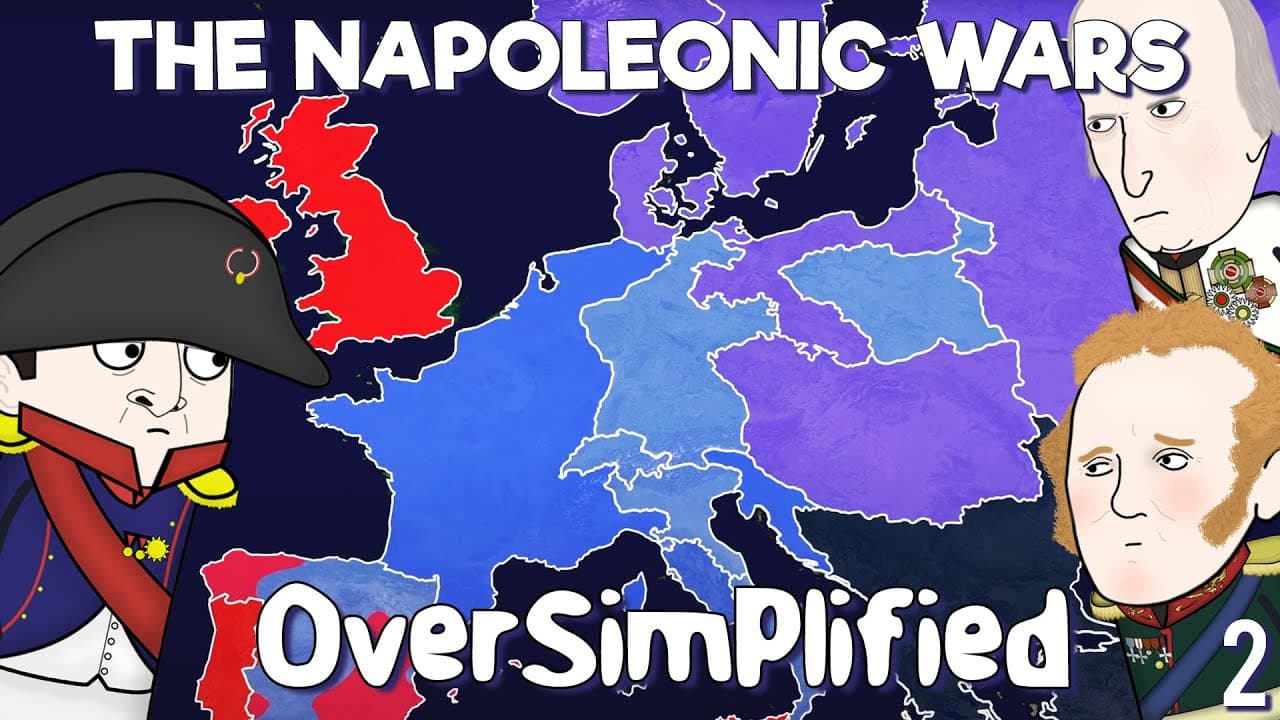
Napoleon's downfall stemmed from his disastrous invasion of Russia, the ineffective Continental System, and resource-draining conflicts like the Peninsular War. His final defeat at Waterloo ended his brief return to power, leading to exile on Saint Helena. Despite his military genius, his overreaching ambition significantly reshaped Europe, and his legal reforms still influence modern systems today.
Transcript
- [Narrator] This video was made possible by Honey. Install now for free using the link below and start saving money when you shop online. (dramatic thud) After the third and fourth Coalition wars, Napoleon had decisively defeated all three of his main rivals on the continent, and he was now undoubtedly the master of Europe. After the Battle of Fri... Read More
Key Insights
- Napoleon's Continental System aimed to cripple the British economy by blocking trade, but it was largely ineffective due to Britain's global trade networks.
- Napoleon's invasion of Russia was a catastrophic failure due to harsh winter conditions and scorched earth tactics by the Russians.
- The Peninsular War in Spain drained French resources and weakened Napoleon's position in Europe, contributing to his eventual downfall.
- Napoleon's defeat at the Battle of Leipzig marked a turning point, leading to his first abdication and exile to Elba.
- Napoleon's escape from Elba and return to power was short-lived, ending with his defeat at the Battle of Waterloo.
- Napoleon's exile to Saint Helena marked the end of his political and military career, where he spent his final years writing memoirs.
- Napoleon's legal reforms, known as the Napoleonic Code, have had a lasting impact on modern legal systems.
- Despite his military genius, Napoleon's ambition and aggressive expansion led to his downfall and reshaped European politics.
Install to Summarize YouTube Videos and Get Transcripts
Explore YouTube Video Summarizer or Get YouTube Transcript Extractor
Questions & Answers
Q: What was the Continental System?
The Continental System was Napoleon's strategy to weaken the British economy by prohibiting European nations from trading with Britain. Despite initial impacts, it was largely ineffective as Britain expanded its trade with other regions, and many European countries continued illicit trade with the UK.
Q: Why did Napoleon invade Russia?
Napoleon invaded Russia in 1812 to enforce the Continental System and punish Russia for resuming trade with Britain. He assembled a massive army, but the campaign failed due to the harsh Russian winter, logistical issues, and the scorched earth tactics employed by the retreating Russian forces.
Q: What was the significance of the Battle of Leipzig?
The Battle of Leipzig, also known as the Battle of the Nations, was significant as it marked the decisive defeat of Napoleon by the Sixth Coalition. It was the largest battle in Europe prior to World War I, leading to Napoleon's first abdication and exile to Elba.
Q: How did Napoleon return to power after his exile to Elba?
Napoleon escaped from Elba in 1815, returned to France, and quickly regained power as many French soldiers and citizens rallied to his side. His return, known as the Hundred Days, ended with his defeat at the Battle of Waterloo and subsequent exile to Saint Helena.
Q: What led to Napoleon's final defeat at Waterloo?
Napoleon's final defeat at Waterloo was due to a combination of factors including miscommunication among his marshals, strong defensive positions held by the British, timely arrival of Prussian reinforcements, and his own tactical errors. This defeat ended his rule and led to his exile to Saint Helena.
Q: How did Napoleon's rule impact Europe after his defeat?
Napoleon's rule spread revolutionary ideals across Europe, challenging traditional monarchies and promoting nationalism. His Napoleonic Code influenced legal systems worldwide. After his defeat, the Congress of Vienna attempted to restore the old order, but the changes he initiated continued to influence European politics.
Q: What were the conditions of Napoleon's exile on Saint Helena?
On Saint Helena, Napoleon lived in isolation under strict British supervision. He was guarded by soldiers and ships, had limited contact with the outside world, and his communications were censored. Despite these conditions, he spent his time writing memoirs to shape his legacy.
Q: How is Napoleon remembered today?
Napoleon is remembered as a military genius and a complex historical figure. His legacy includes significant contributions to military tactics, law, and European political restructuring. However, his aggressive expansion and authoritarian rule continue to generate debate about his role as a revolutionary leader versus a tyrant.
Summary & Key Takeaways
-
Napoleon's strategic brilliance led to numerous victories, but his overreach, especially in Russia, marked the beginning of his decline.
-
The Peninsular War and the War of the Sixth Coalition further weakened Napoleon, leading to his first abdication and exile to Elba.
-
Napoleon's brief return to power ended with his defeat at Waterloo, after which he was exiled to Saint Helena, where he spent his final years.
Read in Other Languages (beta)
Share This Summary 📚
Summarize YouTube Videos and Get Video Transcripts with 1-Click
Try YouTube Summary with ChatGPT & Claude or YouTube Transcript Generator
Explore More Summaries from OverSimplified 📚





Summarize YouTube Videos and Get Video Transcripts with 1-Click
Try YouTube Summary with ChatGPT & Claude or YouTube Transcript Generator