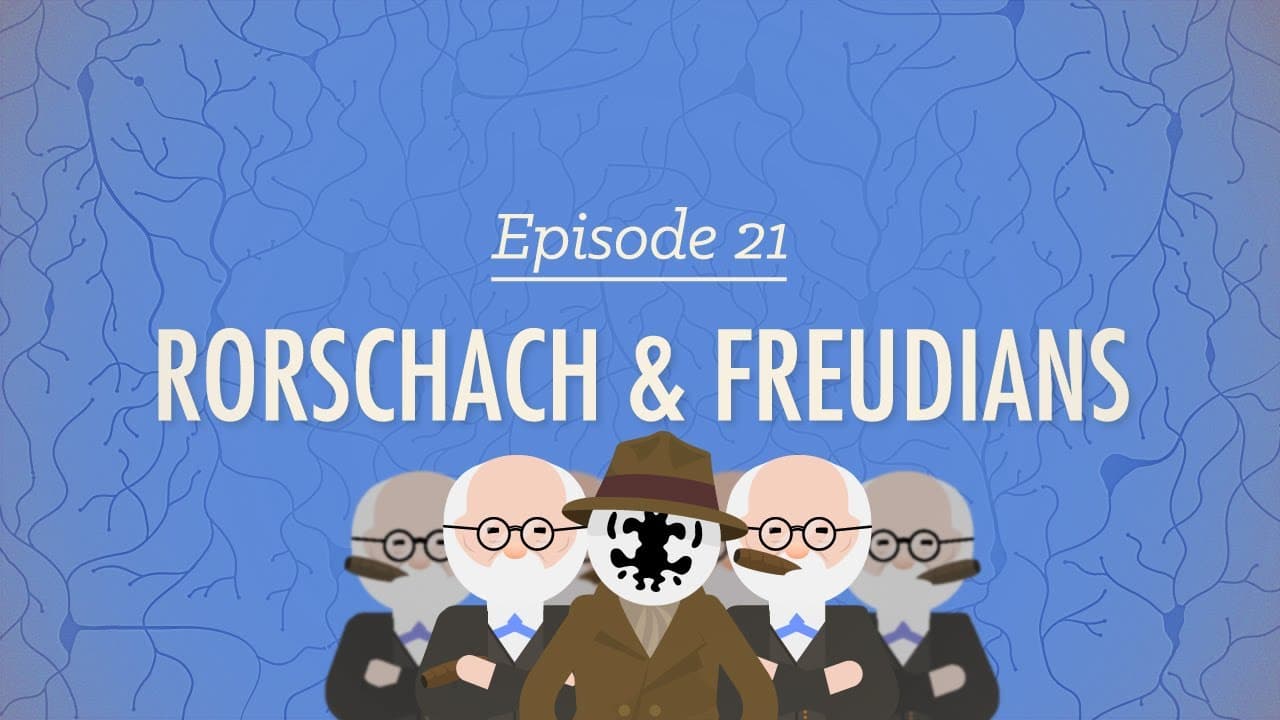
Rorschach and Freudians: Crash Course Psychology #21
TL;DR
Explores Rorschach tests and theories of personality.
Transcript
What do you see in this image? A scary face? A couple of squirrels fighting? Or this one? A squashed frog? Or tumbling poodles? A bleeding bat? Hermann Rorschach wants to know. Eh, he wanted to know–he's dead now He believed that your answers, what you saw in the ink, said something about your personality. Rorschach was a Swiss psychoanalyst who, i... Read More
Key Insights
- Hermann Rorschach developed the inkblot test to explore personality by analyzing what individuals see in ambiguous images, revealing personal associations.
- The Rorschach test remains controversial, with some psychologists valuing it as a diagnostic tool while others criticize its reliability and scientific validity.
- Freud's psychoanalytic theory posits that personality is shaped by the unconscious mind, involving the id, ego, and superego, and influenced by early psychosexual stages.
- Freud's defense mechanisms, such as repression and denial, are used by the ego to manage anxiety and conflict between the id and superego.
- Neo-Freudians like Karen Horney and Carl Jung expanded on Freud's ideas, focusing on social factors and the collective unconscious rather than just sexual motivations.
- Humanistic theories, led by thinkers like Maslow and Rogers, emphasize personal growth, self-actualization, and the inherent goodness of people.
- Maslow's hierarchy of needs suggests that fulfilling basic needs allows individuals to pursue self-actualization and self-transcendence.
- Rogers' person-centered perspective highlights the importance of a nurturing environment with genuineness, acceptance, and empathy for healthy personality development.
Install to Summarize YouTube Videos and Get Transcripts
Explore YouTube Video Summarizer or Get YouTube Transcript Extractor
Questions & Answers
Q: What is the purpose of the Rorschach inkblot test?
The Rorschach inkblot test is designed to explore an individual's personality by analyzing their interpretations of ambiguous inkblot images. The test aims to reveal personal associations and unconscious thoughts by examining how people project their emotions and experiences onto these random shapes, providing insights into their personality traits and psychological state.
Q: How does Freud's psychoanalytic theory explain personality?
Freud's psychoanalytic theory explains personality as being shaped by the unconscious mind, divided into three parts: the id, ego, and superego. The id represents primal desires, the ego manages reality, and the superego embodies moral standards. Personality development is influenced by early psychosexual stages, and defense mechanisms help manage conflicts between these components.
Q: What are some criticisms of the Rorschach test?
Critics argue that the Rorschach test lacks scientific reliability and validity, with concerns about its subjective interpretation and inconsistent results. Some psychologists view it as unscientific, questioning its diagnostic value. Despite these criticisms, some clinicians still find it useful when used cautiously, highlighting the ongoing debate over its effectiveness in assessing personality.
Q: How do neo-Freudians differ from Freud in their views on personality?
Neo-Freudians, such as Karen Horney and Carl Jung, diverged from Freud by emphasizing the role of social factors and the conscious mind in personality development. They downplayed the focus on sexual motivations, with Horney rejecting concepts like penis envy and Jung introducing ideas like the collective unconscious, which includes shared archetypes and cultural symbols.
Q: What is the main focus of humanistic theories of personality?
Humanistic theories of personality, championed by thinkers like Maslow and Rogers, focus on personal growth, self-actualization, and the inherent goodness of people. These theories emphasize the potential for individuals to achieve their full potential in a supportive environment, highlighting the importance of genuineness, acceptance, and empathy in fostering healthy personality development.
Q: What is Maslow's hierarchy of needs?
Maslow's hierarchy of needs is a pyramid-shaped model that outlines the progression of human needs, starting with basic physiological requirements like food and shelter. Once these are met, individuals can pursue higher-level needs such as safety, love, esteem, and ultimately self-actualization and self-transcendence, which involve realizing one's full potential and finding meaning beyond oneself.
Q: How does Rogers' person-centered perspective contribute to personality theory?
Rogers' person-centered perspective contributes to personality theory by emphasizing the importance of a nurturing environment for healthy personality development. He identified three key conditions for growth: genuineness, acceptance, and empathy. These conditions help individuals develop a positive self-concept and encourage personal growth, allowing them to explore their identity and achieve self-actualization.
Q: What are defense mechanisms according to Freud?
According to Freud, defense mechanisms are unconscious strategies used by the ego to manage anxiety and conflict between the id and superego. These mechanisms, such as repression, denial, projection, and rationalization, help protect individuals from distressing thoughts and feelings by distorting reality or redirecting emotions, playing a crucial role in shaping one's personality and behavior.
Summary & Key Takeaways
-
The episode explores Rorschach's inkblot test, a controversial psychological tool used to assess personality by interpreting responses to ambiguous images. It delves into Freud's psychoanalytic theory, highlighting the id, ego, and superego's roles in shaping personality, alongside defense mechanisms like repression and denial.
-
Neo-Freudians such as Karen Horney and Carl Jung expanded on Freud's ideas, focusing on social influences and the collective unconscious. Humanistic theories, led by Maslow and Rogers, emphasize personal growth, self-actualization, and the inherent goodness of people, contrasting with the psychoanalytic focus on internal conflict.
-
Maslow's hierarchy of needs outlines a path from basic survival to self-actualization, while Rogers' person-centered perspective stresses the importance of a supportive environment for healthy personality development. The episode concludes by acknowledging the influence and limitations of these theories in understanding personality.
Read in Other Languages (beta)
Share This Summary 📚
Summarize YouTube Videos and Get Video Transcripts with 1-Click
Try YouTube Summary with ChatGPT & Claude or YouTube Transcript Generator
Explore More Summaries from CrashCourse 📚


Summarize YouTube Videos and Get Video Transcripts with 1-Click
Try YouTube Summary with ChatGPT & Claude or YouTube Transcript Generator