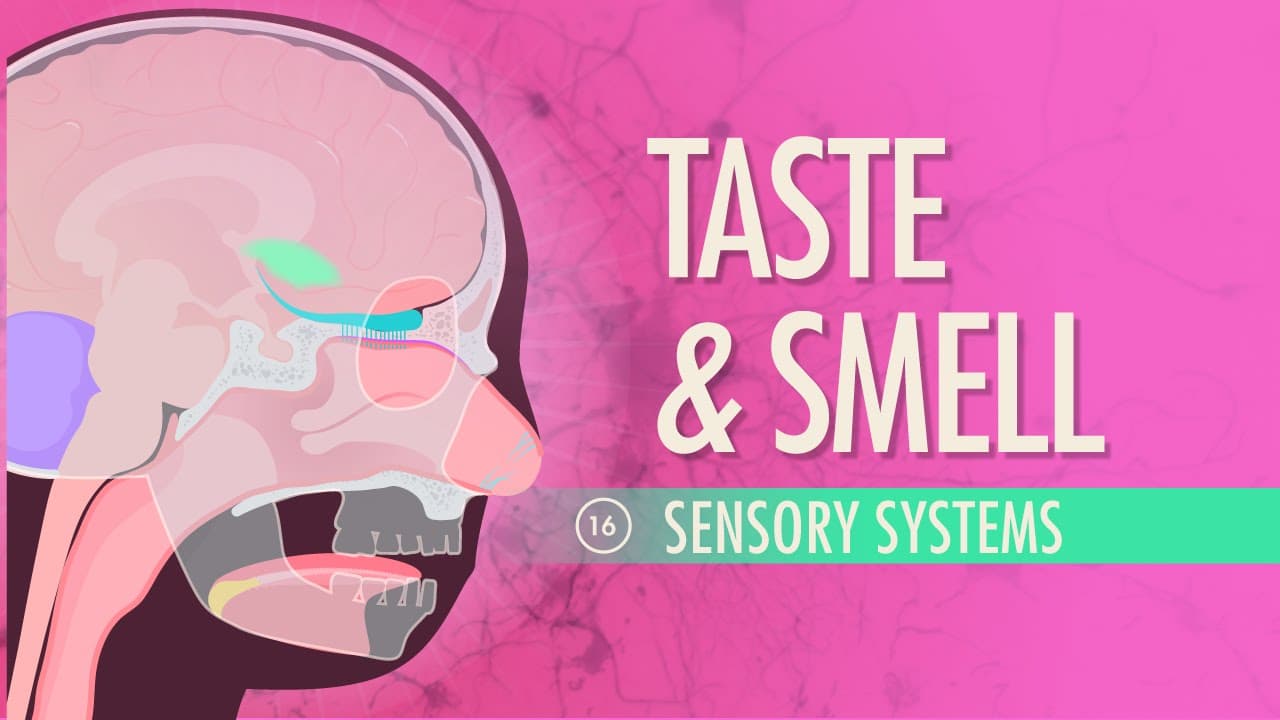
Taste & Smell: Crash Course Anatomy & Physiology #16
TL;DR
Explores how olfaction and gustation work and their sensory processes.
Transcript
Case study of the day: Olivia, she was a healthy 35-year-old woman. Until one spring day, when she got into a bad bike accident, and suffered serious head trauma. The doctors patched her up, but after a couple of days in the hospital, she noticed something strange was happening. Or, rather, something wasn’t happening - she could no longer smell. No... Read More
Key Insights
- Anosmia, the loss of smell, can significantly impact quality of life by diminishing the ability to taste and evoke memories.
- Sensory cells translate stimuli into action potentials, allowing the nervous system to process sensory information.
- Olfactory neurons in the nasal cavity detect volatile molecules, sending signals to the brain to identify smells.
- The olfactory system involves the olfactory epithelium, glomerulus, and mitral cells to process smell information.
- Taste involves gustatory epithelial cells, which detect tastants dissolved in saliva and send signals to the brain.
- Taste buds contain gustatory and basal epithelial cells, with the latter regenerating taste cells regularly.
- Taste maps of the tongue are inaccurate; all taste sensations can be detected across the tongue.
- Both smell and taste are interconnected, with smell contributing significantly to the perception of taste.
Install to Summarize YouTube Videos and Get Transcripts
Explore YouTube Video Summarizer or Get YouTube Transcript Extractor
Questions & Answers
Q: What is anosmia and how does it affect individuals?
Anosmia is the partial or complete loss of the sense of smell, which can result from head trauma, respiratory infections, or aging. It significantly impacts individuals by reducing their ability to taste, evoke memories, and detect environmental dangers, leading to a less interesting and potentially more dangerous life experience.
Q: How do olfactory neurons process smell?
Olfactory neurons in the nasal cavity detect volatile molecules, which dissolve in mucus and bind to receptors on the neurons. This triggers action potentials that travel through the ethmoid bone to the olfactory bulb, where signals are processed and sent to the brain for identification and emotional response.
Q: What role do taste buds play in gustation?
Taste buds, located on the tongue, mouth, and upper throat, contain gustatory and basal epithelial cells. Gustatory cells detect tastants, while basal cells regenerate them. Tastants dissolve in saliva, diffuse through taste pores, and bind to gustatory cells, triggering action potentials that convey taste information to the brain.
Q: How are taste sensations detected on the tongue?
Contrary to the outdated taste map theory, taste sensations are detected across the entire tongue. Variations in sensitivity are insignificant, and all taste types—sweet, salty, sour, bitter, and umami—are registered throughout the tongue, discrediting the notion that specific areas are responsible for specific tastes.
Q: How do smell and taste interact during eating?
During eating, air is forced up the nasal passages, allowing olfactory receptor cells to register smells simultaneously with taste receptors detecting flavors. This interaction means that smell significantly contributes to taste perception, explaining why the ability to taste diminishes when smell is impaired, such as during a cold.
Q: What is the process of transduction in sensory perception?
Transduction is the process by which sensory cells translate chemical, electromagnetic, and mechanical stimuli into action potentials. These action potentials are then interpreted by the nervous system, enabling the brain to process and respond to sensory information, such as smells, tastes, sights, and sounds.
Q: What are gustatory hairs and their function?
Gustatory hairs are thread-like protrusions of the gustatory epithelial cells' membrane that extend into taste pores. They play a crucial role in taste perception by interacting with dissolved tastants in saliva, which bind to receptors on the gustatory hairs, triggering action potentials that convey taste information to the brain.
Q: How does the brain process smell and taste signals?
Smell signals travel from olfactory neurons to the olfactory bulb and then to the brain's olfactory cortex, where they are identified and linked to emotions. Taste signals from gustatory cells travel via cranial nerves to the cerebral cortex, where the brain interprets them, triggering digestive responses and taste recognition.
Summary & Key Takeaways
-
The episode discusses the anatomy and physiology of smell (olfaction) and taste (gustation), focusing on how sensory cells translate stimuli into action potentials for the nervous system to interpret.
-
Olfaction involves olfactory neurons detecting volatile molecules, with signals processed through the olfactory epithelium, glomerulus, and mitral cells to the brain.
-
Taste involves gustatory epithelial cells detecting tastants, with taste buds containing gustatory and basal cells, and taste maps of the tongue debunked as inaccurate.
Read in Other Languages (beta)
Share This Summary 📚
Summarize YouTube Videos and Get Video Transcripts with 1-Click
Try YouTube Summary with ChatGPT & Claude or YouTube Transcript Generator
Explore More Summaries from CrashCourse 📚





Summarize YouTube Videos and Get Video Transcripts with 1-Click
Try YouTube Summary with ChatGPT & Claude or YouTube Transcript Generator