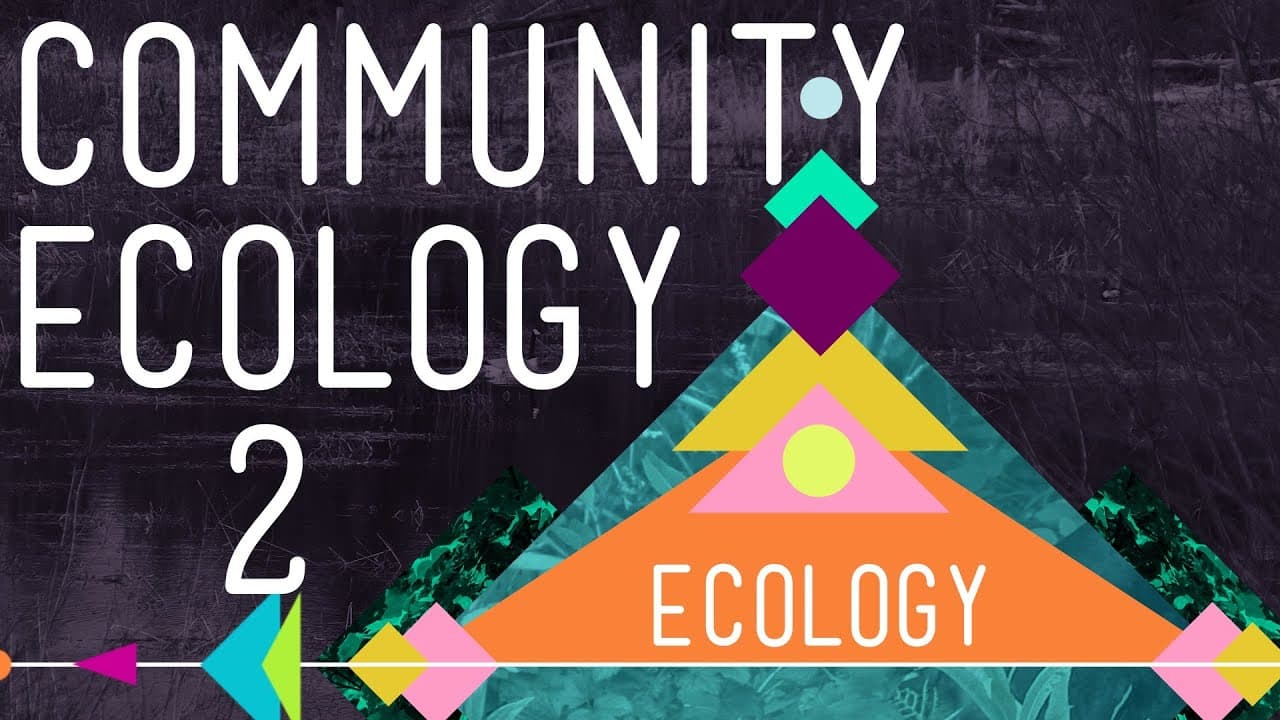
Community Ecology II: Predators - Crash Course Ecology #5
TL;DR
Predation drives evolutionary adaptations and diversity in ecosystems.
Transcript
Of all the ways that species interact on this planet, maybe the one that fascinates us the most is predation, and why not? It's hard not to be captivated by, say, an Alaska Brown Bear, one of North America's apex predators, even though they get much of their nutrition from nuts and bugs and berries. But you can also tell that it's a pretty big fan ... Read More
Key Insights
- Predation is a key ecological interaction that involves one organism killing another for energy, influencing evolutionary pressures.
- Predation includes not just animal-animal interactions but also herbivory and parasitism, highlighting the diverse forms of energy acquisition.
- Co-evolution describes the evolutionary arms race between predators and prey, leading to adaptations in hunting and defense mechanisms.
- Predators have evolved specialized adaptations like keen senses and venomous strikes to capture prey effectively.
- Prey species have developed various adaptations to avoid predation, including camouflage, speed, and grouping behaviors.
- Mimicry, including Mullerian and Batesian mimicry, is an evolutionary strategy where harmless species imitate harmful ones to avoid predation.
- The concept of Batesian mimicry was first described by Henry Walter Bates, illustrating natural selection through mimicry in butterflies.
- Predation and mimicry demonstrate the dynamic nature of ecosystems, where evolutionary changes continuously shape species interactions.
Install to Summarize YouTube Videos and Get Transcripts
Explore YouTube Video Summarizer or Get YouTube Transcript Extractor
Questions & Answers
Q: What is the significance of predation in ecological interactions?
Predation is a fundamental ecological interaction that involves one organism killing another to obtain energy. It significantly influences evolutionary pressures, driving adaptations in both predators and prey. These adaptations can include hunting strategies, defensive mechanisms, and mimicry. Predation also contributes to the diversity and complexity of ecosystems by shaping species interactions and evolutionary trajectories.
Q: How does co-evolution affect predator-prey relationships?
Co-evolution refers to the evolutionary arms race between predators and prey, where each species exerts selective pressures on the other. This process leads to adaptations in hunting and defense mechanisms, enhancing the survival and reproductive success of both predators and prey. Co-evolution results in a dynamic interplay that continually shapes the evolutionary development of interacting species, contributing to biodiversity.
Q: What are some examples of adaptations in predators?
Predators have evolved various adaptations to enhance their hunting efficiency. For instance, wolves possess keen senses of smell and sharp teeth for capturing prey, while eagles have acute eyesight and strong talons. Rattlesnakes use heat-sensing organs and venom to locate and kill prey. These adaptations enable predators to effectively capture and consume prey, ensuring their survival and reproductive success.
Q: How do prey species avoid predation?
Prey species have developed numerous adaptations to avoid being caught by predators. Camouflage, or cryptic coloration, helps them blend into their surroundings, as seen in stick insects and snowshoe hares. Speed and agility allow antelope to escape predators, while grouping behaviors, like bison herds, reduce individual predation risk. These strategies enhance prey survival by minimizing detection and capture.
Q: What is Mullerian mimicry, and how does it benefit species?
Mullerian mimicry involves unpalatable species resembling each other to reinforce predator avoidance. By sharing similar warning coloration, these species collectively enhance predator learning, reducing the likelihood of being attacked. This mimicry benefits all involved species by increasing their survival chances, as predators learn to associate the shared appearance with unpalatability, avoiding them altogether.
Q: What is Batesian mimicry, and who first described it?
Batesian mimicry involves harmless species imitating the appearance of harmful or unpalatable species to avoid predation. This evolutionary strategy was first described by Henry Walter Bates, a 19th-century British naturalist. Bates observed that harmless butterflies mimicked the color patterns of toxic ones, benefiting from reduced predation as predators avoided them, mistaking them for their dangerous counterparts.
Q: How do predators use mimicry to capture prey?
Some predators have evolved mimicry strategies to lure and capture prey. For example, snapping turtles have tongues resembling wiggling worms that attract fish, while anglerfish use bioluminescent lures to entice prey. These deceptive tactics enable predators to draw prey closer, increasing their chances of a successful capture by exploiting prey's natural behaviors and responses.
Q: What role does predation play in shaping ecosystems?
Predation is a driving force in shaping ecosystems by influencing species interactions and evolutionary trajectories. It contributes to biodiversity by promoting adaptations and co-evolutionary dynamics. Predation also affects energy flow and population dynamics, maintaining ecological balance. As species continuously adapt to predation pressures, ecosystems remain dynamic and resilient, showcasing the interconnectedness of life forms.
Summary & Key Takeaways
-
Predation plays a crucial role in ecological interactions, driving evolutionary changes and adaptations among species. It encompasses various forms, including animal-animal interactions, herbivory, and parasitism. These interactions highlight the importance of energy acquisition for survival and reproduction.
-
Co-evolution describes the evolutionary arms race between predators and prey, resulting in diverse adaptations. Predators have developed hunting adaptations, while prey species have evolved defense mechanisms such as camouflage, speed, and grouping behaviors to avoid predation.
-
Mimicry, including Mullerian and Batesian mimicry, showcases evolutionary strategies where harmless species imitate harmful ones to evade predators. Batesian mimicry was first described by Henry Walter Bates, highlighting natural selection's role in shaping species interactions.
Read in Other Languages (beta)
Share This Summary 📚
Summarize YouTube Videos and Get Video Transcripts with 1-Click
Try YouTube Summary with ChatGPT & Claude or YouTube Transcript Generator
Explore More Summaries from CrashCourse 📚




Summarize YouTube Videos and Get Video Transcripts with 1-Click
Try YouTube Summary with ChatGPT & Claude or YouTube Transcript Generator