The Moon: Crash Course Astronomy #12
TL;DR
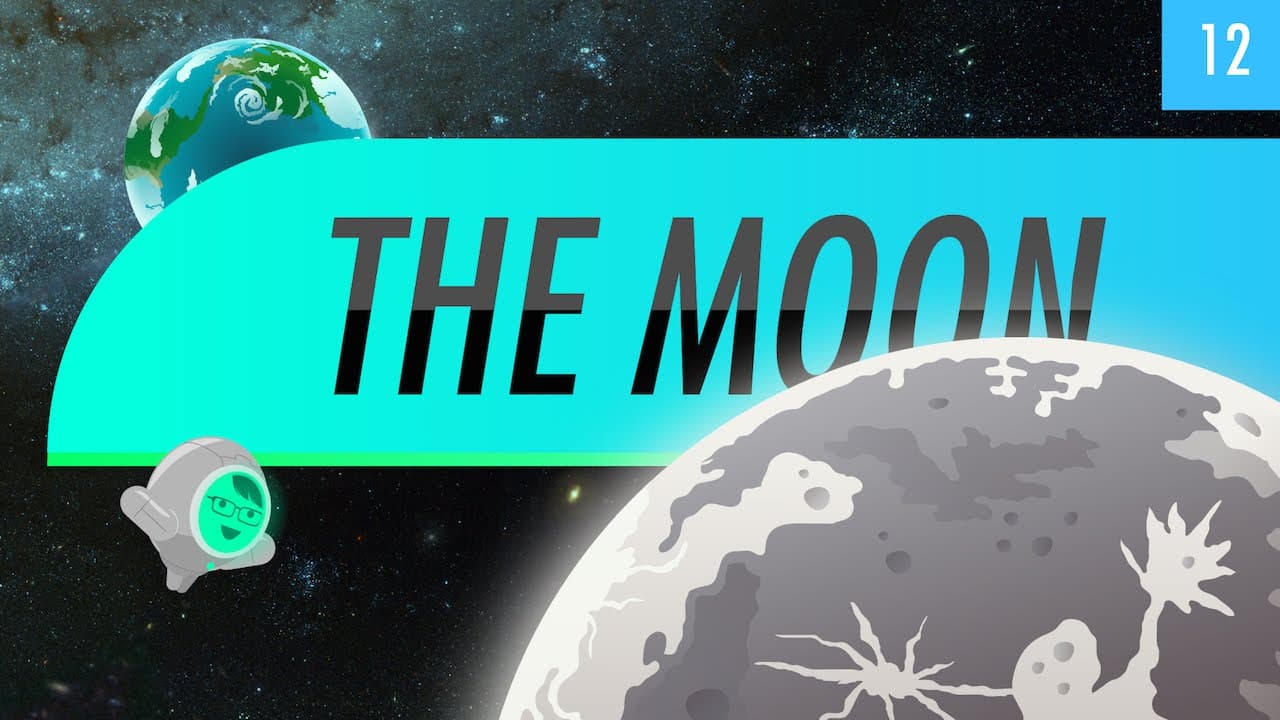
The video explores the Moon's features, formation, and future exploration.
Transcript
This episode of Crash Course is brought to you by Square Space. The Moon is pretty hard to miss when it’s up at night. It’s big and bright and really very pretty. Even cooler, it’s the closest astronomical object in the Universe to us, and arguably, the one we know best. I hate to break it to you, but we humans are pretty egotistical. Even though t... Read More
Key Insights
- The Moon is Earth's closest astronomical object and is the fifth largest moon in the solar system, with a unique size ratio compared to Earth.
- The Moon Illusion makes the Moon appear larger on the horizon due to our brain's perception of distance and size.
- The Moon's internal structure is similar to Earth's, with a solid iron core, liquid outer core, and a thick mantle.
- The Moon's surface features highlands and maria, with craters formed by asteroid impacts and maria from ancient lava flows.
- The Giant Impact hypothesis suggests the Moon formed from debris after a Mars-sized planet collided with Earth.
- The far side of the Moon has a thicker crust and fewer maria due to different cooling and impact histories.
- Water ice has been discovered in permanently shadowed craters near the Moon's poles, a potential resource for future colonization.
- Renewed interest in lunar exploration aims to return humans to the Moon, with several countries planning missions.
Install to Summarize YouTube Videos and Get Transcripts
Explore YouTube Video Summarizer or Get YouTube Transcript Extractor
Questions & Answers
Q: What is the Moon Illusion?
The Moon Illusion is a phenomenon where the Moon appears larger when it is on the horizon compared to when it is high in the sky. This is due to the way our brains perceive the sky as a flattened dome, making us think the horizon is farther away. As a result, the Moon seems larger when it is near the horizon, even though its actual size remains constant.
Q: How does the Moon's internal structure compare to Earth's?
The Moon's internal structure is similar to Earth's in several ways. It has a solid iron inner core, a liquid outer core, and a thick mantle. However, the Moon's core is smaller, with a radius of about 350 kilometers, and it is not as hot as Earth's core. Unlike Earth's mantle, the upper part of the Moon's mantle is solid, which affects its geological activity.
Q: What are the Moon's highlands and maria?
The Moon's surface is characterized by two main types of regions: highlands and maria. The highlands are heavily cratered areas formed by countless impacts from asteroids and comets over billions of years. The maria, Latin for 'seas,' are smoother, darker regions formed by ancient lava flows that flooded older impact craters. These features provide valuable insights into the Moon's geological history.
Q: What is the Giant Impact hypothesis?
The Giant Impact hypothesis suggests that the Moon formed from debris resulting from a colossal collision between a Mars-sized planet, named Theia, and the early Earth. This impact occurred about 50 million years after the solar system began to form. The collision ejected material from Earth's outer layers into space, which coalesced to form the Moon. This hypothesis explains the similarities and differences in composition between the Earth and the Moon.
Q: Why is the Moon's far side different from the near side?
The far side of the Moon is different from the near side due to its thicker crust and lack of maria. After the Moon formed, the near side was heated by Earth's proximity, causing material to vaporize and condense on the cooler far side, resulting in a thicker crust. Additionally, the thicker crust made it harder for lava to break through, leading to fewer maria compared to the near side.
Q: What role does water play in the Moon's future exploration?
Water on the Moon, particularly in the form of ice found in permanently shadowed craters near the poles, is a crucial resource for future exploration and potential colonization. Water is essential for sustaining human life and can also be used to produce hydrogen and oxygen for fuel. The presence of water reduces the need to transport it from Earth, making lunar missions more feasible and cost-effective.
Q: What are some features of the Moon's surface?
The Moon's surface is diverse and includes craters, maria, highlands, and various geological formations. Craters vary in size and complexity, with some featuring central peaks or forming crater chains. Maria are large, dark basaltic plains created by ancient volcanic activity. The surface also has long sinuous rilles, lava tubes, cliffs, mounds, and ancient volcanic structures, each revealing different aspects of the Moon's history.
Q: What is the significance of renewed interest in lunar exploration?
Renewed interest in lunar exploration signifies a new era of space exploration, driven by advances in technology and international collaboration. Countries like the United States, China, and India are planning missions to return humans to the Moon, aiming to establish a sustainable presence. This resurgence in lunar exploration could lead to scientific discoveries, resource utilization, and the potential for future human settlement on the Moon.
Summary & Key Takeaways
-
The Moon, Earth's closest celestial neighbor, has a unique size ratio compared to its planet, making it significant in our solar system. The Moon Illusion is a fascinating phenomenon causing the Moon to appear larger on the horizon, due to our brain's perception of distance and size.
-
The Moon's internal structure resembles Earth's, with a solid iron core, liquid outer core, and a thick mantle. Its surface features highlands and maria, with craters from asteroid impacts and maria formed from ancient lava flows, providing insight into its history.
-
The Giant Impact hypothesis explains the Moon's formation from debris after a Mars-sized planet collided with Earth. Recent discoveries of water ice in shadowed craters near the Moon's poles offer potential for future colonization, as interest in lunar exploration revives globally.
Read in Other Languages (beta)
Share This Summary 📚
Summarize YouTube Videos and Get Video Transcripts with 1-Click
Try YouTube Summary with ChatGPT & Claude or YouTube Transcript Generator
Explore More Summaries from CrashCourse 📚


Summarize YouTube Videos and Get Video Transcripts with 1-Click
Try YouTube Summary with ChatGPT & Claude or YouTube Transcript Generator