How to Convert Slope Intercept to Standard Form
TL;DR
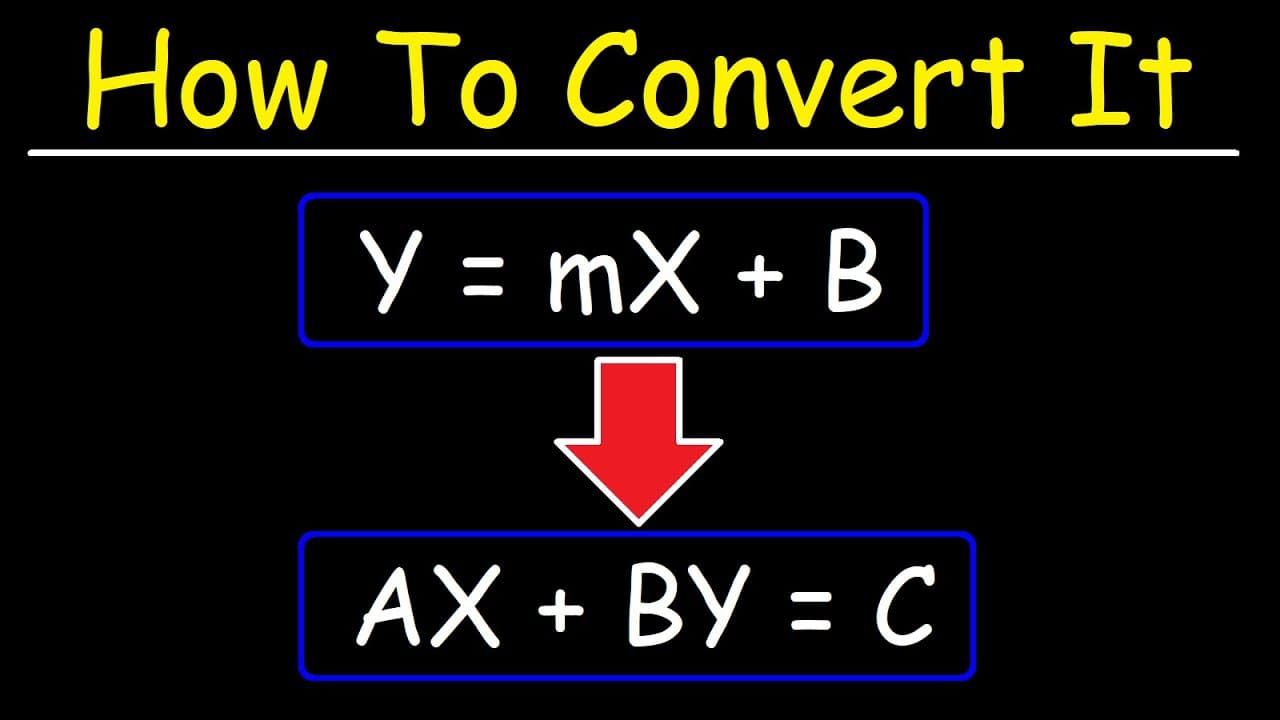
To convert a linear equation from slope intercept form (y = mx + b) to standard form (Ax + By = C), rearrange the equation by moving x and y terms to one side and the constant to the other. Change the signs of the terms being moved and, if fractions are present, multiply through by the common denominator to simplify.
Transcript
in this video we're going to talk about how to convert a linear equation from slope intercept form to standard form so we have this example Y is equal to three x minus 4. right now it's in standard form I mean it's in slope intercept form which is y equals MX plus b and we want to convert that to standard form which is ax plus b y is equal to C how... Read More
Key Insights
- 💁♂️ Converting from slope intercept form to standard form involves moving the x and y variables and changing signs.
- 🍉 Fractions in the equation can be eliminated by multiplying every term by the common denominator.
- ❣️ Standard form follows the convention of having the x term before the y term.
Install to Summarize YouTube Videos and Get Transcripts
Explore YouTube Video Summarizer or Get YouTube Transcript Extractor
Questions & Answers
Q: How do you convert a linear equation from slope intercept form to standard form?
To convert a linear equation from slope intercept form (y=mx+b) to standard form (ax+by=c), you need to move the x and y variables to the left side of the equation and keep the constant term on the right side. Changing the sign of the term when moving it from one side to the other is necessary.
Q: What is the process for converting equations with fractions to standard form?
When the equation contains fractions, you need to eliminate them by multiplying every term in the equation by the common denominator. This will simplify the equation and allow you to convert it to standard form.
Q: Which term should be written first in standard form, the x or the y term?
In standard form (ax+by=c), it is convention to write the x term before the y term. So, regardless of the order in the original equation, rearrange the terms in the converted equation to reflect this convention.
Q: Can you leave the final answer with a negative coefficient in standard form?
Yes, it is acceptable to leave the final answer in standard form with a negative coefficient. However, some teachers may prefer that the coefficient be positive. In that case, simply multiply all terms by -1 to change the signs and make the coefficient positive.
Summary & Key Takeaways
-
The process of converting a linear equation from slope intercept form to standard form involves moving the x and y variables to the left side of the equation and keeping the constant term on the right side.
-
To move a term from one side to the other, simply change its sign. For example, moving 3x from the right side to the left side would result in -3x on the left.
-
In cases where the equation includes fractions, multiply everything by the common denominator to eliminate the fractions and simplify the equation.
Read in Other Languages (beta)
Share This Summary 📚
Summarize YouTube Videos and Get Video Transcripts with 1-Click
Try YouTube Summary with ChatGPT & Claude or YouTube Transcript Generator
Explore More Summaries from The Organic Chemistry Tutor 📚
Summarize YouTube Videos and Get Video Transcripts with 1-Click
Try YouTube Summary with ChatGPT & Claude or YouTube Transcript Generator