How to Use Raoult's Law to Calculate Vapor Pressure
TL;DR
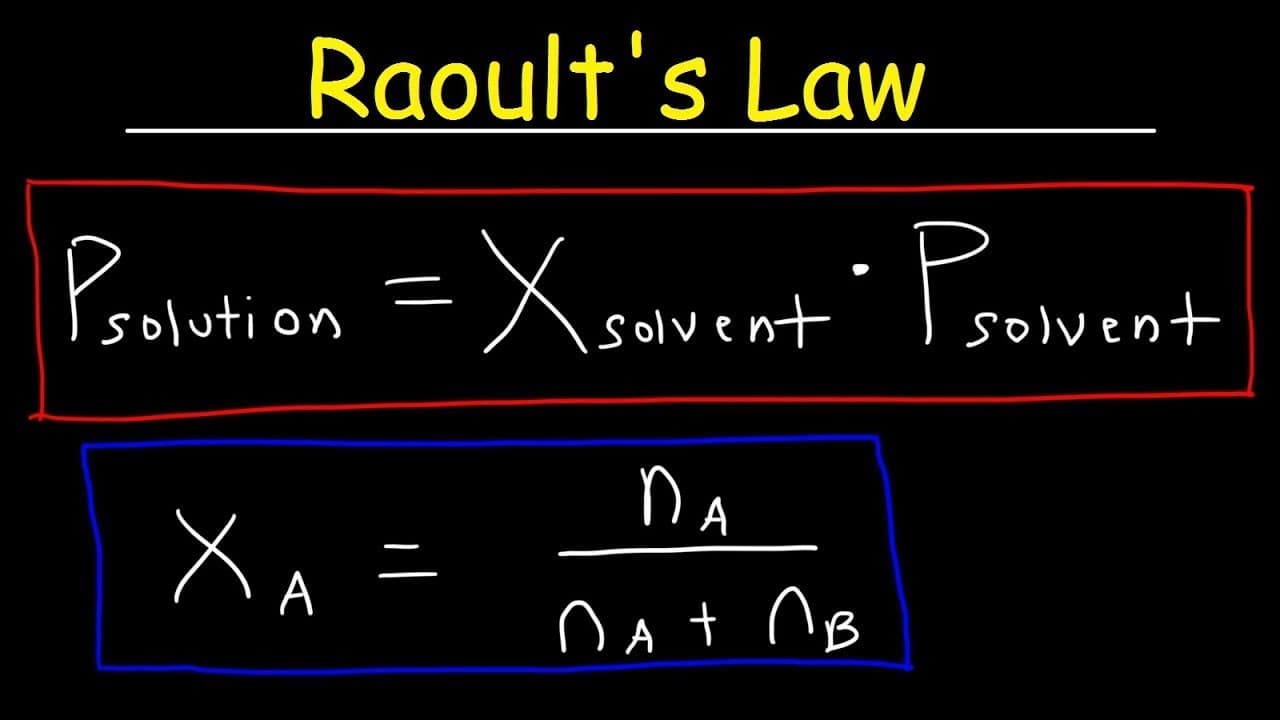
To calculate the vapor pressure of a solution using Raoult's Law, multiply the mole fraction of the solvent by its vapor pressure. Adding a non-volatile solute decreases the vapor pressure, while the total number of solute particles, especially in ionic compounds, influences the final vapor pressure. This method also allows for determining the mass of solute needed to achieve a specific vapor pressure.
Transcript
in this video we're going to talk about how to use raoult's law in order to calculate the vapor pressure of a solution so here is the equation that's associated with raoult's law the vapor pressure of the solution is the product of the mole fraction of the solvent multiplied by the vapor pressure of the solvent so raoult's law states that if you ad... Read More
Key Insights
- ❓ Raoult's Law relates the vapor pressure of a solution to the mole fraction of the solvent and the vapor pressure of the pure solvent.
- 🪜 Adding a non-volatile solute to a solvent decreases the vapor pressure of the solution.
- 🗂️ The mole fraction of the solvent can be calculated by dividing the moles of the solvent by the total moles in the solution.
- ✖️ The vapor pressure of the solution can be calculated by multiplying the mole fraction of the solvent by the vapor pressure of the pure solvent.
- 💼 The number of solute particles, rather than the identity of the solute, determines the vapor pressure of the solution in the case of ionic compounds.
- 💆 Raoult's Law can be used to calculate the mass of a solute required to achieve a desired vapor pressure in a solution.
- ✋ The vapor pressure of a solution is influenced by temperature, with higher temperatures leading to higher vapor pressures.
Install to Summarize YouTube Videos and Get Transcripts
Explore YouTube Video Summarizer or Get YouTube Transcript Extractor
Questions & Answers
Q: What is Raoult's Law?
Raoult's Law is a formula that describes the relationship between the vapor pressure of a solution and the mole fraction of the solvent. It states that the vapor pressure of the solution is equal to the mole fraction of the solvent multiplied by the vapor pressure of the solvent.
Q: How does adding a non-volatile solute affect the vapor pressure of a solution?
Adding a non-volatile solute to a solvent decreases the vapor pressure of the solution. This is because the presence of the solute disrupts the solute-solvent interactions, making it harder for solvent molecules to escape into the gas phase.
Q: How do you calculate the mole fraction of the solvent?
To calculate the mole fraction of the solvent, divide the moles of the solvent by the total moles in the solution, which is the moles of the solvent plus the moles of the solute.
Q: How can Raoult's Law be used to calculate the vapor pressure of a solution?
Once the mole fraction of the solvent is determined, it can be multiplied by the vapor pressure of the pure solvent to calculate the vapor pressure of the solution.
Summary & Key Takeaways
-
Raoult's Law states that the vapor pressure of a solution is the product of the mole fraction of the solvent and the vapor pressure of the solvent.
-
By calculating the moles of water and the moles of solute in a solution, the mole fraction of the solvent can be determined.
-
Using Raoult's Law, the vapor pressure of the solution can then be calculated.
Read in Other Languages (beta)
Share This Summary 📚
Summarize YouTube Videos and Get Video Transcripts with 1-Click
Try YouTube Summary with ChatGPT & Claude or YouTube Transcript Generator
Explore More Summaries from The Organic Chemistry Tutor 📚

Summarize YouTube Videos and Get Video Transcripts with 1-Click
Try YouTube Summary with ChatGPT & Claude or YouTube Transcript Generator