Electrolysis of Sodium Chloride - Electrochemistry
TL;DR
Electrolysis of a sodium chloride solution produces chlorine gas and hydrogen gas at the anode and cathode, respectively.
Transcript
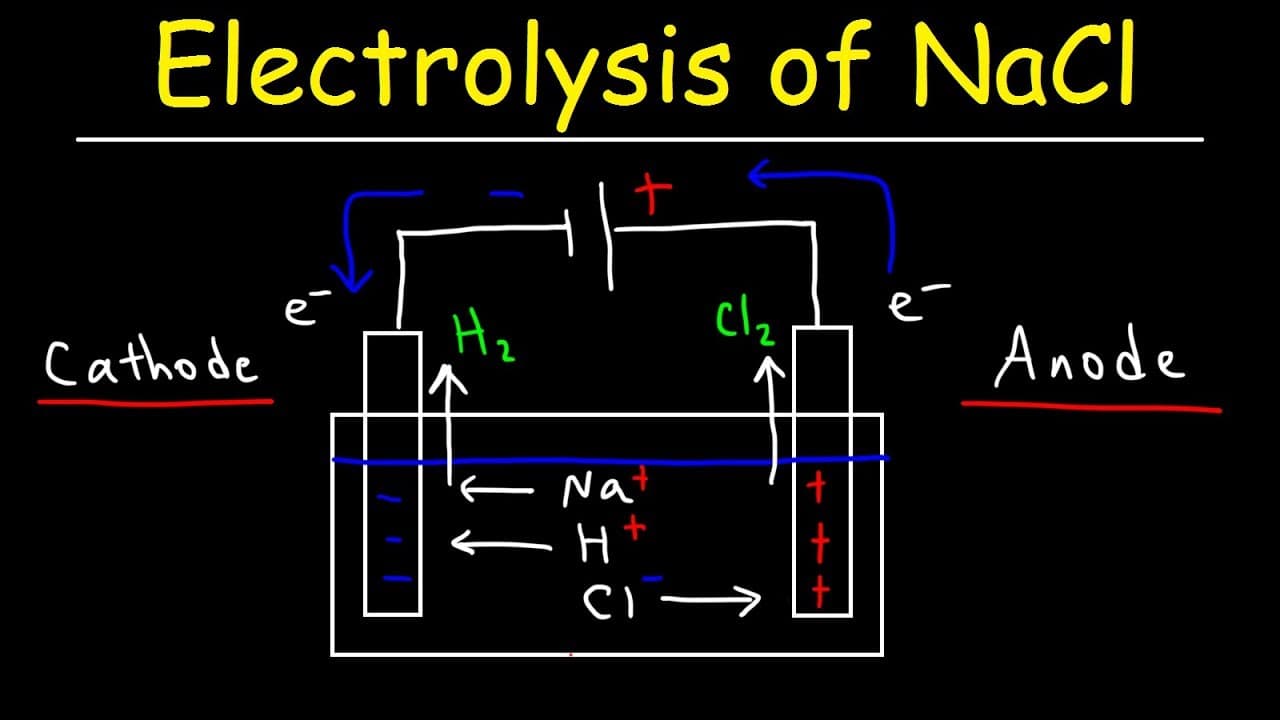
in this video we're going to talk about the electrolysis of an aqueous solution of sodium chloride so we're going to have two graphite electrodes you could also use platinum or some other inner electrodes and this is going to be the positive terminal of the battery and this is the negative terminal of the battery so in the solution we're going to h... Read More
Key Insights
- ❎ The anode is the positive electrode, and the cathode is the negative electrode in an electrolysis setup.
- 😑 Chloride ions flow towards the anode, while sodium and hydrogen ions flow towards the cathode.
- 🫢 The oxidation of chloride to chlorine gas is the principal reaction at the anode.
- 🫢 The reduction of hydrogen ions to hydrogen gas is the principal reaction at the cathode.
- 🫢 Under acidic conditions, water can also be oxidized at the anode to form oxygen gas.
- 🫢 In a basic solution, hydroxide ions can be oxidized to oxygen gas at the anode.
- 🫢 The net reaction in an aqueous sodium chloride solution is the conversion of hydrochloric acid to hydrogen gas and chlorine gas.
Install to Summarize YouTube Videos and Get Transcripts
Explore YouTube Video Summarizer or Get YouTube Transcript Extractor
Questions & Answers
Q: What are the anode and cathode in the electrolysis setup?
The anode is the graphite electrode attached to the positive terminal of the battery, and the cathode is the graphite electrode attached to the negative terminal.
Q: What reactions occur at the anode and cathode during electrolysis?
At the anode, chloride can be oxidized to chlorine gas, while at the cathode, hydrogen ions can be reduced to hydrogen gas.
Q: Why does chlorine gas form at the anode instead of water oxidation?
Chlorine gas forms because the oxidation potential of chloride is lower than that of water. The high cell potential for the oxidation of water makes it difficult to generate hydrogen peroxide, which is an intermediate in the reaction.
Q: How does the reaction change in a basic solution?
In a basic solution, chloride can still be oxidized to chlorine gas, but the oxidation of hydroxide ions to oxygen gas becomes more favorable at the anode. The reduction of water to hydrogen gas is easier at the cathode.
Summary & Key Takeaways
-
The electrolysis setup consists of two graphite electrodes in an aqueous solution of sodium chloride.
-
Cations like sodium and hydrogen ions flow towards the cathode, while anions like chloride flow towards the anode.
-
At the anode, chloride can be oxidized to chlorine gas, while at the cathode, hydrogen ions can be reduced to hydrogen gas.
Read in Other Languages (beta)
Share This Summary 📚
Summarize YouTube Videos and Get Video Transcripts with 1-Click
Try YouTube Summary with ChatGPT & Claude or YouTube Transcript Generator
Explore More Summaries from The Organic Chemistry Tutor 📚





Summarize YouTube Videos and Get Video Transcripts with 1-Click
Try YouTube Summary with ChatGPT & Claude or YouTube Transcript Generator