How Does a Venturi Meter Measure Fluid Speed?
TL;DR
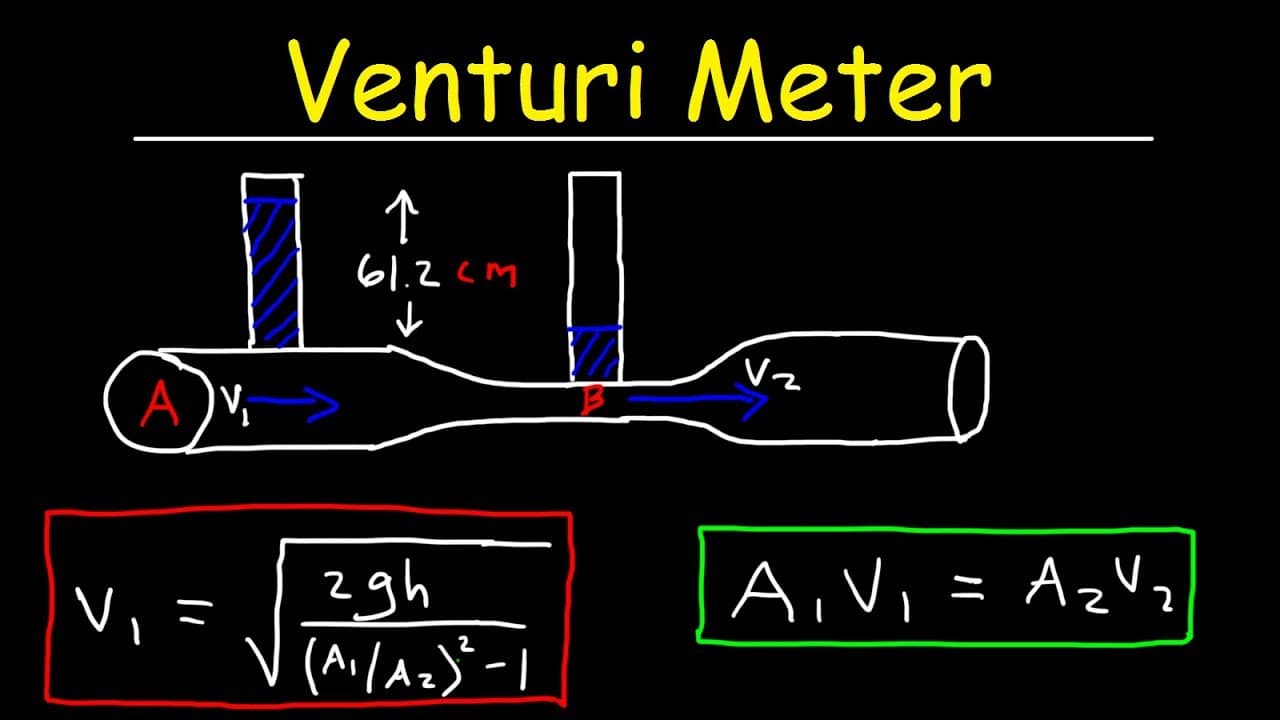
A Venturi meter measures fluid speed by using the principle that fluid velocity increases as the cross-sectional area decreases. The speed of the fluid at a given point can be calculated using the formula v1 = √(2gh / (A1/A2)² - 1), where 'g' is gravity, 'h' is the height difference, and 'A1' and 'A2' are the cross-sectional areas. This relationship shows that pressure decreases as fluid speed increases.
Transcript
in this video we're going to go over the venturi meter the venturi meter shown below is a device used to measure the speed of a fluid in a pipe the cross-sectional areas at points a and b are 10 square centimeters and 5 square centimeters so let's say a1 at point a that's 10 and a2 at point b is 5 square centimeters the height difference of the wat... Read More
Key Insights
- 🤒 The Venturi meter is a useful device for measuring fluid speed in pipes.
- 🐎 Bernoulli's equation and the equation of continuity are essential in deriving and calculating the fluid speed formulas.
- 🤒 The pressure difference between two points in the Venturi meter is proportional to the height difference of the fluid columns.
- 🐕🦺 The pressure decreases as the fluid speed increases, and vice versa, due to the conservation of energy in fluid flow.
Install to Summarize YouTube Videos and Get Transcripts
Explore YouTube Video Summarizer or Get YouTube Transcript Extractor
Questions & Answers
Q: How does the Venturi meter measure the speed of a fluid?
The Venturi meter measures the speed of a fluid by utilizing the principle of fluid dynamics, where the change in cross-sectional area affects the fluid's speed.
Q: How is Bernoulli's equation used to calculate the fluid speed at point A?
Bernoulli's equation relates the pressure, height, and velocity of a fluid. By manipulating the equation and using the equation of continuity, we can derive the formula for the fluid speed at point A.
Q: How can we calculate the fluid speed at point B?
Using the equation of continuity, which states that the volume flow rate at points A and B must be the same, we can calculate the fluid speed at point B by multiplying the area and velocity at point A and dividing it by the area at point B.
Q: What happens to the fluid speed when the pipe expands again at point C?
When the pipe expands again at point C, the fluid speed will decrease back to the same speed as at point A due to the conservation of volume flow rate.
Summary & Key Takeaways
-
The Venturi meter is a device used to measure the speed of a fluid in a pipe, with different cross-sectional areas at points A and B.
-
To calculate the speed of the water at point A, Bernoulli's equation is used to derive the formula.
-
The formula for the speed at point A is the square root of 2gh divided by (A1/A2)^2 - 1.
Read in Other Languages (beta)
Share This Summary 📚
Summarize YouTube Videos and Get Video Transcripts with 1-Click
Try YouTube Summary with ChatGPT & Claude or YouTube Transcript Generator
Explore More Summaries from The Organic Chemistry Tutor 📚



Summarize YouTube Videos and Get Video Transcripts with 1-Click
Try YouTube Summary with ChatGPT & Claude or YouTube Transcript Generator