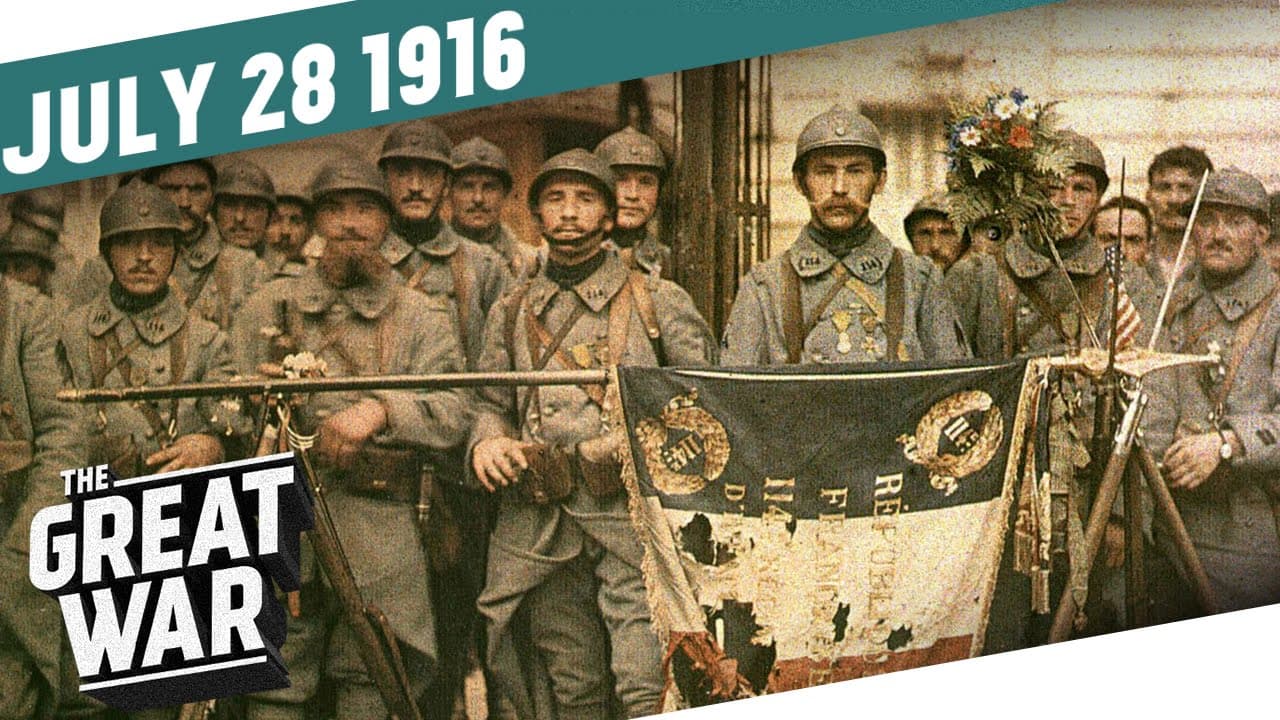
Happy Birthday World War 1 I THE GREAT WAR - Week 105
TL;DR
The video marks two years of World War 1 with major battles.
Transcript
Every episode I begin with some sort of a hook, like poison gas is first used, or Italy joins the war, or something like that. The one this week is painfully obvious. Here it is: The war is exactly two years old. I’m Indy Neidell; welcome to the Great War. Last week Australian troops launched a diversion at Fromelles to prevent German troops from h... Read More
Key Insights
- The video discusses the second anniversary of World War 1, highlighting the simultaneous occurrence of the three largest battles in history: Verdun, the Somme, and Brusilov Offensive.
- The Battle of the Somme faced challenges due to uncoordinated attack timings and poor weather, leading to initial failures but eventual success with heavy artillery support.
- On the Eastern Front, Russian forces continued their offensive, capturing Brody and causing the Austrian army to retreat, highlighting leadership issues within the Austro-Hungarian military.
- German commanders Hindenburg and Ludendorff began taking control of the Eastern Front, aiming to stop the Russian advance and bring stability to the Austro-Hungarian forces.
- The video emphasizes the resilience of the Serbian army, which remained intact and ready to fight despite multiple invasions and hardships.
- The Arab Revolt saw progress with the capture of Yanbo, a significant port, marking a strategic victory against the Ottoman Empire.
- The execution of Captain Charles Fryatt by German authorities is mentioned, highlighting the harsh wartime measures and the controversial nature of his court-martial.
- The episode reflects on the immense human cost of the war, with the ongoing battles resulting in millions of casualties, underscoring the devastating impact of the conflict.
Install to Summarize YouTube Videos and Get Transcripts
Explore YouTube Video Summarizer or Get YouTube Transcript Extractor
Questions & Answers
Q: What were the main challenges faced by the British forces at the Battle of the Somme?
The British forces at the Battle of the Somme faced several challenges, including uncoordinated attack timings due to various divisions starting their assaults at different times. This lack of synchronization alerted German forces and reduced the element of surprise. Additionally, poor weather conditions hindered artillery spotting, making it difficult to effectively target German positions, which were often on reverse slopes. These factors contributed to initial failures, although subsequent attacks with increased artillery support eventually led to some successes.
Q: How did the Russian forces achieve success on the Eastern Front during this period?
Russian forces achieved success on the Eastern Front through the Brusilov Offensive, which continued to push back the Austro-Hungarian army. The Russians captured Brody, taking 40,000 prisoners in just 12 days. The success was attributed not only to the Russians' strategic offensive but also to the shortcomings of the Austro-Hungarian troops, whose leadership was criticized for being out of touch with the front lines. This success forced the Austrians into retreat and led to significant changes in their command structure.
Q: What changes occurred in the Austro-Hungarian military leadership during this week?
During this week, the Austro-Hungarian military faced severe criticism for its leadership, which was seen as being too distant from the front lines and out of touch with the troops. As a result, there were calls to replace Chief of Staff Conrad von Hotzendorf. German commanders Hindenburg and Ludendorff took over a large section of the Austrian front, and German officers were integrated into Austrian units to improve performance. This shift aimed to stabilize the front and halt the Russian advance.
Q: What was the significance of the Arab Revolt's capture of Yanbo?
The capture of Yanbo by the Arab Revolt was significant as it marked a strategic victory against the Ottoman Empire. Yanbo, a crucial port, provided the Arab forces with an important logistical base, facilitating further operations in the region. This victory was part of a broader effort to weaken Ottoman control and support the Allied war effort by disrupting Ottoman supply lines and communications. The success of the Arab Revolt demonstrated the growing effectiveness of the Arab forces in the Middle Eastern theater.
Q: What was the outcome of the Battle of Baranovichi?
The Battle of Baranovichi ended in a humiliating defeat for the Russian forces. Despite having a significantly larger force of 400,000 men compared to the Germans' 66,000, the Russians suffered 80,000 casualties while the Germans incurred only 16,000. The battle highlighted the challenges faced by the Russian army, including poor coordination and leadership, which allowed the smaller German force to effectively defend their positions and inflict heavy losses on the Russians.
Q: What was the impact of Captain Charles Fryatt's execution?
Captain Charles Fryatt's execution by German authorities had a significant impact as it highlighted the harsh wartime measures and the controversial nature of his court-martial. Fryatt was accused of being a pirate for attempting to ram a German submarine that was attacking his ship. His execution was widely condemned as an act of injustice, sparking outrage in Britain and among Allied nations. It underscored the brutal realities of naval warfare and the severe consequences faced by those involved in maritime conflicts during the war.
Q: How did the Serbian army manage to remain intact and ready to fight?
The Serbian army's resilience is remarkable, given the multiple invasions and hardships it faced, including the winter death march through Albania. Despite these challenges, the Serbian forces managed to regroup and reconstitute in Salonika, where they joined the Allies. Their determination and ability to adapt to changing circumstances, along with support from Allied nations, allowed them to maintain their fighting capability and continue contributing to the war effort. This resilience was a testament to their commitment to the Allied cause.
Q: What was the significance of the three largest battles being fought simultaneously?
The simultaneous occurrence of the three largest battles in history—Verdun, the Somme, and the Brusilov Offensive—was significant as it represented the peak of World War 1's intensity and devastation. These battles involved millions of soldiers and resulted in massive casualties, highlighting the scale and brutality of the conflict. The simultaneous engagements stretched the resources and strategies of both the Central and Allied Powers, underscoring the global nature of the war and its profound impact on the course of history. The battles exemplified the war's apocalyptic nature, with a total casualty cost of four million men.
Summary & Key Takeaways
-
The video marks the second anniversary of World War 1, focusing on the simultaneous battles of Verdun, the Somme, and the Brusilov Offensive, which together resulted in millions of casualties. It highlights the challenges faced by the British at the Somme and the Russian successes against the Austrians.
-
Leadership issues within the Austro-Hungarian military are discussed, with German commanders taking control to stabilize the front. The resilience of the Serbian army is noted, as well as the strategic gains made by the Arab Revolt. The execution of Captain Fryatt is also mentioned.
-
The episode reflects on the war's immense human cost and the significant battles being fought, emphasizing the ongoing devastation and the historical significance of the conflict. The show's two-year anniversary is also celebrated, thanking supporters and viewers.
Read in Other Languages (beta)
Share This Summary 📚
Summarize YouTube Videos and Get Video Transcripts with 1-Click
Try YouTube Summary with ChatGPT & Claude or YouTube Transcript Generator
Explore More Summaries from The Great War 📚
Summarize YouTube Videos and Get Video Transcripts with 1-Click
Try YouTube Summary with ChatGPT & Claude or YouTube Transcript Generator