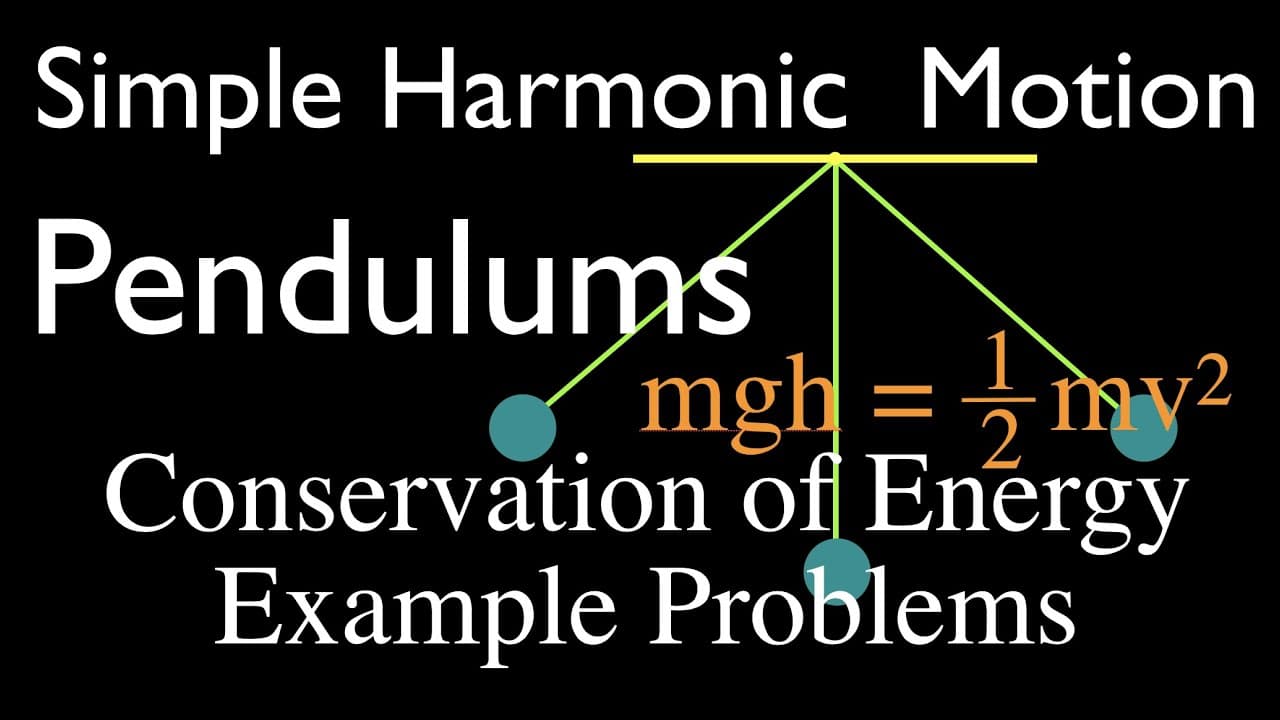
How to Solve Pendulum Problems Using Conservation of Energy
TL;DR
To solve pendulum problems using conservation of energy, calculate the kinetic and potential energy at different points. Maximum velocity can be found using the formula V = √(2gh), where h is the height change. Both period and frequency can be derived from the length of the pendulum and gravitational acceleration, illustrating the consistent total mechanical energy throughout its swing.
Transcript
so for today's video I think I'm gonna go over five different example problems for pendulums I'm gonna be using the conservation of energy kinetic and potential energy to solve these problems now please don't forget before you start to subscribe to my channel get all my excellent physics chemistry and math movie that's step-by-step science I've als... Read More
Key Insights
- ❓ Conservation of energy is fundamental in solving pendulum physics problems.
- ❓ The period and frequency of a pendulum are inversely related.
- 😥 Calculations involve determining kinetic and potential energy at various points in a pendulum's swing.
- ❓ Mass does not impact the velocity of a pendulum.
- ⏰ Pendulums have been historically used in timekeeping devices like grandfather clocks.
- 😥 Total mechanical energy remains constant at any point in a pendulum's swing.
- 😥 Kinetic and potential energy interchange at different points of a pendulum's motion.
Install to Summarize YouTube Videos and Get Transcripts
Explore YouTube Video Summarizer or Get YouTube Transcript Extractor
Questions & Answers
Q: How is conservation of energy used to solve pendulum problems?
Conservation of energy states that the total mechanical energy (kinetic + potential) of a pendulum remains constant throughout its swing, allowing for calculations of velocity and height.
Q: Why is the period of a pendulum inversely proportional to its frequency?
The period is the time to complete one full swing, while frequency is the number of swings in a given time. As period increases, frequency decreases, and vice versa.
Q: Can you explain how kinetic energy and potential energy are related in pendulum problems?
At certain points, like the maximum displacement or equilibrium position, kinetic energy is equal to potential energy, demonstrating the transfer between kinetic and potential energy in a pendulum's motion.
Q: Why is the mass of a pendulum not a factor in determining its velocity?
The mass cancels out when calculating velocity using conservation of energy, showing that a pendulum's mass does not affect its velocity.
Summary & Key Takeaways
-
Five different pendulum example problems are solved using conservation of energy.
-
Maximum velocity, period, and frequency calculations are demonstrated.
-
Each problem involves calculating kinetic and potential energy at different points of the pendulum's swing.
Read in Other Languages (beta)
Share This Summary 📚
Summarize YouTube Videos and Get Video Transcripts with 1-Click
Try YouTube Summary with ChatGPT & Claude or YouTube Transcript Generator
Explore More Summaries from Step by Step Science 📚
Summarize YouTube Videos and Get Video Transcripts with 1-Click
Try YouTube Summary with ChatGPT & Claude or YouTube Transcript Generator