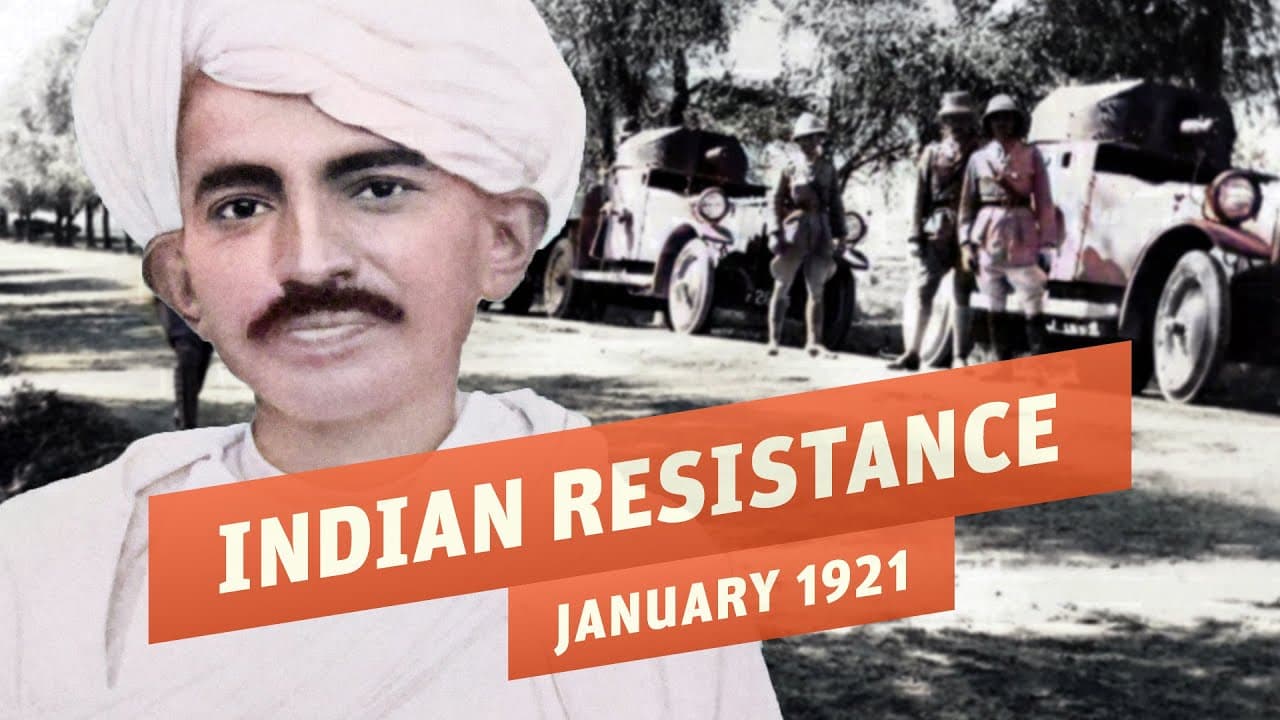
The Rise of Mahatma Gandhi (Documentary)
TL;DR
Gandhi's nonviolent movement challenged British rule post-WWI.
Transcript
hi I'm Jesse Alexander and welcome to the Great War India had been the so-called jewel in the crown of the British Empire since the 18th century but the years following the Great War saw British rule shaken and the Indian movement for Independence gained new strength in this episode we'll take a look at the dramatic events in India following the fi... Read More
Key Insights
- British rule in India faced increasing opposition post-WWI, with Indian nationalists demanding more autonomy and self-governance.
- The Montague-Chelmsford reforms introduced limited self-governance, but failed to meet Indian nationalist demands, leading to further unrest.
- Gandhi emerged as a key leader with his philosophy of nonviolent resistance, known as Satyagraha, which aimed to morally challenge British authority.
- The Amritsar Massacre in 1919 was a turning point, galvanizing Indian opposition and highlighting the brutality of British colonial rule.
- General Dyer's actions during the massacre were controversial, sparking debate in Britain and India about colonial policies and military conduct.
- Gandhi's approach differed from other Indian leaders by incorporating spiritual elements and appealing to both Hindu and Muslim communities.
- The British government's repressive measures, such as the Rowlatt Act, further fueled Indian discontent and resistance movements.
- Despite initial support for British war efforts, Indian nationalists became disillusioned with the lack of meaningful reforms and continued colonial control.
Install to Summarize YouTube Videos and Get Transcripts
Explore YouTube Video Summarizer or Get YouTube Transcript Extractor
Questions & Answers
Q: What was the impact of the Montague-Chelmsford reforms on Indian governance?
The Montague-Chelmsford reforms introduced a system of dyarchy, allowing limited Indian participation in government. However, the reforms were seen as insufficient by Indian nationalists, as they only applied to less important ministries and maintained British control over key areas like foreign affairs and finance. This led to increased dissatisfaction and calls for greater autonomy.
Q: How did Gandhi's approach differ from other Indian nationalist leaders?
Gandhi's approach was distinct in its emphasis on nonviolent resistance and spiritual elements, appealing to both Hindu and Muslim communities. Unlike some leaders who were westernized intellectuals, Gandhi rejected Western methods, adopting traditional dress and connecting political ideas to spiritual concepts. This helped him gain support among the rural poor and students, making the movement more inclusive.
Q: What was the significance of the Amritsar Massacre in the Indian independence movement?
The Amritsar Massacre was a turning point in the Indian independence movement, as it exposed the brutality of British colonial rule. The massacre galvanized Indian opposition, with many, including Gandhi, losing any remaining faith in British justice. It also sparked debates in Britain about the morality of colonial policies and the actions of General Dyer, who ordered the massacre.
Q: How did the British government respond to the Amritsar Massacre?
The British government's response to the Amritsar Massacre was controversial. The Hunter Report found General Dyer at fault but did not hold the British Indian government accountable. Dyer was retired early but faced no further punishment. This response failed to address Indian grievances and was seen as inadequate by Indian nationalists, further fueling the independence movement.
Q: What role did the Rowlatt Act play in the Indian independence movement?
The Rowlatt Act, introduced in 1919, granted the British government extensive powers to curb sedition, including detention without trial and media control. This act was perceived as a continuation of wartime restrictions and was widely opposed by Indians. It made nationalist activities illegal, further alienating the Indian population and strengthening the resolve of independence movements.
Q: How did Gandhi's nonviolent resistance strategy impact British colonial policies?
Gandhi's nonviolent resistance strategy, or Satyagraha, aimed to morally challenge British authority by accepting punishment without retaliation. This approach gained widespread support, making it difficult for the British to maintain control without resorting to force. Gandhi's strategy highlighted the ethical contradictions of British rule and increased international awareness of India's struggle for independence.
Q: What were the challenges faced by Gandhi's non-cooperation movement?
Gandhi's non-cooperation movement faced challenges such as internal divisions within the independence movement and outbreaks of violence that contradicted its nonviolent principles. Tensions between Hindu and Muslim communities and British calls for Gandhi's arrest also posed significant obstacles. Despite these challenges, the movement succeeded in raising awareness and support for Indian self-rule.
Q: How did World War I influence the Indian independence movement?
World War I significantly influenced the Indian independence movement by highlighting India's contributions to the British war effort and the lack of corresponding political concessions. The war strained British resources and exposed the contradictions of colonial rule, leading to increased demands for self-governance. The post-war period saw a rise in nationalist activities and the emergence of leaders like Gandhi advocating for independence.
Summary & Key Takeaways
-
Following WWI, Indian nationalists increased their demands for self-governance, challenging British colonial rule. The limited reforms offered by Britain failed to satisfy these demands, leading to growing unrest.
-
Gandhi's philosophy of nonviolent resistance, Satyagraha, became central to the Indian independence movement, drawing widespread support across different communities and emphasizing moral superiority over colonial authority.
-
The Amritsar Massacre in 1919 was a pivotal event that intensified Indian opposition to British rule, highlighting the oppressive nature of colonial policies and sparking debates about the legitimacy of British actions.
Read in Other Languages (beta)
Share This Summary 📚
Summarize YouTube Videos and Get Video Transcripts with 1-Click
Try YouTube Summary with ChatGPT & Claude or YouTube Transcript Generator
Explore More Summaries from The Great War 📚


Summarize YouTube Videos and Get Video Transcripts with 1-Click
Try YouTube Summary with ChatGPT & Claude or YouTube Transcript Generator