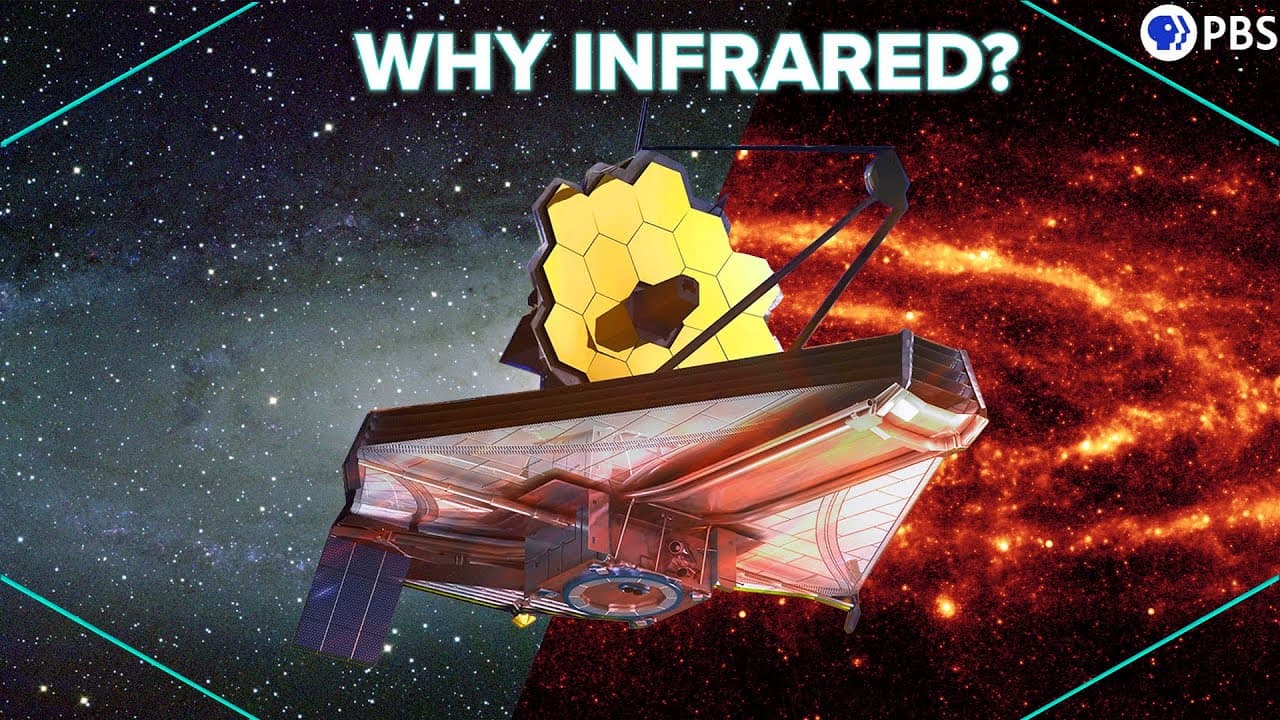
Science of the James Webb Telescope Explained!
TL;DR
Anyone can use the James Webb Telescope with the right proposal.
Transcript
We’d like to thank Henson Shaving for supporting PBS. You’ve probably heard about the James Webb Space Telescope and seen some cool pictures. But why should astronomers have all the fun? How do we get to use this new toy ourselves? The James Webb Space Telescope has now been in full operational science mode for several weeks now, and has seen some ... Read More
Key Insights
- The James Webb Space Telescope (JWST) is now fully operational and has already captured remarkable images, including those of colliding galaxies and exoplanet atmospheres.
- JWST is designed to observe the universe primarily in the infrared spectrum, allowing it to study the early universe and galaxies from different cosmic epochs.
- The telescope features a foldable 8-meter mirror, making it significantly larger and more sensitive than the Hubble Space Telescope.
- Anyone, regardless of their professional background, can propose a project to use the JWST through the General Observer (GO) program.
- Successful proposals require detailed planning, including precise observation targets and instrument settings, with a subsequent phase 2 proposal for execution details.
- JWST data is stored in the Mikulski Archive for Space Telescopes (MAST) and becomes publicly available after a 12-month proprietary period.
- Legacy programs maximize the scientific value of JWST data by making it immediately available to the scientific community and focusing on well-studied sky areas.
- The public can engage with JWST by downloading images and processing them, with resources available online to guide image processing techniques.
Install to Summarize YouTube Videos and Get Transcripts
Explore YouTube Video Summarizer or Get YouTube Transcript Extractor
Questions & Answers
Q: How can someone use the James Webb Space Telescope?
Anyone can use the James Webb Space Telescope (JWST) by submitting a proposal through the General Observer (GO) program. This proposal must detail the scientific objectives, observation targets, and specific instrument settings. If approved, NASA will execute the proposal, and the data will be provided to the proposer for analysis.
Q: What makes the James Webb Space Telescope unique compared to Hubble?
The James Webb Space Telescope (JWST) is unique due to its focus on infrared observations, which allows it to study the early universe and penetrate cosmic dust clouds. Its 8-meter foldable mirror is much larger than Hubble's, providing greater sensitivity to faint objects. JWST's advanced instruments enable detailed spectral analysis and multi-object observations.
Q: What are some key scientific goals of the JWST?
Key scientific goals of the James Webb Space Telescope (JWST) include studying the formation and evolution of galaxies over cosmic time, observing the atmospheres of exoplanets for signs of habitability, and exploring the early universe by capturing light from the first galaxies. Its infrared capabilities make it especially suited for these objectives.
Q: How does the data from JWST become available to the public?
Data from the James Webb Space Telescope (JWST) is initially proprietary to the proposal team for 12 months after collection. After this period, the data is made publicly available through the Mikulski Archive for Space Telescopes (MAST), allowing researchers worldwide to access and analyze it for further scientific discoveries.
Q: What are legacy programs in the context of JWST?
Legacy programs in the context of the James Webb Space Telescope (JWST) are large-scale projects designed to maximize the scientific value of the data for the entire community. These programs often focus on well-studied sky areas and make the data immediately available to researchers without a proprietary period, fostering wide-ranging scientific exploration.
Q: How can the public engage with JWST data?
The public can engage with James Webb Space Telescope (JWST) data by downloading images and processing them to create enhanced visual representations. Online resources and tutorials are available to guide individuals in processing JWST images, allowing enthusiasts to participate in the exploration and visualization of space phenomena.
Q: What challenges were faced during the development of JWST?
The development of the James Webb Space Telescope (JWST) faced numerous challenges, including technological hurdles, budgetary constraints, and political setbacks. The mission's cost consumed a significant portion of NASA's budget, leading to its temporary cancellation by Congress before being reinstated. Despite these challenges, the telescope was successfully launched after decades of planning.
Q: What are some examples of JWST's early achievements?
Early achievements of the James Webb Space Telescope (JWST) include capturing images of colliding galaxies, analyzing exoplanet atmospheres, and observing some of the earliest galaxies formed after the Big Bang. These observations have provided unprecedented insights into cosmic phenomena and the evolution of the universe, showcasing JWST's advanced capabilities.
Summary & Key Takeaways
-
The James Webb Space Telescope (JWST) is a powerful new tool for astronomers, designed to observe the universe in the infrared spectrum. It allows for the study of early galaxies and exoplanet atmospheres. The telescope's 8-meter mirror and advanced instruments make it significantly more sensitive than previous telescopes.
-
Anyone can propose to use the JWST through the General Observer program, which requires a detailed proposal outlining the scientific goals and observation plans. Successful proposals are executed by NASA, and the resulting data is initially proprietary before becoming publicly available.
-
JWST data is accessible through the Mikulski Archive for Space Telescopes, and legacy programs aim to maximize the scientific value of this data by making it broadly available. The public can also engage with JWST by processing its images, with tutorials available online to assist in this process.
Read in Other Languages (beta)
Share This Summary 📚
Summarize YouTube Videos and Get Video Transcripts with 1-Click
Try YouTube Summary with ChatGPT & Claude or YouTube Transcript Generator
Explore More Summaries from PBS Space Time 📚


Summarize YouTube Videos and Get Video Transcripts with 1-Click
Try YouTube Summary with ChatGPT & Claude or YouTube Transcript Generator