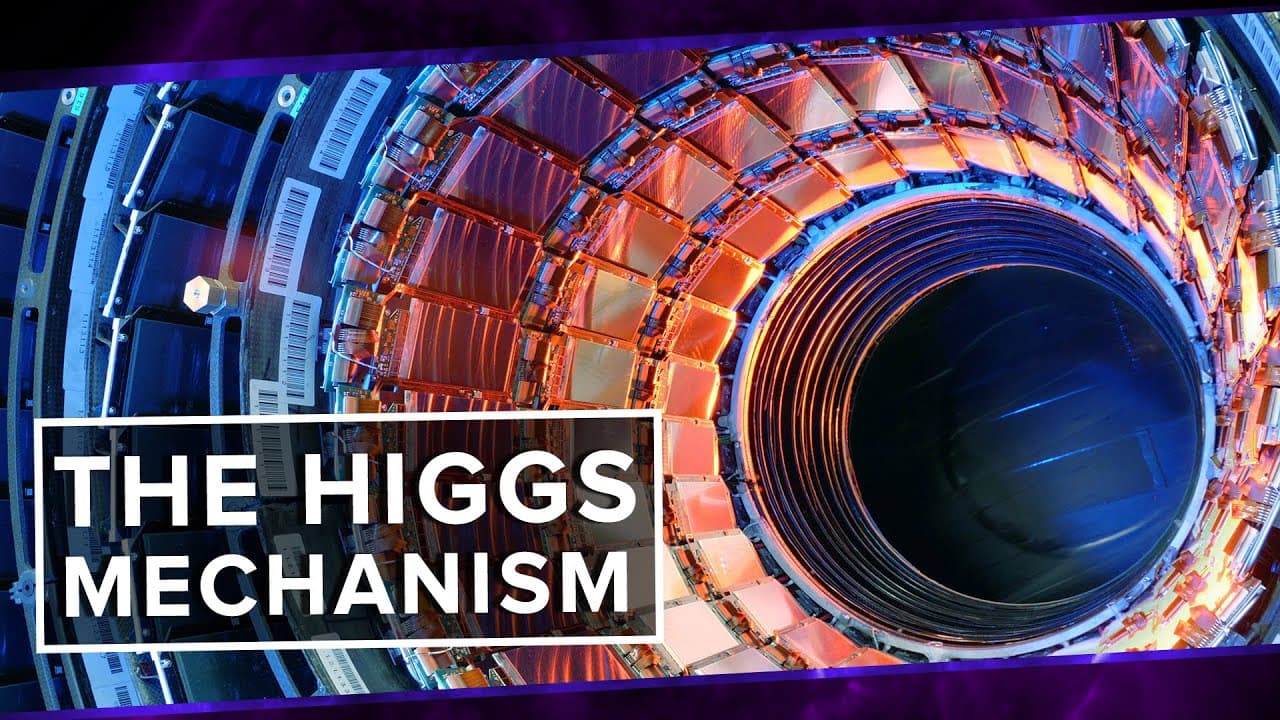
The Higgs Mechanism Explained | Space Time | PBS Digital Studios
TL;DR
The Higgs field gives particles mass, confirmed by 2012 discovery.
Transcript
In 2012, a new particle was discovered by the Large Hadron Collider. Physicists believe that the elusive Higgs boson has finally been found. But what's the big deal with this whole Higgs thing, anyway? [THEME MUSIC] We saw in a previous episode that most of the mass in your body, in fact, the mass of anything that's made of atoms, doesn't come fr... Read More
Key Insights
- The Higgs boson, discovered in 2012, confirms the existence of the Higgs field, which imparts mass to particles.
- Quantum Field Theory (QFT) describes particles as excitations in fields, but initially predicted them to be massless.
- Particles like electrons have mass due to interactions with the Higgs field, unlike massless photons.
- The Higgs field is unique because it has a positive strength throughout the universe, unlike other fields.
- Electrons experience mass because they constantly interact with the Higgs field, which transfers weak hyper-charge.
- The Higgs field solves the QFT's mass problem, making it an essential component of the universe.
- The Higgs boson is unstable, decaying quickly, making it challenging to study its properties.
- There is potential for the Higgs field to explain phenomena like dark energy and inflation.
Install to Summarize YouTube Videos and Get Transcripts
Explore YouTube Video Summarizer or Get YouTube Transcript Extractor
Questions & Answers
Q: What is the significance of the Higgs boson's discovery?
The discovery of the Higgs boson in 2012 was crucial because it confirmed the existence of the Higgs field, a fundamental component of the universe that imparts mass to particles. This discovery resolved a major gap in Quantum Field Theory, which initially predicted that particles should be massless.
Q: How does the Higgs field give particles mass?
The Higgs field gives particles mass through its interaction with them. Particles like electrons constantly interact with the Higgs field, which transfers weak hyper-charge, causing them to experience mass. This interaction prevents electrons from being massless like photons, which do not interact with the Higgs field.
Q: Why are photons massless while electrons have mass?
Photons are massless because they do not interact with the Higgs field, allowing them to travel at the speed of light without experiencing time. In contrast, electrons interact with the Higgs field, which transfers weak hyper-charge, giving them mass and causing them to experience time and evolve.
Q: What makes the Higgs field unique compared to other quantum fields?
The Higgs field is unique because, unlike other quantum fields that hover around zero in empty space, it has a positive strength throughout the universe. This constant presence allows it to interact with particles, giving them mass and making it a crucial component of the universe's structure.
Q: What challenges exist in studying the Higgs boson?
Studying the Higgs boson is challenging due to its instability and rapid decay, lasting only around 10 to the power of minus 22 seconds. This short lifespan makes it difficult to observe and analyze its properties, complicating efforts to understand the Higgs field's full implications.
Q: How does the Higgs field relate to Quantum Field Theory?
The Higgs field is integral to Quantum Field Theory (QFT) as it resolves the theory's initial prediction that particles are massless. By interacting with particles and providing them mass, the Higgs field completes QFT, making it a more accurate description of the subatomic universe.
Q: Could the Higgs field explain phenomena like dark energy?
There is potential for the Higgs field to explain phenomena such as dark energy and cosmic inflation. While its primary role is to give particles mass, its unique properties and constant presence throughout the universe suggest it might influence other cosmic phenomena, warranting further investigation.
Q: What role does weak hyper-charge play in the Higgs mechanism?
Weak hyper-charge is a key component in the Higgs mechanism, allowing particles like electrons to interact with the Higgs field and gain mass. This charge is transferred between the Higgs field and particles, facilitating the process that imparts mass and distinguishes massive particles from massless ones like photons.
Summary & Key Takeaways
-
The discovery of the Higgs boson in 2012 confirmed the existence of the Higgs field, which is crucial for giving particles mass. The Higgs field interacts with particles like electrons, allowing them to have mass, unlike photons. This field is a fundamental part of Quantum Field Theory.
-
Quantum Field Theory describes particles as excitations in fields, yet initially suggested they should be massless. The Higgs field, with its unique positive strength, provides a solution by interacting with particles like electrons, giving them mass through a process involving weak hyper-charge.
-
The Higgs boson is a vital component of understanding the universe's structure, despite its instability and rapid decay. Its discovery was a significant milestone in physics, with the Higgs field potentially explaining other cosmic phenomena such as dark energy and inflation.
Read in Other Languages (beta)
Share This Summary 📚
Summarize YouTube Videos and Get Video Transcripts with 1-Click
Try YouTube Summary with ChatGPT & Claude or YouTube Transcript Generator
Explore More Summaries from PBS Space Time 📚




Summarize YouTube Videos and Get Video Transcripts with 1-Click
Try YouTube Summary with ChatGPT & Claude or YouTube Transcript Generator