What Is GPT-1 and How Does It Work?
TL;DR
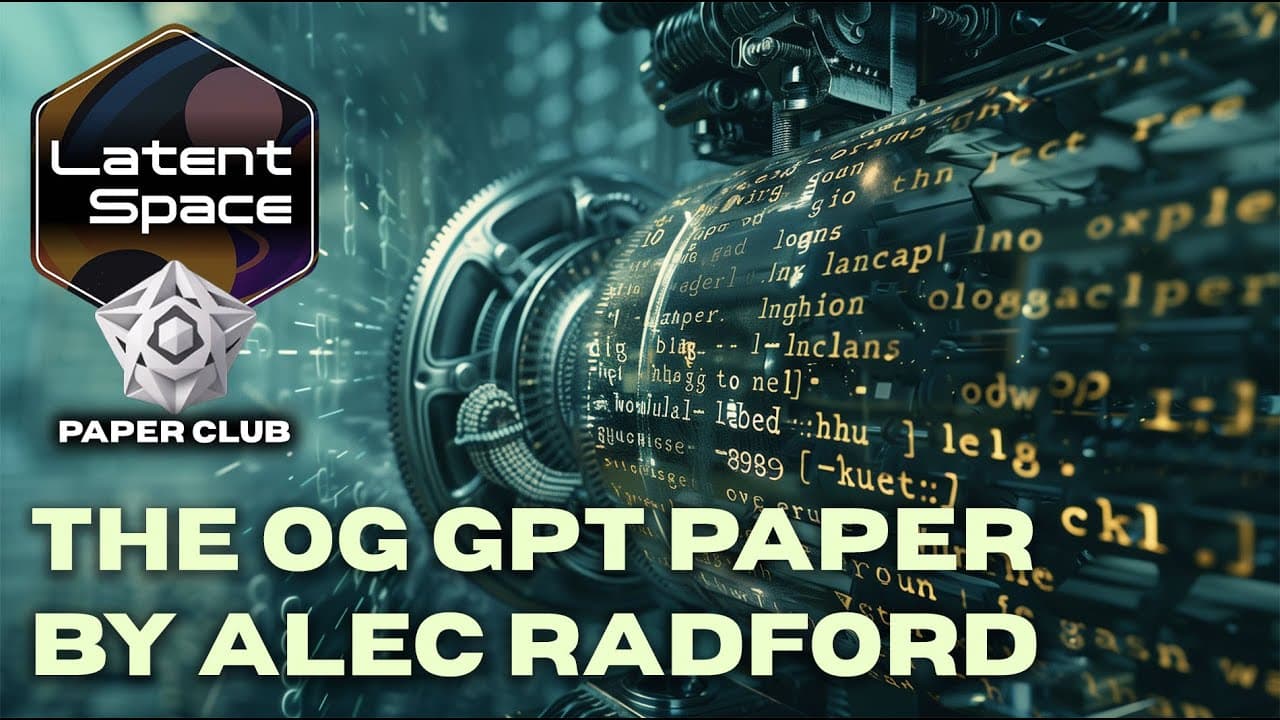
GPT-1 introduces a two-step method combining unsupervised pre-training and supervised fine-tuning to tackle natural language tasks. By leveraging large volumes of unlabeled text, it mitigates the need for extensive labeled datasets while using Transformers for effective representation learning. This approach establishes a strong foundation for model performance across various language tasks.
Transcript
okay sure so hey everyone uh my name is Amad I'm a engineer I generally do ml consulting services to startups I help them like ship AI uh Power Products especially in the field of NLB and speech to text applications and I run a a Blog where I like publish posts about ml stuff so feel free to check it out I've done some posts about whisper uh yeah s... Read More
Key Insights
- 🪡 Unsupervised learning mitigates the need for labeled data in deep learning.
- ❓ Transformers are effective for natural language understanding tasks.
- 😥 Pre-training provides a strong starting point for fine-tuning models.
- 🔑 Word embeddings capture semantic similarities between words.
- 🌥️ Longer context and larger training data enhance model performance.
- ❓ Fine-tuning on specific tasks improves overall model capabilities.
- 🥺 Scaling up in terms of model size and training time can lead to better results.
Install to Summarize YouTube Videos and Get Transcripts
Explore YouTube Video Summarizer or Get YouTube Transcript Extractor
Questions & Answers
Q: How does GPT1 address the issue of deep learning models requiring large amounts of annotated data?
GPT1 utilizes unsupervised learning through pre-training, which leverages linguistic information from unlabeled data, reducing the need for annotated data.
Q: What is the role of word embeddings in GPT1?
Word embeddings in GPT1 project words into an N-dimensional space, allowing for capturing semantic similarities between words based on their meanings. These embeddings are used as input features during fine-tuning.
Q: How does the two-step approach in GPT1 work?
The first step is unsupervised pre-training, where a language model is trained on a large corpus of text. The second step is supervised fine-tuning, where the pre-trained model is adapted to specific tasks using labeled data.
Q: What are the key insights from the GPT1 paper?
- Unsupervised learning through pre-training can alleviate the need for large amounts of labeled data.
- Transformers are a powerful architecture for natural language understanding tasks.
- The more layers transferred from pre-training to fine-tuning, the better the performance.
- Pre-training without fine-tuning performs significantly better than starting from scratch.
- Word embeddings play a crucial role in capturing semantic similarities between words.
- Long-range context and larger data sets improve the performance of deep learning models.
- GPT1 achieves state-of-the-art results on various natural language understanding tasks.
- Scaling up the model and training time can further improve performance.
Summary & Key Takeaways
-
Deep learning models require large amounts of annotated data for training, creating a bottleneck in the field.
-
Unsupervised learning, specifically unsupervised pre-training, allows leveraging linguistic information from unlabeled data, reducing the need for labeled data.
-
GPT1 utilizes this approach by pre-training a Transformer model on a large corpus of text and then fine-tuning it on specific tasks.
Read in Other Languages (beta)
Share This Summary 📚
Summarize YouTube Videos and Get Video Transcripts with 1-Click
Try YouTube Summary with ChatGPT & Claude or YouTube Transcript Generator
Explore More Summaries from Latent Space - The AI Engineer Podcast (Video Podcast) 📚



Summarize YouTube Videos and Get Video Transcripts with 1-Click
Try YouTube Summary with ChatGPT & Claude or YouTube Transcript Generator