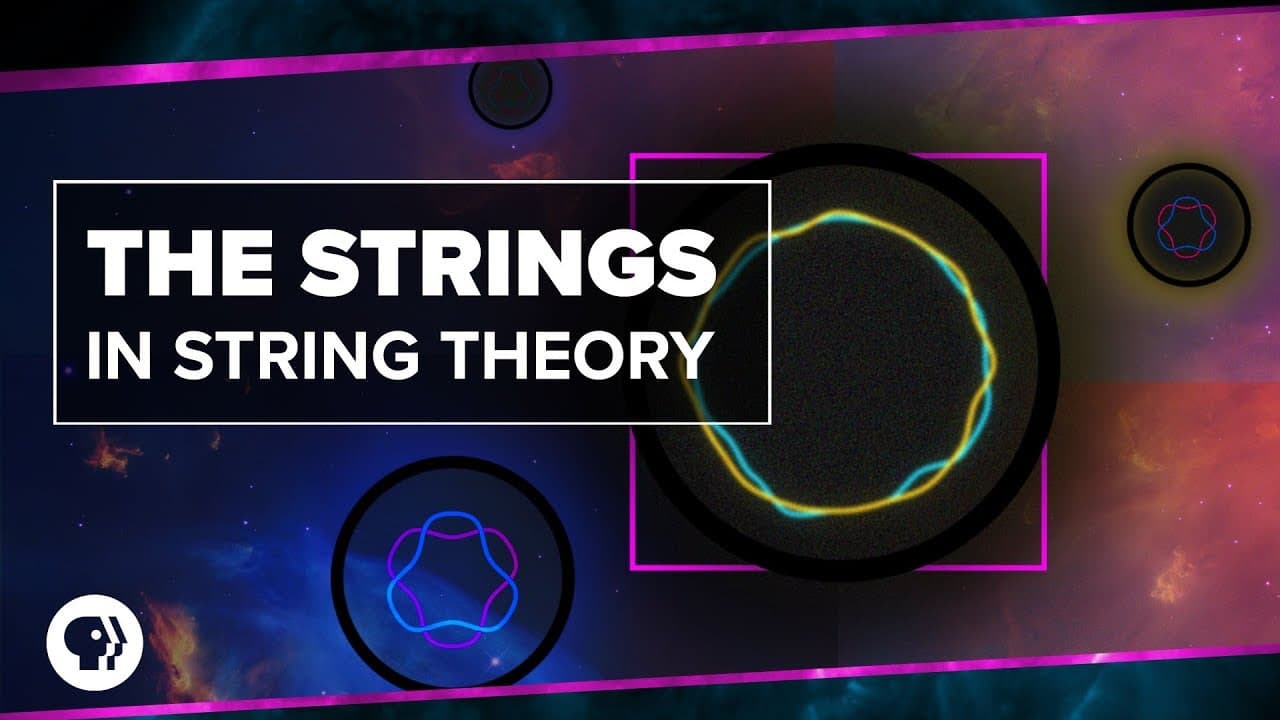
What are the Strings in String Theory?
TL;DR
String theory aims to unify forces with vibrating strings.
Transcript
Thank you to 23andme for supporting PBS Digital Studios You may have heard the usual pop sci description of string theory. There are these tiny vibrating strings and That's where all the forces particles including gravity in the entire universe come from This raises more questions than it answers Like why strings? What are they made of? And what's ... Read More
Key Insights
- String theory proposes that fundamental particles are tiny vibrating strings, potentially unifying all forces, including gravity, into a single framework.
- The theory originated in the 1960s to explain hadron behavior, suggesting quarks in mesons are connected by strings, but evolved to explore quantum gravity.
- String theory requires extra dimensions beyond the familiar four; initially 26 were proposed, but modern versions like M-theory suggest 11 dimensions.
- Strings can carry waves, and their vibrational modes define particle properties like mass, charge, and spin, potentially reducing the parameters needed in the standard model.
- The theory introduces the concept of supersymmetry, aiming to unify bosons and fermions, leading to the development of superstring theory.
- Despite its elegance, string theory has yet to produce confirmed predictions, facing challenges in matching its framework to our universe's observed properties.
- The theory suggests our universe could be a 3D brane in a higher-dimensional space, with strings vibrating in extra compact dimensions unseen by us.
- String theory's potential to solve quantum gravity issues, like avoiding infinities at the Planck scale, maintains interest despite its current predictive challenges.
Install to Summarize YouTube Videos and Get Transcripts
Explore YouTube Video Summarizer or Get YouTube Transcript Extractor
Questions & Answers
Q: What is the fundamental idea behind string theory?
String theory proposes that the fundamental constituents of the universe are one-dimensional 'strings' rather than point-like particles. These strings vibrate at specific frequencies, and these vibrations correspond to different particles. The theory aims to unify all fundamental forces, including gravity, into a single theoretical framework, potentially providing a 'theory of everything.'
Q: Why does string theory require extra dimensions?
String theory requires extra dimensions to be mathematically consistent. Initially, 26 dimensions were proposed, but modern versions like M-theory suggest 11 dimensions. These additional dimensions allow strings to vibrate in ways that produce the properties of known particles. The extra dimensions are compactified and not directly observable, which is why we perceive only three spatial dimensions and one time dimension.
Q: How does string theory aim to unify forces?
String theory unifies forces by proposing that all fundamental particles and forces are manifestations of vibrating strings. Different vibrational modes of these strings correspond to different particles, including force-carrying particles like photons and gravitons. By using a single framework for all particles, string theory seeks to unify electromagnetism, the weak and strong nuclear forces, and gravity.
Q: What challenges does string theory face?
String theory faces several challenges, including the lack of confirmed predictions and the difficulty of matching its framework to the observed properties of our universe. The theory's requirement for extra dimensions and its complex mathematical structure make it challenging to test experimentally. Additionally, the vast number of possible configurations for the extra dimensions complicates finding a model that accurately describes our universe.
Q: What is the significance of supersymmetry in string theory?
Supersymmetry is significant in string theory because it proposes a symmetry between bosons (force-carrying particles) and fermions (matter particles). This symmetry helps to unify these two classes of particles within the string theory framework. Supersymmetry also addresses certain theoretical issues, such as stabilizing the mass of the Higgs boson and potentially explaining dark matter.
Q: How does string theory address quantum gravity?
String theory addresses quantum gravity by proposing that the graviton, the hypothetical quantum particle of gravity, is a closed loop of string rather than a point particle. This loop structure helps avoid mathematical infinities that arise when trying to quantize gravity using point particles. String theory provides a framework where gravitational interactions can be described consistently at quantum scales.
Q: What are the implications of string theory for our understanding of the universe?
If string theory is correct, it implies a radically different understanding of the universe, where fundamental particles are not point-like but are one-dimensional strings. It suggests the existence of multiple dimensions beyond the four we experience, potentially leading to new insights into the nature of space-time and the unification of all forces. However, these implications remain speculative without experimental confirmation.
Q: What is the current status of string theory research?
Currently, string theory remains a leading candidate for a unified theory of fundamental forces, but it has not yet produced testable predictions or experimental confirmation. Researchers continue to explore its mathematical framework, seeking ways to connect it with observable phenomena. Despite its challenges, the theory's elegance and potential to solve major theoretical issues keep it a central topic in theoretical physics.
Summary & Key Takeaways
-
String theory describes fundamental particles as tiny vibrating strings, aiming to unify all forces, including gravity, into a single theoretical framework. It originated from efforts to understand hadron behavior in the 1960s and evolved into a theory of quantum gravity.
-
The theory requires extra dimensions beyond the familiar four, with modern versions like M-theory suggesting 11 dimensions. Vibrational modes of strings define particle properties, potentially reducing the number of parameters needed in the standard model.
-
Despite its promise, string theory faces challenges in producing confirmed predictions and matching its framework to our universe's observed properties. Its potential to solve quantum gravity issues maintains interest among physicists.
Read in Other Languages (beta)
Share This Summary 📚
Summarize YouTube Videos and Get Video Transcripts with 1-Click
Try YouTube Summary with ChatGPT & Claude or YouTube Transcript Generator
Explore More Summaries from PBS Space Time 📚




Summarize YouTube Videos and Get Video Transcripts with 1-Click
Try YouTube Summary with ChatGPT & Claude or YouTube Transcript Generator