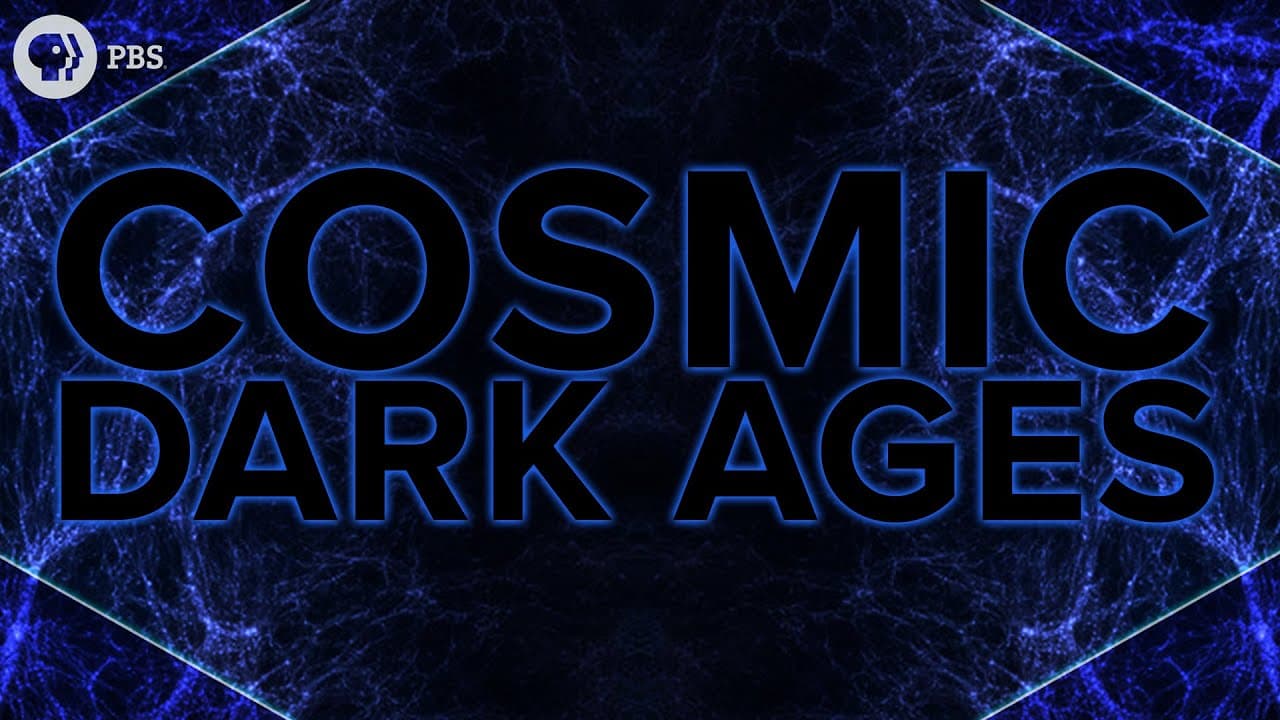
The Cosmic Dark Ages
TL;DR
Exploration of the universe's early dark ages and star formation.
Transcript
Thank you to ExpressVPN for supporting PBS. We live in the stelliferous era. Somewhere between 10 and 1000 billion trillion stars fill the observable universe with light. But there was a time before the first star ignited. A time we call the cosmic dark ages. In astronomy we study things that are very far away. It’s a powerful challenge because eve... Read More
Key Insights
- The cosmic dark ages occurred between the formation of the first atoms and the first stars, lasting about 100 million years.
- Recombination marked the universe's transition to transparency, allowing us to observe the cosmic microwave background.
- The first stars formed around 150 million years after recombination, initiating the epoch of reionization.
- Massive first-generation stars contributed to reionization and produced the universe's first heavy elements.
- Supermassive black holes and quasars formed from the remnants of these early massive stars.
- The Gunn-Peterson trough in quasar spectra provides evidence of the universe's reionization phase.
- 21cm radio waves from hydrogen atoms offer insights into the dark ages, with future telescopes set to explore this further.
- The current stelliferous era is likely the only habitable epoch in the universe's history.
Install to Summarize YouTube Videos and Get Transcripts
Explore YouTube Video Summarizer or Get YouTube Transcript Extractor
Questions & Answers
Q: What were the cosmic dark ages?
The cosmic dark ages were a period in the universe's history between the formation of the first atoms and the first stars, lasting about 100 million years. During this time, there were no light sources, making it a challenging era to study. It ended with the formation of the first stars, which initiated the epoch of reionization.
Q: What is recombination and why is it significant?
Recombination refers to the event when the universe cooled enough for electrons to combine with protons, forming neutral hydrogen atoms. This made the universe transparent for the first time, allowing light to travel freely. It is significant because it allowed us to observe the cosmic microwave background, offering a glimpse into the universe's early conditions.
Q: How did the first stars contribute to reionization?
The first stars, formed around 150 million years after recombination, were massive and emitted intense ultraviolet radiation. This radiation ionized the surrounding hydrogen gas, stripping atoms of their electrons and contributing to the epoch of reionization. These stars also produced the universe's first heavy elements through their life cycles and supernova explosions.
Q: What role did supermassive black holes and quasars play in the early universe?
Supermassive black holes formed from the remnants of the first massive stars, growing by merging and accreting gas. Quasars, powered by these black holes, emitted immense light, outshining entire galaxies. Their light provides valuable information about the universe's reionization phase, as it interacted with the surrounding neutral hydrogen, creating observable absorption features.
Q: What is the Gunn-Peterson trough and its significance?
The Gunn-Peterson trough is an absorption feature in quasar spectra, indicating the presence of neutral hydrogen in the early universe. It signifies the epoch of reionization when the universe transitioned from being mostly neutral to ionized. The trough's width helps determine when the universe became fully ionized, providing insights into the reionization process.
Q: How do 21cm radio waves help study the cosmic dark ages?
21cm radio waves are emitted or absorbed by neutral hydrogen atoms when their electrons change spin states. These waves are crucial for studying the cosmic dark ages because they can provide information about the distribution and density of hydrogen during this era. Future radio telescopes aim to detect these signals, offering a deeper understanding of the universe's early stages.
Q: Why is the current stelliferous era considered unique?
The current stelliferous era is marked by the presence of stars and galaxies that fill the universe with light, making it potentially the only habitable epoch in the universe's history. The formation of stars and the subsequent creation of heavy elements have made life possible, distinguishing this era from the dark ages and other cosmic phases.
Q: What challenges do scientists face in studying the cosmic dark ages?
Studying the cosmic dark ages is challenging due to the lack of light sources and the vast distances involved. The era is difficult to observe directly, requiring scientists to rely on indirect evidence, such as the cosmic microwave background and absorption features in quasar spectra. Future advancements in radio telescopes may provide more direct insights into this enigmatic period.
Summary & Key Takeaways
-
The cosmic dark ages were a period of darkness in the universe, occurring between the formation of the first atoms and the first stars. This era was characterized by a lack of light sources and is difficult to study due to its remote nature.
-
Recombination marked the universe's transition to transparency, allowing us to see the cosmic microwave background. First-generation stars formed around 150 million years later, initiating reionization and producing the first heavy elements.
-
The formation of supermassive black holes and quasars from early massive stars provides insight into the universe's evolution. These phenomena, along with radio waves, help us understand the dark ages and the epoch of reionization.
Read in Other Languages (beta)
Share This Summary 📚
Summarize YouTube Videos and Get Video Transcripts with 1-Click
Try YouTube Summary with ChatGPT & Claude or YouTube Transcript Generator
Explore More Summaries from PBS Space Time 📚

Summarize YouTube Videos and Get Video Transcripts with 1-Click
Try YouTube Summary with ChatGPT & Claude or YouTube Transcript Generator