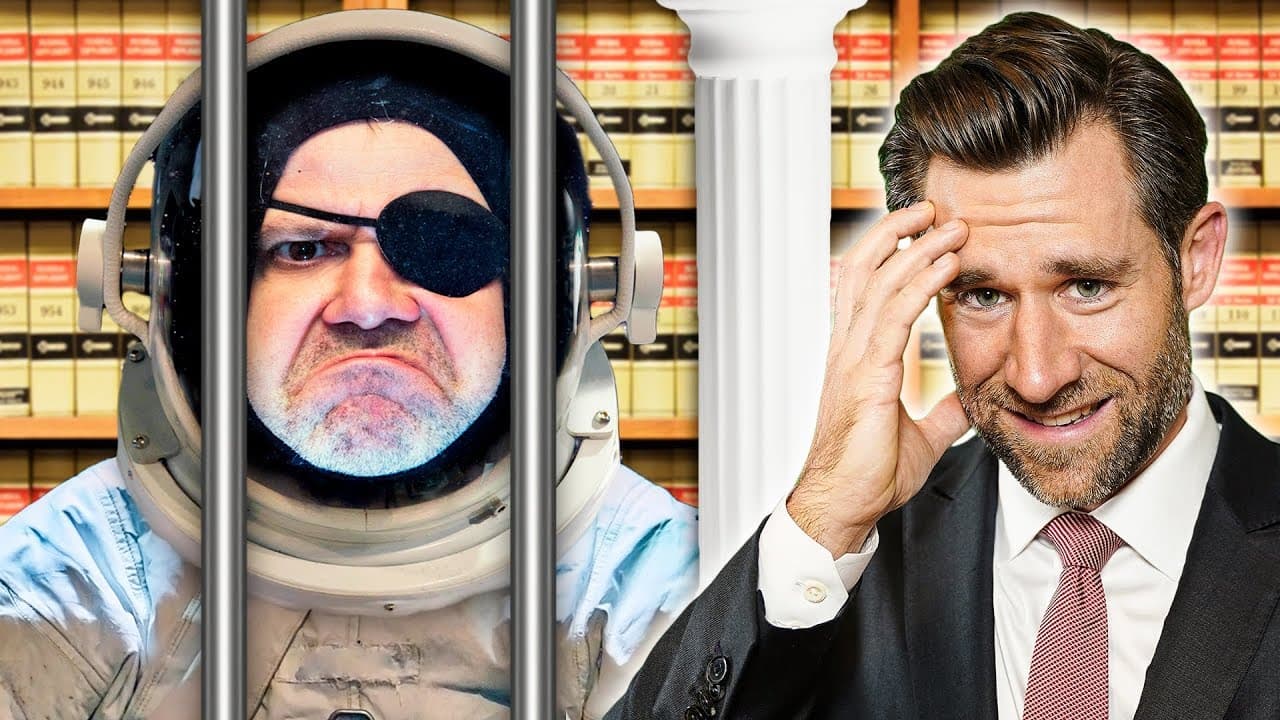
The World's First Space Crime? IN SPACE! (Real Law Review)
TL;DR
Space crime allegations between astronauts raise jurisdiction questions and highlight the complexities of enforcing laws in outer space.
Transcript
- Thanks to Indochino for keeping Legal Eagle in the air and helping me look fly. Humans have been jetting off into space since April 12th, 1961, when Russian lieutenant Yuri Gagarin became the first human to orbit the Earth. Alan Shepard became the first American to enter space less than a month later. Yes, that's right, the Russians beat us to sp... Read More
Key Insights
- 👾 Human space travel history dates back to 1961, with challenges like weightlessness and unique environmental concerns.
- 👾 The Outer Space Treaty of 1967 established foundational principles for international space law, promoting peaceful exploration and cooperation.
- 👾 Jurisdictional issues in space, especially on the International Space Station, highlight the need for clear regulations and enforcement mechanisms.
- 👾 Space crimes present complex legal challenges, requiring specialized investigations and considerations of jurisdiction.
- 👾 Analogies to laws governing Antarctica and international waters offer insights into potential approaches to addressing crimes in space.
- 👾 The need for evolving space law with the rise of space tourism underscores the importance of adapting legal frameworks to new technological advancements.
- 👾 Current legal frameworks, like Title 51 of the US code, offer guidelines for space exploration but lack specific provisions for criminal acts.
Install to Summarize YouTube Videos and Get Transcripts
Explore YouTube Video Summarizer or Get YouTube Transcript Extractor
Questions & Answers
Q: What is the history of space law and how have international treaties shaped it?
The Outer Space Treaty of 1967 established key principles for space exploration and use, emphasizing international cooperation and the peaceful use of outer space.
Q: How does jurisdiction work in space, especially on the International Space Station?
The participating nations in the International Space Station have agreed on criminal jurisdiction, enabling each nation to handle criminal activities by their own nationals on the ISS.
Q: What legal challenges arise when a crime is committed in space, and how do current laws address them?
Space law faces uncertainties in addressing crimes in space, drawing parallels to laws governing Antarctica and international waters to navigate jurisdictional issues.
Q: How are space crimes investigated and prosecuted, and what challenges do they present?
Investigations into space crimes, like the recent case involving Anne McClain, require specialized expertise and raise questions about the application of existing laws in space.
Summary & Key Takeaways
-
Human space travel has a rich history dating back to 1961, with weightless environments and unique challenges.
-
The first case of space crime involves astronaut Anne McClain accused of identity theft onboard the International Space Station.
-
The complexities of enforcing laws in space highlight the need for clear jurisdiction and regulations.
Read in Other Languages (beta)
Share This Summary 📚
Summarize YouTube Videos and Get Video Transcripts with 1-Click
Try YouTube Summary with ChatGPT & Claude or YouTube Transcript Generator
Explore More Summaries from LegalEagle 📚






Summarize YouTube Videos and Get Video Transcripts with 1-Click
Try YouTube Summary with ChatGPT & Claude or YouTube Transcript Generator