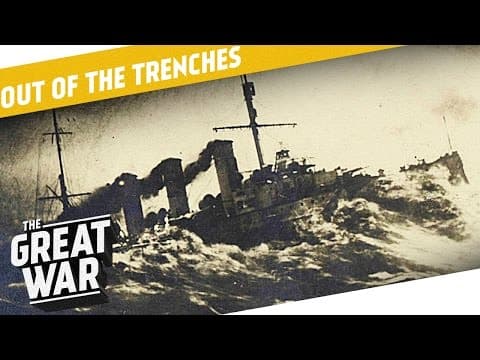
Anti Submarine Warfare and Tactics in World War 1 I THE GREAT WAR Special

TL;DR
Convoys proved most effective against German U-Boats in WWI.
Transcript
100 years ago, on February 1st, 1917, Germany reintroduced unrestricted submarine warfare, where any ship within the maritime war zones from any nation, could, and would be sunk without warning. This caused a crisis in Britain and France, for how does one defend against a plague of U-boats? That's what we'll talk about, today. ♪ 'The Great War' the... Read More
Key Insights
- Germany's reintroduction of unrestricted submarine warfare in 1917 created a crisis for Britain and France, leading to various defensive strategies against U-Boats.
- The British initially underestimated submarines, believing they were only effective for coastal defense until German subs sank three British cruisers in 1914.
- The 'Q-Ship' program aimed to lure and attack submarines but was ultimately deemed ineffective due to high losses and insufficient results.
- Alternative methods like mines, steel nets, and submarine escorts were employed but had limited success in blocking German subs from reaching the Atlantic.
- The introduction of Felixstowe F.2 Flying Boats provided aerial reconnaissance, though they faced challenges like poor weather and limited bomb effectiveness.
- British airships, known as 'Balloonatics,' were used to spot and deter U-Boats, despite their slow speed and uncomfortable flying conditions.
- Depth charges became a crucial anti-submarine weapon, with their production and deployment increasing significantly by the end of the war.
- Convoy systems, initially resisted by the British Admiralty, proved highly effective in reducing naval losses and countering the U-Boat threat.
Install to Summarize YouTube Videos and Get Transcripts
Explore YouTube Video Summarizer or Get YouTube Transcript Extractor
Questions & Answers
Q: What was the 'Q-Ship' program and why was it implemented?
The 'Q-Ship' program involved using disguised merchant ships armed to lure German submarines into surfacing and then attacking them. Implemented by the British during WWI, it aimed to counter the U-Boat threat by exploiting the subs' tendency to conserve torpedoes and engage with surface weapons. However, the program was ultimately deemed ineffective due to high losses and insufficient success in sinking submarines.
Q: How did the Felixstowe F.2 Flying Boats contribute to anti-submarine efforts?
The Felixstowe F.2 Flying Boats played a crucial role in anti-submarine warfare by providing aerial reconnaissance over the seas. They had a wider and clearer view compared to surface ships and were equipped with bombs designed to force submarines to surface. Despite challenges such as poor weather and limited bomb effectiveness, these flying boats were instrumental in locating U-Boats and coordinating attacks with destroyers.
Q: What were the challenges faced by British airships in anti-submarine operations?
British airships, or 'Balloonatics,' faced several challenges in anti-submarine operations. Their slow speed and open-air cockpits made flying conditions uncomfortable and cold. Despite carrying bombs and machine guns, their primary role was reconnaissance, spotting potential threats and deterring U-Boats from surfacing. The airships' limited range and vulnerability to weather conditions made their missions difficult, yet they were valuable in enforcing naval blockades.
Q: Why were depth charges significant in anti-submarine warfare?
Depth charges became a significant weapon in anti-submarine warfare due to their ability to cause damage through hydraulic shock. Unlike direct hits, they didn't need to make contact to be effective, as the shock could damage or force submarines to surface. Although initially produced in limited quantities, their effectiveness led to increased production, with anti-sub ships carrying dozens by 1918, significantly enhancing the Allies' ability to counter U-Boats.
Q: What led to the adoption of convoy systems in WWI?
The adoption of convoy systems in WWI was driven by the need to reduce shipping losses from German U-Boat attacks. Despite initial resistance from the British Admiralty, who believed convoys would create larger targets, the massive losses in April 1917 forced a reconsideration. Convoys proved effective as they allowed ships to travel in groups with coordinated defenses, drastically reducing the success rate of U-Boat attacks and maintaining vital supply lines.
Q: How did the convoy system impact German U-Boat strategy?
The convoy system significantly impacted German U-Boat strategy by reducing the effectiveness of their attacks. As ships traveled in groups with coordinated defenses, U-Boats found it more challenging to target and sink vessels. The system's success forced Germany to shift focus to the Mediterranean, but they never again reached their target of sinking 600,000 tons of shipping per month, undermining their strategy to starve Britain into submission.
Q: What role did aerial reconnaissance play in anti-submarine warfare?
Aerial reconnaissance played a pivotal role in anti-submarine warfare by providing a broader view of the sea, allowing for early detection of U-Boats. Aircraft like the Felixstowe F.2 Flying Boats and airships helped locate submarines and coordinate attacks with naval forces. Despite challenges such as poor weather and limited range, aerial reconnaissance was crucial in tracking enemy movements and enhancing the effectiveness of other anti-submarine measures.
Q: What were the long-term effects of unrestricted submarine warfare on WWI?
Unrestricted submarine warfare had significant long-term effects on WWI. It heightened tensions with neutral nations, particularly the United States, leading to their eventual entry into the war. The aggressive U-Boat campaign aimed at starving Britain ultimately failed due to effective countermeasures like convoys. The strategy's failure to achieve its goals and the diplomatic repercussions contributed to the eventual defeat of the Central Powers.
Summary & Key Takeaways
-
The episode discusses how Germany's unrestricted submarine warfare in 1917 posed a significant threat to Allied shipping, prompting various defensive measures. These included 'Q-Ships,' mines, and air reconnaissance, though the most successful strategy was the implementation of convoy systems.
-
British and Allied forces initially struggled to counter the U-Boat threat, trying methods like steel nets and submarine escorts. However, the introduction of Felixstowe F.2 Flying Boats and depth charges marked significant advancements in anti-submarine warfare.
-
Despite initial resistance, the British Admiralty eventually adopted convoy systems, which drastically reduced shipping losses and hindered Germany's strategy to starve Britain out of the war. This shift in tactics played a critical role in maintaining supply lines and countering the U-Boat menace.
Read in Other Languages (beta)
Share This Summary 📚
Summarize YouTube Videos and Get Video Transcripts with 1-Click
Try YouTube Summary with ChatGPT & Claude or YouTube Transcript Generator
Explore More Summaries from The Great War 📚





Summarize YouTube Videos and Get Video Transcripts with 1-Click
Try YouTube Summary with ChatGPT & Claude or YouTube Transcript Generator