How To Identify The Number of Lone Pairs on an Atom Using Formal Charge
TL;DR
Learn how to determine the number of lone pairs on atoms using a formula, considering their valence electrons, formal charge, and number of bonds.
Transcript
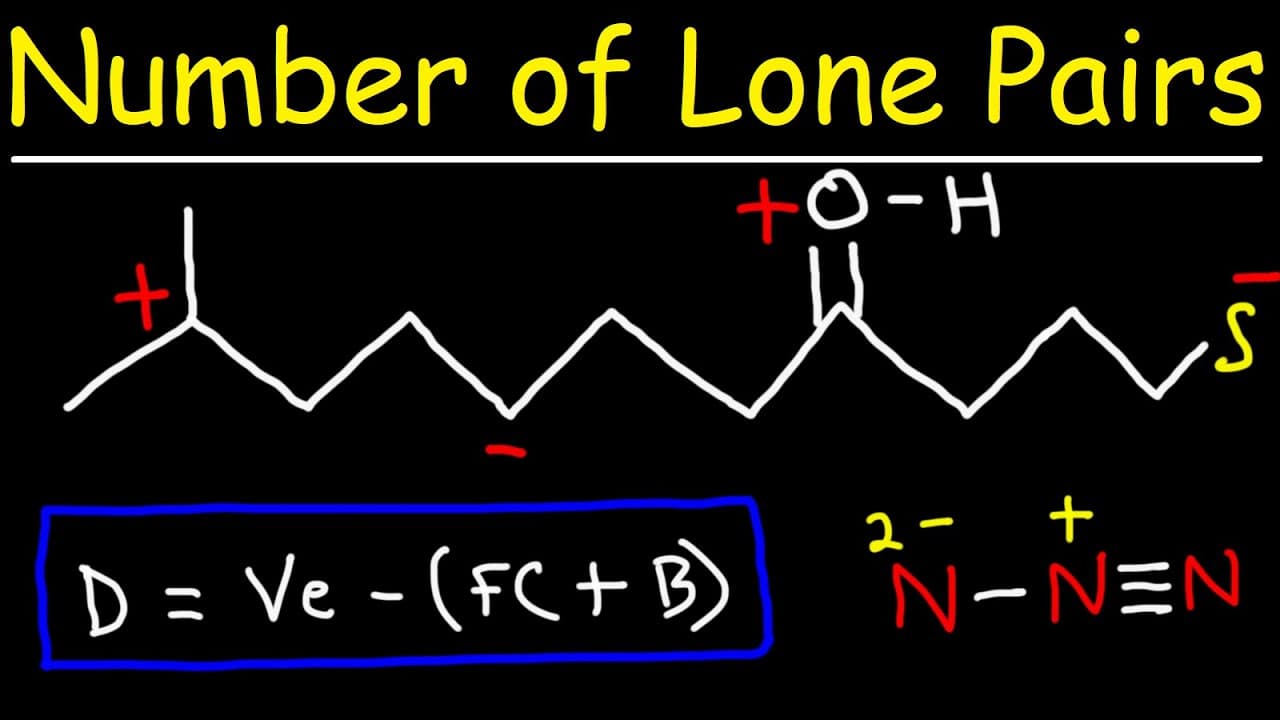
have you ever wondered how many lone pairs you should put on an atom when you look at this structure should we put a loan here on this carbon atom what about the carbanion the carbon with the negative charge what about the oxygen how many lone pairs should we put on it now normally we typically add lone pairs until the atom has eight electrons and ... Read More
Key Insights
- 🫀 Most atoms follow the octet rule, aiming to have eight valence electrons.
- 🔛 Elements in the second row (C, N, O, F) usually have a complete octet, while others may have an expanded octet.
- #️⃣ Calculating the number of lone pairs involves considering valence electrons, formal charge, and the number of bonds.
- #️⃣ The formula Valence electrons - Formal charge + Number of bonds helps calculate the number of lone pairs on an atom.
- 🦕 Radicals, or species with odd electron numbers, have incomplete octets.
- 🌀 Hydrogen usually does not have lone pairs.
- 🫀 Different atoms, like oxygen and sulfur, have different preferences for the number of bonds and lone pairs.
Install to Summarize YouTube Videos and Get Transcripts
Explore YouTube Video Summarizer or Get YouTube Transcript Extractor
Questions & Answers
Q: How do you determine the number of lone pairs on an atom?
The formula to calculate the number of lone pairs is: Number of dots = Valence electrons - Formal charge + Number of bonds.
Q: Can atoms in the second row have an expanded octet?
No, elements like C, N, O, and F cannot have more than eight electrons in their valence shells, so they generally have a complete octet.
Q: How many lone pairs are on an oxygen atom with one bond and a positive one formal charge?
For oxygen, with six valence electrons and a positive one formal charge, the calculation would be: 6 - (+1) + 1 = 6. Therefore, it needs two lone pairs.
Q: Is it possible for an atom to have an incomplete octet?
Yes, certain elements like boron can have an incomplete octet, meaning they have less than eight electrons in their valence shell.
Summary & Key Takeaways
-
The number of lone pairs on an atom can vary based on its electronic configuration and charge.
-
Atoms in the second row (C, N, O, F) typically have an octet of electrons, while other elements like P, S, and Cl can have an expanded octet.
-
Calculating the number of lone pairs involves considering the valence electrons, formal charge, and number of bonds on the atom.
Read in Other Languages (beta)
Share This Summary 📚
Summarize YouTube Videos and Get Video Transcripts with 1-Click
Try YouTube Summary with ChatGPT & Claude or YouTube Transcript Generator
Explore More Summaries from The Organic Chemistry Tutor 📚
Summarize YouTube Videos and Get Video Transcripts with 1-Click
Try YouTube Summary with ChatGPT & Claude or YouTube Transcript Generator