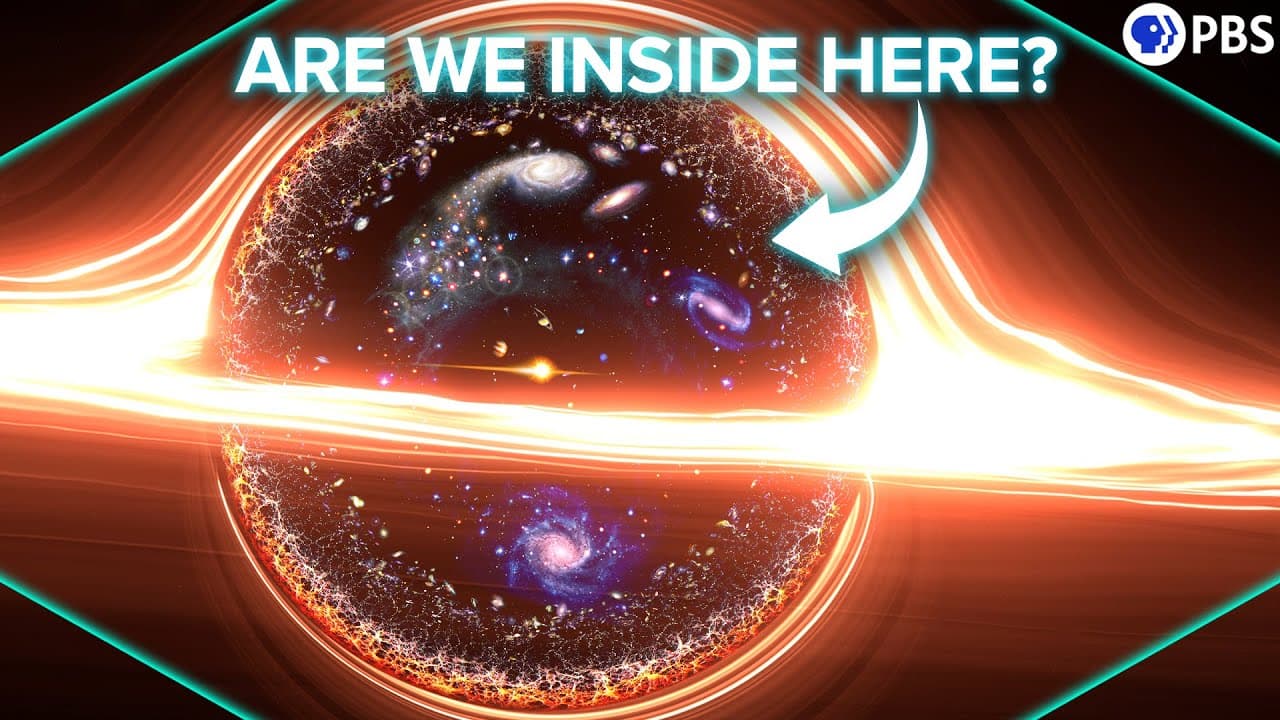
Could The Universe Be Inside A Black Hole?
TL;DR
The universe might be inside a black hole, but it's unlikely.
Transcript
What is inside a black hole? Inevitable crushing doom? Gateways to other universes? Weird, multidimensional libraries? If you’ve ever wanted to know then you might be in luck - Some physicists have argued that you’re inside a black hole right now. Einstein’s ridiculously successful general theory of relativity has never failed. But we know it must:... Read More
Key Insights
- Physicists speculate that the universe could be inside a black hole due to mathematical similarities between black holes and the Big Bang.
- Both black holes and the universe feature singularities, with black holes having future singularities and the universe having a past singularity.
- The concept of geodesic incompleteness in general relativity suggests singularities as endpoints for geodesics, applicable to both black holes and the Big Bang.
- A white hole, the time-reversed version of a black hole, could resemble our universe with a past singularity and an unpassable event horizon.
- The Friedmann-Lemaitre-Robertson-Walker metric can describe the interior of a black or white hole to make it indistinguishable from a universe.
- The Cosmological Natural Selection theory posits that new universes could form from black holes, but lacks concrete evidence.
- Hawking's theory suggests black holes and white holes might be indistinguishable under certain conditions, blurring the line between them.
- Despite intriguing hypotheses, there is no substantial evidence to support the universe being a black hole, requiring further exploration and evidence.
Install to Summarize YouTube Videos and Get Transcripts
Explore YouTube Video Summarizer or Get YouTube Transcript Extractor
Questions & Answers
Q: What similarities exist between black holes and the Big Bang?
Black holes and the Big Bang both involve singularities where matter is packed to infinite densities, causing the breakdown of general relativity. Both have event horizons; for black holes, it is a boundary beyond which nothing can escape, while the universe's expansion creates a cosmological event horizon beyond which events cannot be observed.
Q: How does the concept of geodesic incompleteness relate to singularities?
In general relativity, geodesics are the straightest paths through curved spacetime. Singularities are defined as endpoints of geodesics, where these paths terminate. For the universe, geodesics end at the Big Bang, a past singularity, while in black holes, they end at a future singularity, suggesting a fundamental similarity.
Q: What is a white hole, and how does it relate to our universe?
A white hole is the time-reversed version of a black hole, with a past singularity and an event horizon that cannot be crossed from the outside. It resembles our universe with a past, space-like singularity and an expanding space, suggesting that our universe could theoretically be a white hole.
Q: How does the Friedmann-Lemaitre-Robertson-Walker metric apply to black holes?
The Friedmann-Lemaitre-Robertson-Walker (FLRW) metric describes a homogeneous and isotropic universe. It can also describe the interior of a black hole or white hole, making it resemble our universe from the inside, as demonstrated by the Oppenheimer-Snyder solution for collapsing stars with homogeneous density.
Q: What is the Cosmological Natural Selection theory?
The Cosmological Natural Selection theory, proposed by Lee Smolin, suggests that new universes are born from black holes. As black holes collapse, they bounce back and create new spacetimes, potentially leading to a series of nested universes. However, this theory lacks substantial evidence and remains speculative.
Q: How does Hawking's theory blur the distinction between black and white holes?
Stephen Hawking proposed that if a black hole's mass loss through Hawking radiation is perfectly balanced by absorbed radiation, the distinction between black and white holes becomes unclear. In such a scenario, they could be considered the same object, challenging our understanding of these cosmic phenomena.
Q: Why is there skepticism about the universe being inside a black hole?
Despite intriguing mathematical similarities and theoretical models, there is no substantial evidence to support the universe being inside a black hole. The hypothesis lacks explanatory power and evidence, making it a speculative idea rather than a widely accepted scientific theory.
Q: What potential insights could arise if the universe is inside a black hole?
If the universe is inside a black hole, it could provide insights into the nature of black holes and their interiors. It would suggest a nested structure of universes, each inside a black hole, leading to a deeper understanding of spacetime and the potential for infinite universes within universes.
Summary & Key Takeaways
-
The video explores the hypothesis that the universe might be inside a black hole, drawing parallels between black holes and the Big Bang. It discusses the similarities in singularities and event horizons, with black holes having future singularities and the universe having a past singularity.
-
The concept of geodesic incompleteness is explained, and how singularities act as endpoints for geodesics. The video also covers white holes, which are time-reversed black holes with a past singularity and an event horizon, resembling our universe.
-
While theories like Cosmological Natural Selection and Hawking's ideas on black and white holes are discussed, the video concludes that there is no concrete evidence to support the universe being inside a black hole, though it's not entirely ruled out.
Read in Other Languages (beta)
Share This Summary 📚
Summarize YouTube Videos and Get Video Transcripts with 1-Click
Try YouTube Summary with ChatGPT & Claude or YouTube Transcript Generator
Explore More Summaries from PBS Space Time 📚
Summarize YouTube Videos and Get Video Transcripts with 1-Click
Try YouTube Summary with ChatGPT & Claude or YouTube Transcript Generator