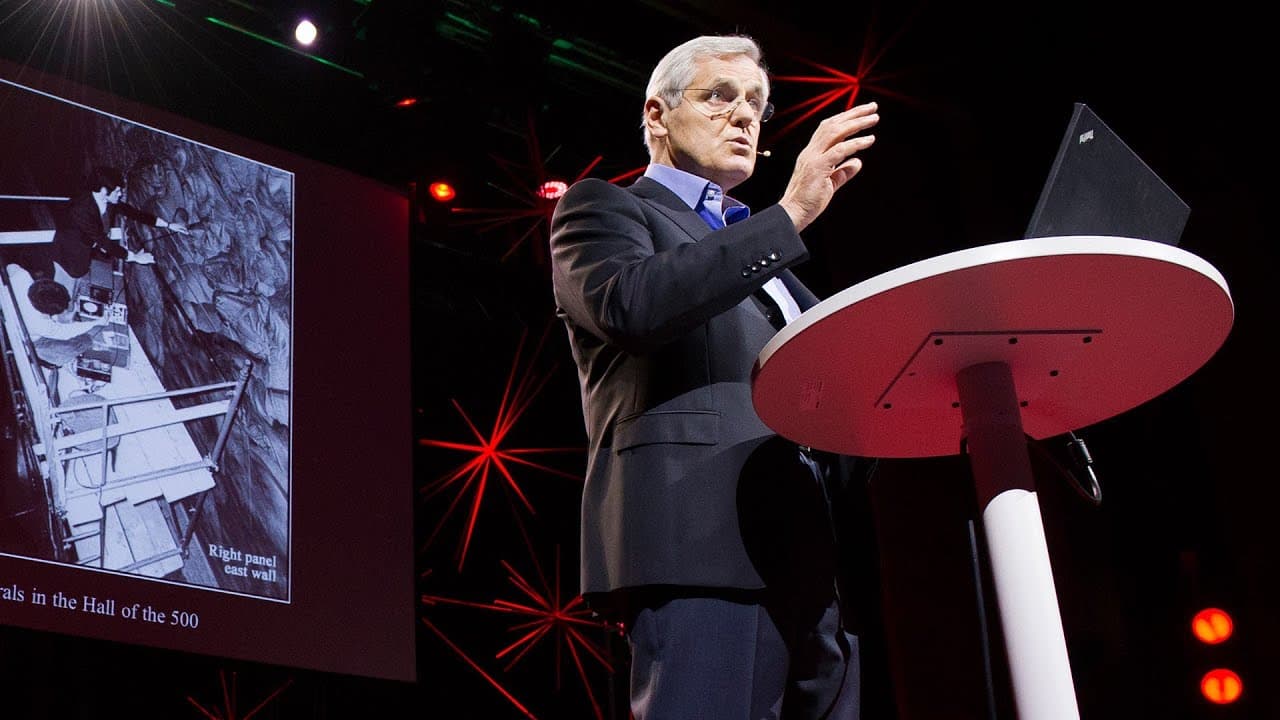
The secret lives of paintings - Maurizio Seracini
TL;DR
A bioengineer uses technology to uncover Da Vinci's lost masterpiece, revealing hidden artwork and revolutionizing art authentication.
Transcript
in 1975 I met in Florence at Professor carlopa directly my former professor world history and today a world-renowned scholar of Leonardo da Vinci well he asked me if I could find some technological way to unfold the five centuries old mystery related to a lost masterpiece but another da Vinci the battle van Garrett which is supposed to be located i... Read More
Key Insights
- 😚 Advanced technology like radar antennas and endoscopy revolutionized the search for Da Vinci's lost masterpiece.
- 👻 Reconstruction of the original hall layout and identification of hidden windows were essential in locating the painting.
- 🔬 The establishment of a research center for engineering sciences in culture heritage marked a shift towards blending art and science.
- 🥰 Augmented reality applications on tablets offer new ways for people to interact with art in museums.
- 💹 The concept of a clinical chart for artworks could revolutionize conservation practices and authentication methods.
- ❓ Technology has the potential to challenge traditional attributions and uncover hidden artwork beneath surface layers.
- 🫡 Rediscovering cultural values through engineering for heritage preservation can shape a future that respects and embraces the past.
Install to Summarize YouTube Videos and Get Transcripts
Explore YouTube Video Summarizer or Get YouTube Transcript Extractor
Questions & Answers
Q: How did the bioengineer start the search for Da Vinci's lost masterpiece?
The bioengineer, in collaboration with researchers, began probing the Palazzo Vecchio in Florence in 1975, using technology like radar antennas and endoscopy to locate hidden windows and reconstruct the hall's original layout.
Q: What technological advancements were crucial in uncovering the lost masterpiece?
Tools such as radar antennas, endoscopy, tomography, and XRF x-ray diffraction were pivotal in locating hidden features, documenting fragments of the painting, and verifying the presence of pigments related to Da Vinci.
Q: What significant discoveries were made during the research?
The team found evidence of the Battle of Anghiari, identified hidden artwork beneath layers of paint, and showcased the importance of blending engineering with cultural heritage in art authentication and conservation.
Q: How did the bioengineer use technology to make art history more accessible?
By developing a tablet application for augmented reality, the bioengineer enabled museum visitors to virtually explore hidden details in paintings, revolutionizing the way art is experienced and understood.
Summary & Key Takeaways
-
In 1975, a bioengineer began the quest to find Da Vinci's lost masterpiece, the Battle of Anghiari, using technology to probe the Palazzo Vecchio in Florence.
-
Through advanced tools like radar antennas and endoscopy, they located hidden windows, reconstructed the original hall layout, and found evidence of the painting.
-
The project halted in 2004 due to political reasons, leading the bioengineer to establish a research center for engineering sciences in culture heritage.
Read in Other Languages (beta)
Share This Summary 📚
Summarize YouTube Videos and Get Video Transcripts with 1-Click
Try YouTube Summary with ChatGPT & Claude or YouTube Transcript Generator
Explore More Summaries from TED-Ed 📚





Summarize YouTube Videos and Get Video Transcripts with 1-Click
Try YouTube Summary with ChatGPT & Claude or YouTube Transcript Generator