Consciousness: Crash Course Psychology #8
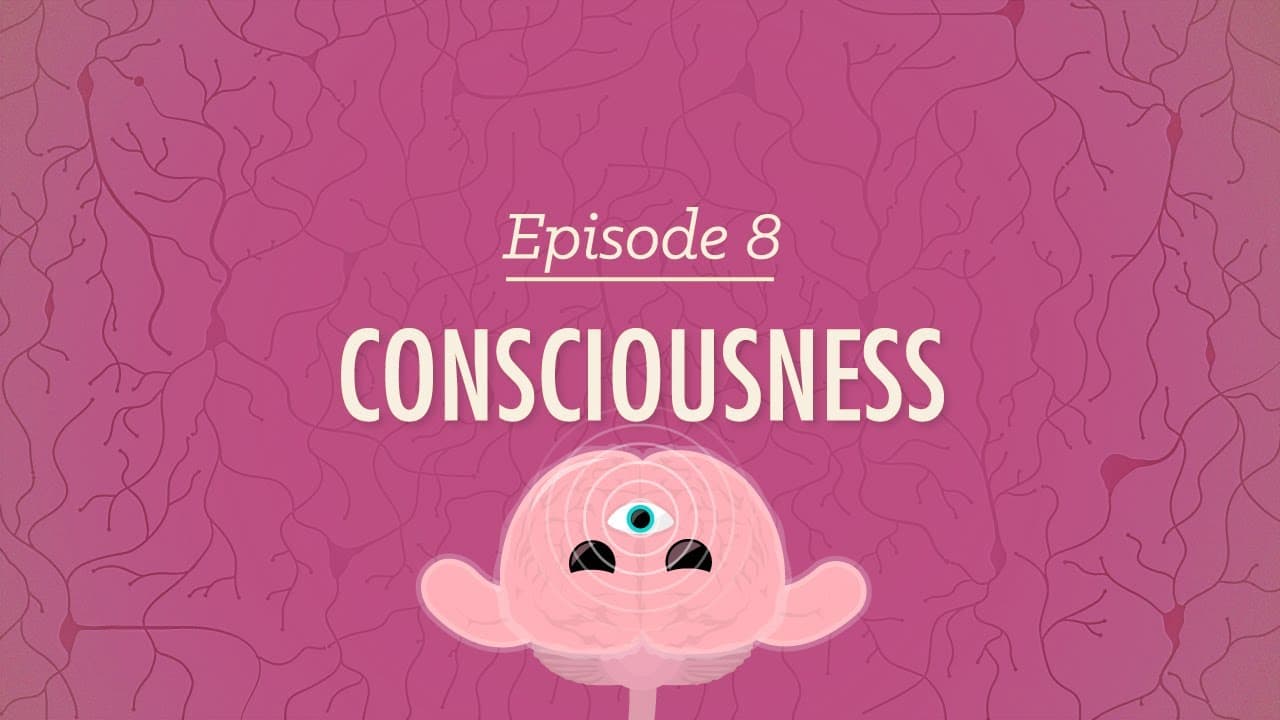
TL;DR
Consciousness is complex, involving attention, awareness, and dual processing.
Transcript
Here’s a riddle, my Hobbitses: What’s something we all experience, all the time, that we can’t really measure, and barely have words to define? You can’t hold it in your hand, or take a bite out of it. It isn’t something you learn or practice; it just IS. Consciousness. Every science has certain concepts that are so fundamental, yet abstract, that ... Read More
Key Insights
- Consciousness is difficult to define, yet it's our awareness of ourselves and our surroundings, allowing us to process information from multiple sources.
- William James described consciousness as a 'stream,' while others compare it to a 'flashlight' that highlights different things over time.
- Consciousness enables us to plan, reflect, and consider consequences, making it both familiar and mysterious.
- We experience various states of consciousness, such as waking and dreaming, which can be altered through physiological or psychological means.
- Neuroimaging has revolutionized psychology by allowing us to observe brain activity and its connection to mental processes, despite some interpretation challenges.
- Consciousness operates on dual processes: deliberate and automatic, where the latter processes vast amounts of information subconsciously.
- Selective attention helps us focus on specific stimuli while tuning out others, demonstrated by phenomena like the cocktail party effect and inattentional blindness.
- Magicians exploit inattentional and change blindness, highlighting our limited awareness and the potential dangers of misdirected attention.
Install to Summarize YouTube Videos and Get Transcripts
Explore YouTube Video Summarizer or Get YouTube Transcript Extractor
Questions & Answers
Q: What is consciousness according to the video?
Consciousness is defined as our awareness of ourselves and our environment. It allows us to process and organize information from various sources and senses, enabling us to plan, reflect, and consider consequences. Despite its importance, consciousness remains a complex and elusive concept, defying simple definitions.
Q: How does neuroimaging contribute to our understanding of consciousness?
Neuroimaging has revolutionized psychology by allowing scientists to observe brain activity and its connection to mental processes. It provides insights into how specific brain states correlate with conscious experiences. However, interpreting neuroimaging findings can be challenging, as correlation does not imply causation, and there's ongoing debate about their significance.
Q: What are the dual processes of consciousness mentioned in the video?
Consciousness operates on dual processes: the deliberate, conscious mind and the automatic, implicit mind. The deliberate mind focuses on specific stimuli, while the automatic mind processes vast amounts of information subconsciously. This dual processing model helps explain how we manage to navigate complex environments and make decisions efficiently.
Q: What is selective attention, and why is it important?
Selective attention is the ability to focus on a particular stimulus or group of stimuli while tuning out others. It's crucial for managing the vast amount of information our senses receive, allowing us to concentrate on what's relevant. This capability is exemplified by the cocktail party effect, where we can focus on one conversation amidst background noise.
Q: What is inattentional blindness, and how is it demonstrated?
Inattentional blindness is the failure to notice obvious things when our attention is directed elsewhere. A famous demonstration is the Invisible Gorilla experiment, where participants focused on counting basketball passes often fail to notice a person in a gorilla suit walking through the scene, highlighting the limits of our awareness.
Q: How do magicians use psychological principles to perform tricks?
Magicians exploit inattentional and change blindness through misdirection, redirecting the audience's attention to conceal their actions. This manipulation of selective attention and failure to notice changes in the environment allows magicians to create illusions and surprise their audience, demonstrating how easily our perception can be influenced.
Q: What dangers can arise from selective inattention?
Selective inattention can be dangerous when it leads to ignoring important stimuli, such as when texting and driving. Focusing on a phone distracts from the road, increasing the risk of accidents. This failure to notice critical changes or obstacles can have severe consequences for both the driver and others, emphasizing the importance of attentive awareness.
Q: What role does consciousness play in our daily lives?
Consciousness plays a vital role in our daily lives by enabling us to be aware of ourselves and our surroundings, plan for the future, reflect on the past, and make decisions. It helps us navigate complex environments, manage social interactions, and engage in activities that require focused attention, making it an essential aspect of human experience.
Summary & Key Takeaways
-
Consciousness is our awareness of ourselves and our environment, allowing us to process information from various sources and senses. Its definition is elusive, yet it's fundamental to our existence.
-
We experience different states of consciousness, including waking, sleeping, and altered states, influenced by physiological or psychological factors. Neuroimaging helps us understand brain activity linked to these states.
-
Selective attention allows us to focus on specific stimuli while ignoring others, but it can lead to inattentional blindness. Magicians exploit this through misdirection, showcasing our limited awareness.
Read in Other Languages (beta)
Share This Summary 📚
Summarize YouTube Videos and Get Video Transcripts with 1-Click
Try YouTube Summary with ChatGPT & Claude or YouTube Transcript Generator
Explore More Summaries from CrashCourse 📚


Summarize YouTube Videos and Get Video Transcripts with 1-Click
Try YouTube Summary with ChatGPT & Claude or YouTube Transcript Generator