Radioactivity: What is a Decay Chain
TL;DR
Decay chains are series of radioactive decays leading to stable isotopes, crucial in nuclear science.
Transcript
in today's video we are going to go over what is a decay chain and this is a decay chain as it relates to radioactive dk now before we get started please don't forget to subscribe to my channel step by step science get all my excellent physics chemistry and math videos when i look at my youtube analytics i see that more than 90 of people who watch ... Read More
Key Insights
- ⛓️ Decay chains are crucial in understanding the decay process of radioactive isotopes.
- ☠️ Half-life determines the rate at which isotopes decay in a chain.
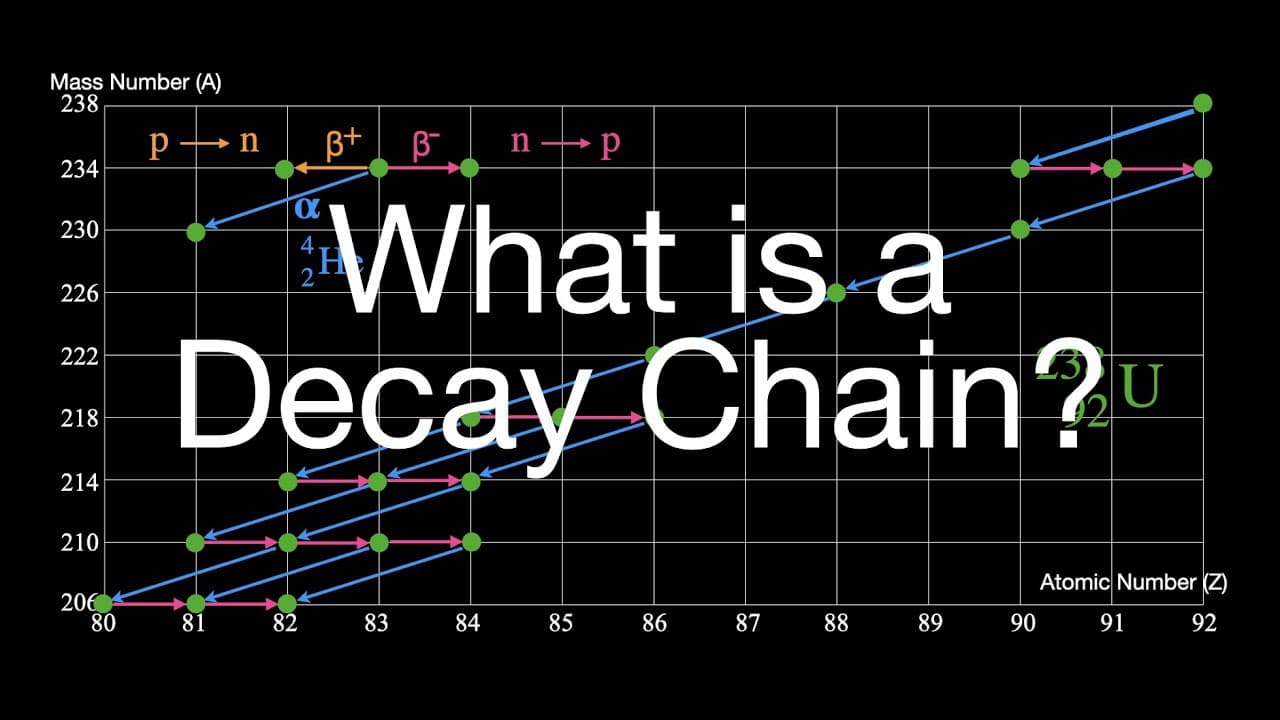
- ⛓️ Different types of radioactive decay, including alpha and beta decay, contribute to the transition of isotopes in a chain.
- 🥺 Isotopes like uranium and lead play significant roles in decay chains as parent and stable isotopes, respectively.
- ⛓️ Diagrams represent decay chains visually, showcasing the progression of isotopes through decay processes.
- 😷 Decay chains are essential in nuclear science, aiding in research, medical applications, and more.
- #️⃣ Alpha decay results in a loss of 4 from the mass number and 2 from the atomic number.
Install to Summarize YouTube Videos and Get Transcripts
Explore YouTube Video Summarizer or Get YouTube Transcript Extractor
Questions & Answers
Q: What is a decay chain and why is it important in nuclear science?
A decay chain is a series of radioactive decays leading to stable isotopes, crucial in understanding the decay process and its implications in various fields like nuclear physics and medicine.
Q: How does half-life play a role in decay chains?
Half-life is the time taken for half of the parent isotopes in a sample to decay to their daughter products, providing a measure of the decay rate and the stability of the radioactive isotope.
Q: What are the different types of radioactive decay mentioned in the content?
The content discusses alpha decay, beta-minus decay, and beta-plus decay, elucidating how each type results in specific changes in the atomic number and mass number of isotopes.
Q: Can you explain the significance of isotopes like uranium and lead in decay chains?
Isotopes like uranium serve as parent isotopes in decay chains, decaying through a series of isotopes to eventually reach stable isotopes like lead, highlighting the process of radioactive decay and its end products.
Summary & Key Takeaways
-
Decay chains are sequences of radioactive decays leading to stable isotopes like lead.
-
Half-life determines decay rate of radioactive isotopes.
-
Represented in diagrams, decay chains show the transition of isotopes via alpha, beta decay.
Read in Other Languages (beta)
Share This Summary 📚
Summarize YouTube Videos and Get Video Transcripts with 1-Click
Try YouTube Summary with ChatGPT & Claude or YouTube Transcript Generator
Explore More Summaries from Step by Step Science 📚
Summarize YouTube Videos and Get Video Transcripts with 1-Click
Try YouTube Summary with ChatGPT & Claude or YouTube Transcript Generator