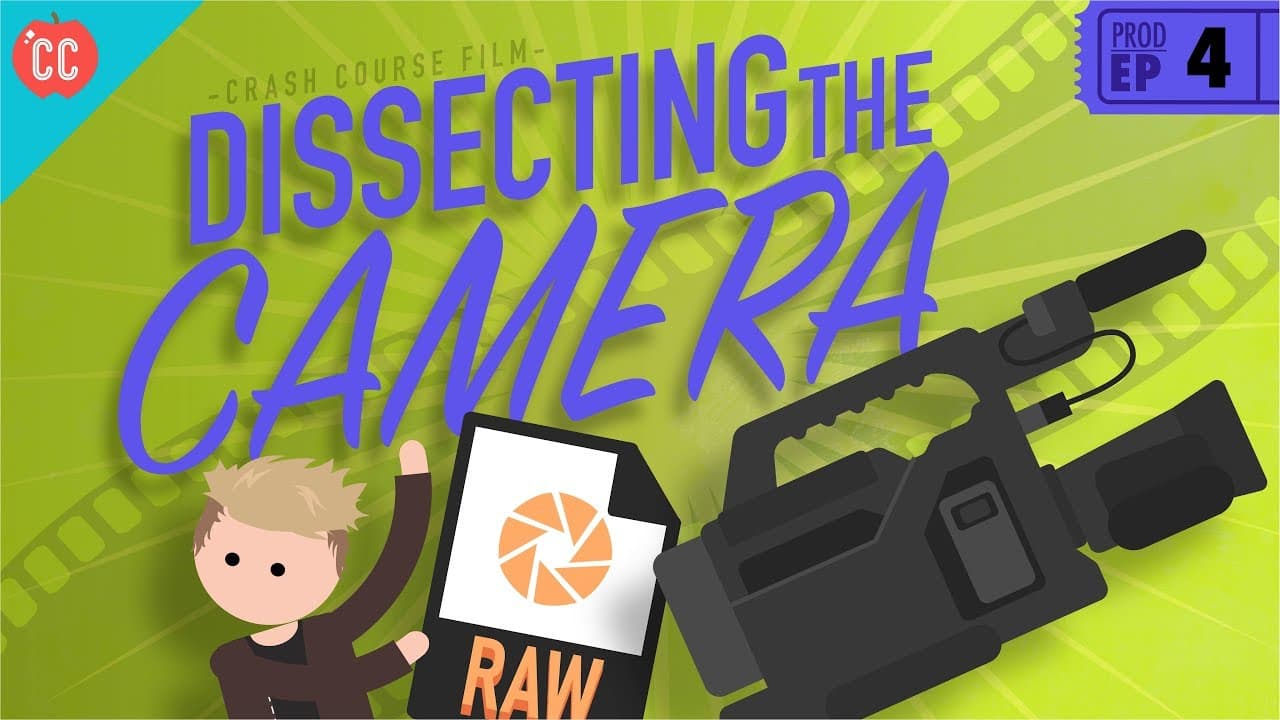
Dissecting The Camera: Crash Course Film Production with Lily Gladstone #4
TL;DR
Learn the essentials of camera technology for filmmaking.
Transcript
Hey, you! Yeah, I’m talking to you. But, I’m actually talking to a camera. A camera is a collection of parts that can help you tell a visual story. It takes in light through a lens and captures images, creating that illusion of reality we keep talking about. You could even use your cell phone camera to make a movie! But filmmakers usually have equi... Read More
Key Insights
- Cameras are crucial tools in filmmaking, capturing light through lenses to create visual stories.
- Lenses can be fixed or interchangeable, with focal length determining the field of view and image focus.
- Aperture controls light entry into the camera, affecting exposure and depth of field, measured in f-stops.
- Shutter speed, often double the frame rate, influences motion blur and image crispness in footage.
- Digital cameras use CMOS or CCD sensors to convert light into digital images, with ISO affecting image sensitivity to light.
- Media storage in cameras varies from film to digital devices, with codecs compressing and decompressing footage.
- Cinematographers and camera crews collaborate to use camera technology and techniques for effective storytelling.
- Camera movements like pans, pushes, and pulls, along with framing rules like the rule of thirds, enhance visual storytelling.
Install to Summarize YouTube Videos and Get Transcripts
Explore YouTube Video Summarizer or Get YouTube Transcript Extractor
Questions & Answers
Q: What is the function of a camera in filmmaking?
A camera in filmmaking is a tool that captures light through lenses to create visual representations of reality. It records images by focusing light onto a film or sensor, allowing filmmakers to tell stories through visual means. The camera's components, like lenses, aperture, and shutter speed, work together to control light exposure and image quality.
Q: How do lenses affect filmmaking?
Lenses play a crucial role in filmmaking by determining the field of view and focus of the image. They can be fixed or interchangeable, allowing filmmakers to choose different focal lengths for creative control. Prime lenses offer high-quality glass for a single focal length, while zoom lenses provide versatility by allowing focal length adjustments, impacting the composition and storytelling.
Q: What is the importance of aperture in camera usage?
Aperture is vital in camera usage as it controls the amount of light entering the camera, affecting exposure and depth of field. Measured in f-stops, aperture size influences the brightness and sharpness of the image. A larger aperture allows more light and a shallower depth of field, while a smaller aperture results in less light and a deeper depth of field, impacting the visual storytelling.
Q: How does shutter speed impact image quality?
Shutter speed impacts image quality by controlling how long the film or sensor is exposed to light. A faster shutter speed reduces motion blur and creates crisper images, while a slower speed allows more motion blur, making images appear smoother. Typically, shutter speed is set to be double the frame rate, balancing exposure and motion capture for cinematic quality.
Q: What role does ISO play in digital cameras?
ISO in digital cameras determines the sensor's sensitivity to light, affecting image brightness and quality. A lower ISO results in cleaner, richer images but requires more light, while a higher ISO increases sensitivity for low-light conditions but can introduce noise and graininess. Filmmakers must balance ISO settings with other camera controls to maintain image quality in various lighting conditions.
Q: Why is codec selection important in digital filmmaking?
Codec selection is crucial in digital filmmaking as it determines how footage is compressed and stored on media. Codecs like H.264 compress video efficiently for storage and playback, while shooting in raw retains higher quality but requires more storage. The choice of codec affects post-production workflows, image quality, and the overall efficiency of managing digital assets.
Q: What are the responsibilities of a cinematographer?
A cinematographer, or Director of Photography, leads the camera department, collaborating with the director to create the visual style of a film. They design shot lists, choose camera equipment, and oversee camera operations to capture the screenplay visually. The cinematographer ensures that camera techniques and movements align with the storytelling goals, enhancing the narrative through visual means.
Q: How do camera movements contribute to storytelling?
Camera movements contribute significantly to storytelling by guiding the audience's focus and emotions. Techniques like pans, pushes, and pulls create dynamic visual experiences, enhancing tension, revealing new information, or emphasizing character actions. Movements like tracking shots follow the action, while handheld shots add chaos and immediacy. These movements, combined with framing techniques, enrich the narrative and emotional impact.
Summary & Key Takeaways
-
Cameras are essential in filmmaking, capturing light through lenses to create visual stories. Lenses can be fixed or interchangeable, affecting the field of view and image focus. Aperture controls light entry, impacting exposure and depth of field.
-
Shutter speed influences motion blur and image crispness, while digital sensors convert light into images. ISO affects image sensitivity to light. Media storage varies from film to digital, with codecs compressing and decompressing footage.
-
Cinematographers and camera crews use camera technology and techniques for storytelling. Camera movements and framing enhance storytelling, with movements like pans and pushes, and rules like the rule of thirds, guiding visual composition.
Read in Other Languages (beta)
Share This Summary 📚
Summarize YouTube Videos and Get Video Transcripts with 1-Click
Try YouTube Summary with ChatGPT & Claude or YouTube Transcript Generator
Explore More Summaries from CrashCourse 📚



Summarize YouTube Videos and Get Video Transcripts with 1-Click
Try YouTube Summary with ChatGPT & Claude or YouTube Transcript Generator