New Results in Quantum Tunneling vs. The Speed of Light
TL;DR
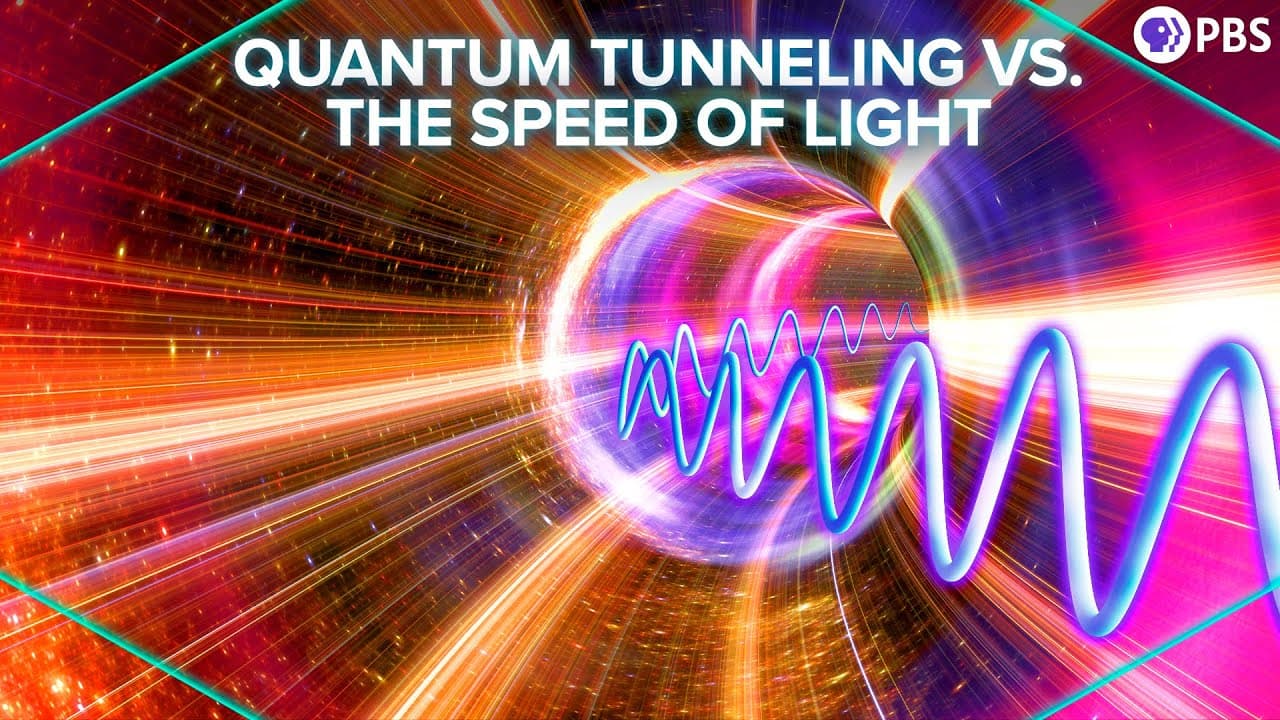
Quantum tunneling suggests potential for faster-than-light motion without causing paradoxes.
Transcript
Thank you to Brilliant for supporting PBS. Paradoxically, the most promising prospects for moving matter around faster than light may be to put a metaphorical brick wall in its way. New efforts in quantum tunneling - both theory and experiment - show that superluminal motion may be possible, while still managing to avoid the paradox of superluminal... Read More
Key Insights
- Quantum tunneling allows particles to pass through barriers, potentially faster than light, challenging classical physics.
- The Hartman effect suggests that tunneling time can be independent of barrier thickness, implying superluminal motion.
- Relativity's constraints are preserved as faster-than-light signaling remains impossible, maintaining causality.
- Recent studies use the Dirac equation to better integrate special relativity into tunneling time analysis.
- Experimental evidence using Larmor precession as a clock confirms theoretical predictions of tunneling behavior.
- Theoretical and experimental approaches are converging on understanding the limits of faster-than-light motion.
- Quantum tunneling is crucial in various natural processes, including nuclear fusion and electronic component function.
- Despite potential FTL motion, quantum tunneling does not allow for faster-than-light communication, preserving relativity.
Install to Summarize YouTube Videos and Get Transcripts
Explore YouTube Video Summarizer or Get YouTube Transcript Extractor
Questions & Answers
Q: What is quantum tunneling and how does it challenge classical physics?
Quantum tunneling is a phenomenon in quantum mechanics where particles pass through seemingly impenetrable barriers. This challenges classical physics because it suggests that particles can move faster than light under certain conditions, known as the Hartman effect. This phenomenon is crucial in processes like nuclear fusion and electronic component function.
Q: How does the Hartman effect relate to faster-than-light motion?
The Hartman effect suggests that the time taken for a particle to tunnel through a barrier can become independent of the barrier's thickness. This implies that particles can effectively teleport through barriers faster than they would travel the same distance without a barrier, potentially faster than light. However, this does not violate relativity as it doesn't allow for superluminal signaling.
Q: How does recent research integrate relativity into tunneling time analysis?
Recent research uses the Dirac equation, which incorporates Einstein's special relativity, to analyze tunneling time. This approach provides a more accurate framework for understanding tunneling behavior, as previous analyses using the Schrodinger equation lacked the speed limit constraints of relativity. This integration helps maintain the consistency of relativity with tunneling phenomena.
Q: What role does Larmor precession play in experimental tunneling studies?
Larmor precession, the swiveling axis of a particle's quantum spin in a magnetic field, is used as a clock in experimental tunneling studies. This method allows researchers to measure the time particles spend within a barrier. Experiments have shown that particles' spins change as predicted by theory, confirming theoretical predictions of tunneling behavior without violating causality.
Q: How do theoretical and experimental approaches to tunneling converge?
Theoretical and experimental approaches to tunneling are converging as researchers use both the Dirac equation and innovative experimental methods like Larmor precession to study tunneling behavior. This convergence is helping to clarify the limits of faster-than-light motion and ensuring that theoretical predictions align with experimental results, advancing our understanding of quantum mechanics.
Q: Why doesn't quantum tunneling allow faster-than-light communication?
Quantum tunneling does not allow faster-than-light communication because, despite potential superluminal motion, it does not permit superluminal signaling. The constraints of relativity are preserved, maintaining causality and preventing paradoxes. Theoretical studies show that while particles may tunnel faster than light, they cannot be used to transmit information faster than light.
Q: What is the significance of quantum tunneling in natural processes?
Quantum tunneling is significant in natural processes such as nuclear fusion, which powers the sun, and in the functioning of electronic components like transistors. It allows particles to overcome energy barriers that would be insurmountable in classical physics, enabling processes that are essential for the stability and function of various systems in nature and technology.
Q: How is causality preserved in the context of quantum tunneling?
Causality is preserved in quantum tunneling because, even though particles can tunnel faster than light, they cannot be used to send information faster than light. This aligns with the principles of relativity, ensuring that events do not influence each other in ways that would create paradoxes. Theoretical studies confirm that superluminal signaling is impossible, maintaining the consistency of physical laws.
Summary & Key Takeaways
-
Quantum tunneling, a phenomenon in quantum mechanics, allows particles to pass through barriers, suggesting the possibility of faster-than-light motion. This challenges classical physics but doesn't violate relativity due to the impossibility of superluminal signaling. Recent studies using the Dirac equation provide a more accurate theoretical framework for understanding tunneling time.
-
The Hartman effect shows that tunneling time can be independent of barrier thickness, implying superluminal motion. However, experiments using Larmor precession as a clock confirm theoretical predictions without violating causality. The convergence of theory and experiment is bringing us closer to understanding the limits of faster-than-light motion.
-
Quantum tunneling plays a crucial role in various natural processes, including nuclear fusion and electronic components. Despite the potential for faster-than-light motion, tunneling does not allow for faster-than-light communication, preserving the constraints of relativity and ensuring that causality is maintained.
Read in Other Languages (beta)
Share This Summary 📚
Summarize YouTube Videos and Get Video Transcripts with 1-Click
Try YouTube Summary with ChatGPT & Claude or YouTube Transcript Generator
Explore More Summaries from PBS Space Time 📚

Summarize YouTube Videos and Get Video Transcripts with 1-Click
Try YouTube Summary with ChatGPT & Claude or YouTube Transcript Generator