The EM Drive: Fact or Fantasy?
TL;DR
The EM Drive's claimed thrust is still unverified and speculative.
Transcript
One of Space Time's most requested topics is the controversial EmDrive. They've flooded in since Eagleworks Labs published a paper detailing their tests of an EM drive in a hard vacuum chamber. Those tests were consistent with a positive result: a real thrust. Today we inaugurate the Space Time Journal Club by taking a very careful look at this res... Read More
Key Insights
- The EM Drive is a controversial topic in physics due to its claim of producing thrust without propellant, challenging the Law of Conservation of Momentum.
- Eagleworks Labs reported a positive thrust from the EM Drive in a vacuum, but results are not yet conclusive, with thermal effects still a possible cause.
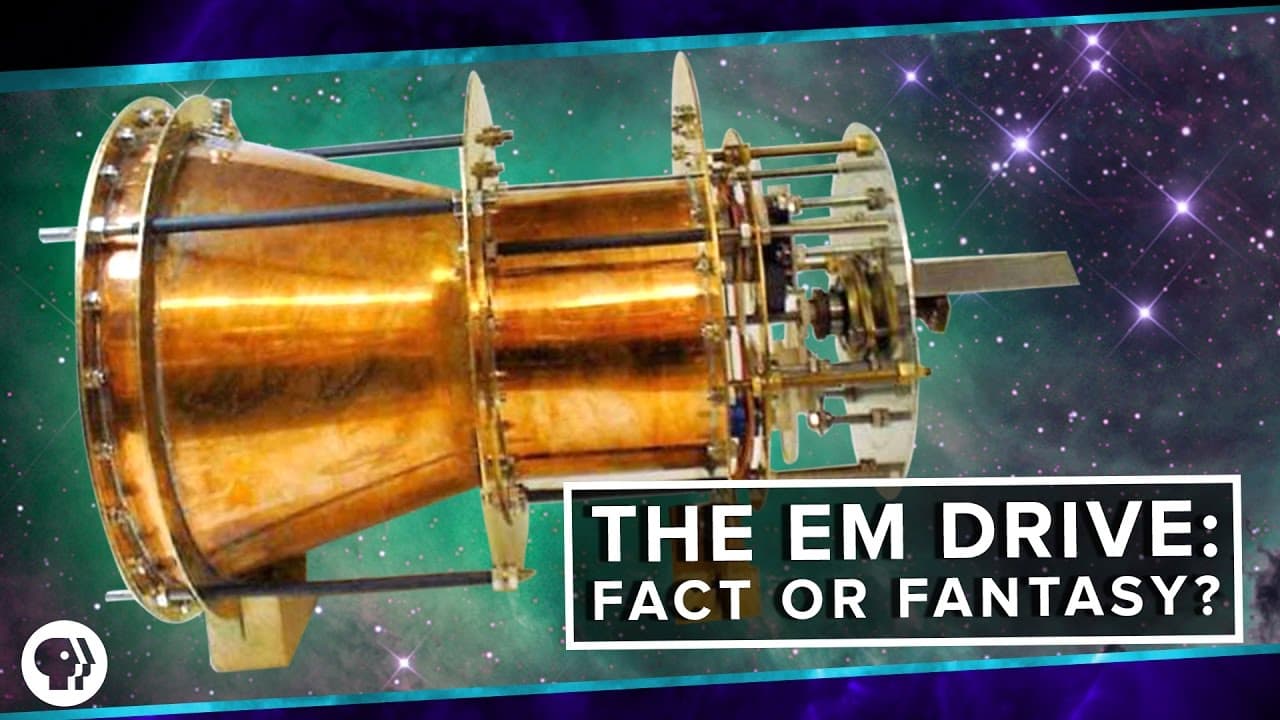
- The structure of the EM Drive is a tapered copper cylinder, where microwave standing waves are induced to create thrust.
- Critics argue that the EM Drive's explanation violates physics principles, likening it to trying to move a car by pushing from inside.
- The latest tests were conducted in a vacuum to eliminate thermal convection, but other thermal effects might still influence results.
- The EM Drive's thrust-to-power ratio is low, requiring immense power for significant thrust, making it impractical for near-term applications.
- The paper speculates on a connection between the EM Drive and pilot wave theory, but this is highly speculative and not widely accepted.
- Further tests are needed to rule out all mundane causes before considering new physics as an explanation for the observed thrust.
Install to Summarize YouTube Videos and Get Transcripts
Explore YouTube Video Summarizer or Get YouTube Transcript Extractor
Questions & Answers
Q: What is the EM Drive and why is it controversial?
The EM Drive is a proposed propulsion system that claims to generate thrust without the need for propellant, which would violate the Law of Conservation of Momentum. This claim is controversial because it challenges established physics principles, and experiments to verify its function have produced inconclusive results, sparking debate within the scientific community.
Q: What were the conditions of the Eagleworks Labs' tests on the EM Drive?
Eagleworks Labs conducted their tests in a hard vacuum chamber to eliminate thermal convection as a potential cause of observed thrust. The tests were performed at power levels of 40, 60, and 80 Watts, using a torsion balance to measure force. Despite these controlled conditions, the results remain inconclusive due to potential thermal effects.
Q: How does the EM Drive allegedly produce thrust?
The EM Drive is designed as a tapered copper cylinder with microwave standing waves inside. It is claimed that these waves create a differential radiation pressure between the ends of the cylinder, resulting in thrust. However, this explanation is disputed because it appears to violate the conservation of momentum unless the system allows photons to escape as propellant.
Q: What are the criticisms against the EM Drive's explanation for thrust?
Critics argue that the EM Drive's explanation is flawed because it suggests momentum can be exchanged within a closed system without propellant, akin to trying to move a car by pushing from inside. This contradicts the Law of Conservation of Momentum, which requires an external force or expulsion of mass for movement.
Q: What potential sources of error are identified in the EM Drive's tests?
The main potential sources of error in the EM Drive's tests include thermal effects, such as deformation due to thermal expansion, which could mimic thrust. The authors of the paper suggest further tests to eliminate these possibilities, such as heating the device without the radiation field to check for similar false positive signals.
Q: How does the paper relate the EM Drive to pilot wave theory?
The paper speculates that the EM Drive could interact with the quantum vacuum as a deformable medium, based on pilot wave theory. This theory suggests that the quantum vacuum might be treated like a plasma, allowing momentum exchange. However, this idea is highly speculative and not widely accepted in the scientific community.
Q: What is the significance of the thrust-to-power ratio in the EM Drive tests?
The thrust-to-power ratio observed in the EM Drive tests is approximately 1.2 millinewtons per kilowatt, which is significantly low. This means that a large amount of power would be required to achieve meaningful thrust, making the EM Drive impractical for near-term applications and limiting its potential for long-range spaceflight without propellant.
Q: What are the next steps for verifying the EM Drive's thrust claims?
To verify the EM Drive's thrust claims, further experiments must be conducted to rule out all mundane causes of the observed forces, such as thermal effects. Only once these are eliminated beyond reasonable doubt can researchers consider new physics as a potential explanation. Continued research by Eagleworks and other teams is necessary to reach a definitive conclusion.
Summary & Key Takeaways
-
The EM Drive, a proposed propellantless thruster, has shown positive thrust results in Eagleworks Labs' vacuum tests, but these results are still inconclusive. The device's design involves a tapered copper cylinder with microwave standing waves, and its claimed operation challenges fundamental physics laws.
-
Critics argue that the EM Drive's explanation of thrust violates momentum conservation principles, and previous non-vacuum tests might have been influenced by thermal convection. While recent tests eliminated convection, other thermal effects could still be responsible for the observed forces.
-
The paper discusses a speculative connection between the EM Drive and pilot wave theory, but this remains unproven. Further experimentation is necessary to rule out conventional explanations before considering the possibility of new physics driving the observed thrust.
Read in Other Languages (beta)
Share This Summary 📚
Summarize YouTube Videos and Get Video Transcripts with 1-Click
Try YouTube Summary with ChatGPT & Claude or YouTube Transcript Generator
Explore More Summaries from PBS Space Time 📚

Summarize YouTube Videos and Get Video Transcripts with 1-Click
Try YouTube Summary with ChatGPT & Claude or YouTube Transcript Generator