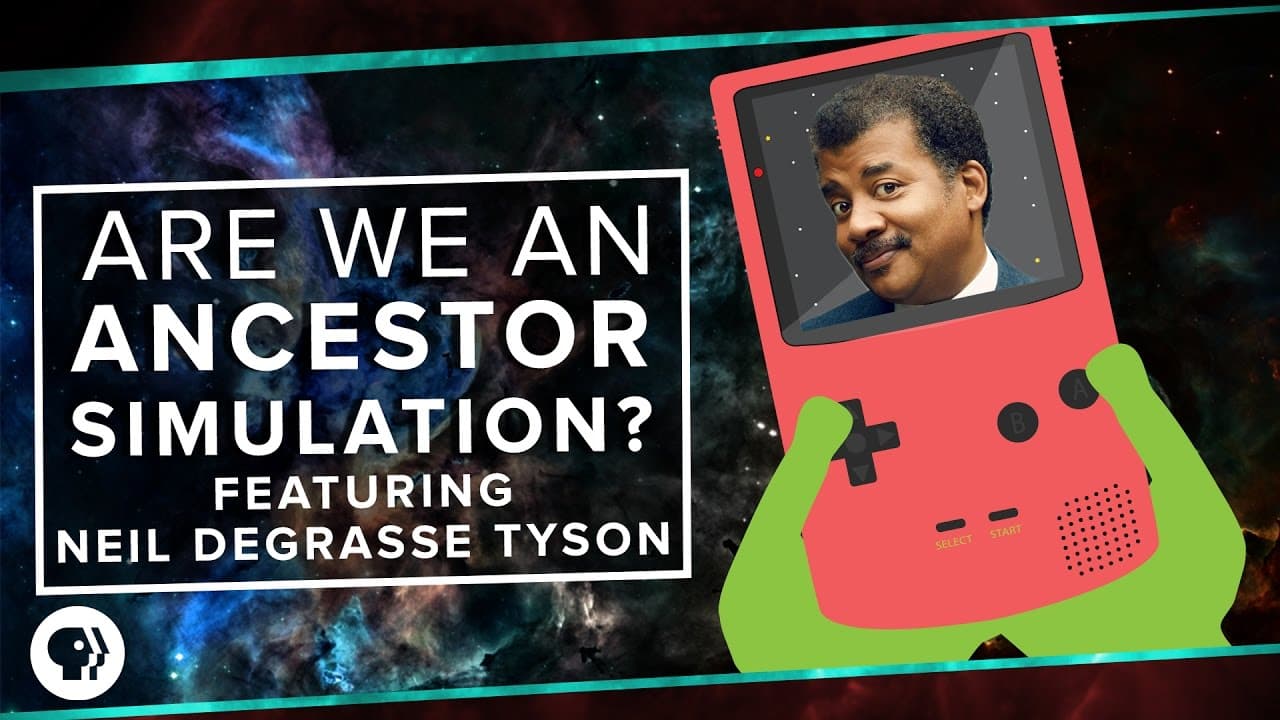
Are We Living in an Ancestor Simulation? ft. Neil deGrasse Tyson | Space Time
TL;DR
Discussion on the likelihood of our reality being a simulation.
Transcript
[MUSIC] This episode is supported by LegalZoom®. As our video games become more and more lifelike it's becoming clear that at some point perhaps soon our simulations will be indistinguishable from reality. If that's true, how do we know it didn't already happen? Could we be in a simulation... ...now? [THEME] Before I get into details, I want to sha... Read More
Key Insights
- The conversation explores the concept of ancestor simulations, where future civilizations might simulate past human minds for research purposes.
- Nick Bostrom's simulation argument suggests that if civilizations can create simulations, most minds would be simulated rather than real.
- Neil deGrasse Tyson humorously suggests we might be a simulation created by advanced aliens for entertainment.
- The idea hinges on the assumption that a supercomputer could simulate human history multiple times over in a second.
- The discussion touches on the philosophical implications of the Copernican principle, suggesting we are typical observers in the universe.
- The hypothesis of being in a simulation is unfalsifiable, as any evidence could be edited out by the simulators.
- Bostrom argues that the odds of us being in a simulation are less than 50%, as civilizations might not reach the capability or choose not to simulate.
- The conversation also references the Boltzmann brain concept, questioning the nature of consciousness and reality.
Install to Summarize YouTube Videos and Get Transcripts
Explore YouTube Video Summarizer or Get YouTube Transcript Extractor
Questions & Answers
Q: What is an ancestor simulation?
An ancestor simulation is a theoretical concept where a future civilization simulates the minds and experiences of past humans to study their history. This idea suggests that advanced societies might have the technology to create detailed simulations of human consciousness, raising the possibility that our current reality could be such a simulation.
Q: How does Bostrom's simulation argument work?
Bostrom's simulation argument suggests that if advanced civilizations can create realistic simulations of human minds, then the majority of conscious experiences would likely be simulated rather than real. This is because a single advanced civilization could produce a vast number of simulations, making it statistically more probable that any given conscious experience is simulated.
Q: What are the philosophical implications of the simulation hypothesis?
The simulation hypothesis raises profound philosophical questions about the nature of reality and consciousness. It challenges our understanding of existence, suggesting that our perceived reality might be an artificial construct. This hypothesis also touches on the Copernican principle, implying that we are not in a special place in the universe but rather typical observers, potentially in a simulated environment.
Q: Why is the simulation hypothesis considered unfalsifiable?
The simulation hypothesis is considered unfalsifiable because any evidence that could disprove it might be altered or erased by the entities running the simulation. This means that even if we suspect we are in a simulation, we cannot conduct an experiment to prove or disprove it, as any anomalies could be edited out by the simulators.
Q: What is the connection between ancestor simulations and Boltzmann brains?
Both ancestor simulations and Boltzmann brains explore the idea of consciousness existing in non-traditional forms. Boltzmann brains suggest that random fluctuations could create conscious experiences, while ancestor simulations propose that advanced civilizations might deliberately create simulated minds. Both concepts challenge our understanding of reality and consciousness, questioning whether our experiences are genuine or artificial.
Q: What are the potential technological requirements for creating ancestor simulations?
Creating ancestor simulations would require immense computational power, potentially from a computer the size of a planet. Such a computer could simulate the entire mental lives of all humans in history multiple times over every second. The technology would need to simulate human consciousness and sensory experiences with high fidelity to convince the simulated minds of their reality.
Q: How does the Copernican principle relate to the simulation hypothesis?
The Copernican principle suggests that we are not in a special or unique position in the universe. Applied to the simulation hypothesis, it implies that if simulated minds vastly outnumber real ones, we are more likely to be typical observers in a simulated reality. This principle supports the idea that our consciousness might be part of a common simulation rather than a unique, real experience.
Q: What are the limitations of using anthropic arguments in the simulation hypothesis?
Anthropic arguments, which consider the conditions necessary for observers to exist, can lead to overreaching conclusions when applied to the simulation hypothesis. These arguments might suggest that we live in a universe optimized for creating minds, but this reasoning can lead to speculative scenarios with no empirical basis. Bostrom warns against such reasoning, highlighting the need for cautious interpretation of anthropic principles.
Summary & Key Takeaways
-
The discussion revolves around the possibility that our reality could be a simulation created by advanced civilizations. Neil deGrasse Tyson humorously suggests that we might be the product of an alien teenager's boredom, while Nick Bostrom's simulation argument provides a more structured hypothesis.
-
Bostrom posits that if future civilizations can create ancestor simulations, the majority of conscious minds in existence would be simulated ones. This leads to the philosophical implication that we might be living in a simulated reality ourselves.
-
The conversation also delves into the unfalsifiability of the simulation hypothesis and its connection to the Boltzmann brain concept, raising questions about the nature of consciousness and the universe's structure.
Read in Other Languages (beta)
Share This Summary 📚
Summarize YouTube Videos and Get Video Transcripts with 1-Click
Try YouTube Summary with ChatGPT & Claude or YouTube Transcript Generator
Explore More Summaries from PBS Space Time 📚
Summarize YouTube Videos and Get Video Transcripts with 1-Click
Try YouTube Summary with ChatGPT & Claude or YouTube Transcript Generator