Gravitation (3 of 17) Mass vs Weight, An Explanation
TL;DR
Mass is the amount of matter in an object, while weight is the force due to gravity acting on the object, varying by location.
Transcript
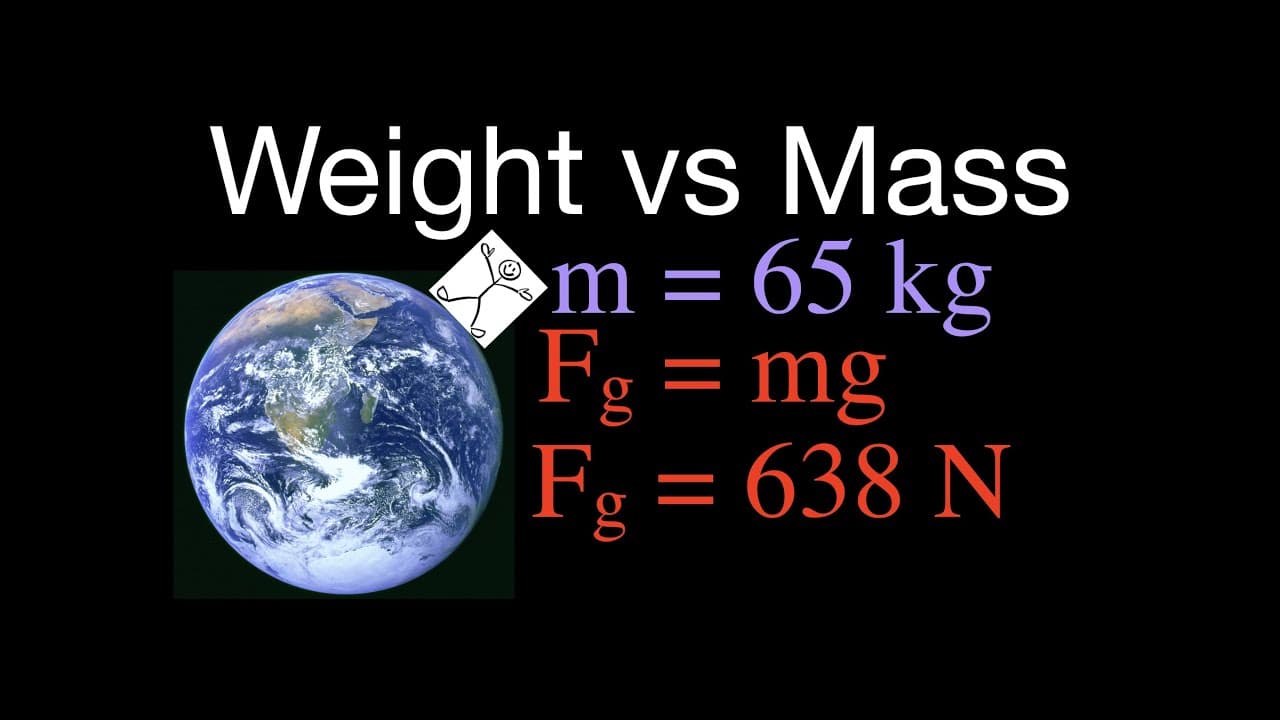
okay and say dude I'm gonna go over a very interesting and somewhat confusing topic as people often use these two words interchangeably mass and weight we're gonna talk about what is the difference between mass and weight because when people asks sometimes like when people ask about how much do you weigh for example say oh I weigh 65 kilograms well... Read More
Key Insights
- 🧑🏭 Mass represents the amount of matter in an object, while weight indicates the force of gravity acting on it.
- 🏋️ Mass remains constant, whereas weight fluctuates depending on the gravitational pull of the location.
- 👮♂️ Newton's second law (F = ma) is utilized to calculate weight by multiplying mass with the acceleration due to gravity.
- 🏋️ Weight differs between planets due to varying gravitational accelerations, showcasing the relationship between mass, gravity, and weight.
- 💆 Understanding the distinction between mass and weight is crucial for accurate scientific calculations and measurements.
- 🏋️ Mass is measured in kilograms, while weight is measured in Newtons, reflecting their unique properties in physics.
- 💆 Objects with higher mass offer more resistance to motion, demonstrating the practical implications of mass in everyday scenarios.
Install to Summarize YouTube Videos and Get Transcripts
Explore YouTube Video Summarizer or Get YouTube Transcript Extractor
Questions & Answers
Q: What is the fundamental difference between mass and weight?
Mass refers to the amount of matter in an object, while weight signifies the force of gravity acting upon the object, varying with location due to differing gravitational accelerations.
Q: How does an object's mass affect its resistance to motion?
The greater an object's mass, the more resistance it offers to changes in motion, making heavier objects harder to manipulate compared to lighter ones.
Q: Why does weight vary on different planets even if an object's mass remains constant?
Weight fluctuates on different planets due to the varying accelerations due to gravity, directly affecting the force of attraction between the object and the planet.
Q: How does Newton's second law play a role in calculating weight?
Weight can be calculated using Newton's second law (F = ma), where F represents the weight (force), m is the mass, and a is the acceleration due to gravity.
Summary & Key Takeaways
-
Mass is a measure of an object's resistance to motion, representing the amount of matter it contains.
-
Weight is the force of gravity acting on an object, varying based on the acceleration due to gravity in different locations.
-
While mass remains constant no matter the location, weight changes depending on the gravitational pull.
Read in Other Languages (beta)
Share This Summary 📚
Summarize YouTube Videos and Get Video Transcripts with 1-Click
Try YouTube Summary with ChatGPT & Claude or YouTube Transcript Generator
Explore More Summaries from Step by Step Science 📚
Summarize YouTube Videos and Get Video Transcripts with 1-Click
Try YouTube Summary with ChatGPT & Claude or YouTube Transcript Generator