Organic Chemistry 1 Exam 2 Review
TL;DR
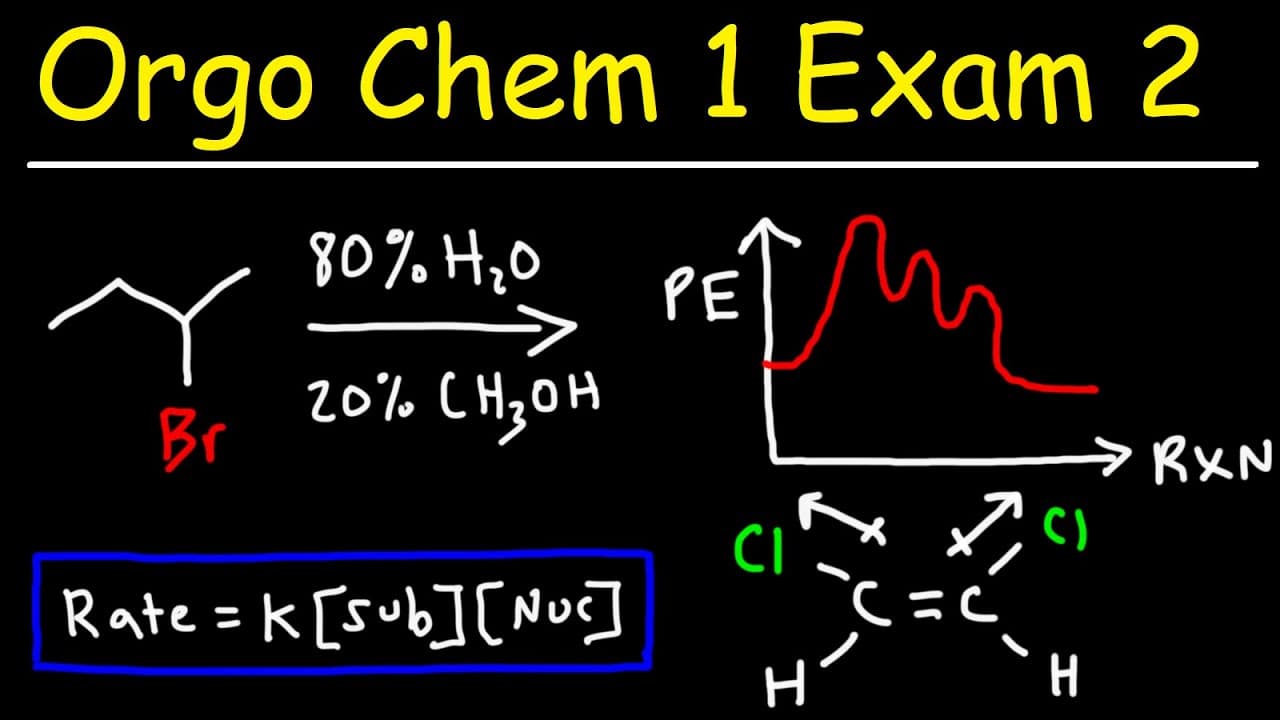
This video covers stereochemistry, SN1, SN2, E1, and E2 reactions, and the properties of different isomers in organic chemistry exams.
Transcript
this video is for those of you who are preparing for the second exam of your first semester for organic chemistry in the full length extended version of this video we're going to cover four key topics stereochemistry sn1 sn2 E1 E2 reactions alkene reactions and reactions of alkynes so let's go ahead and begin with stereochemistry what is the relati... Read More
Key Insights
- ❓ Constitutional isomers have different connectivity, while stereoisomers have the same connectivity but differ in spatial arrangement.
- 🪩 Enantiomers are mirror images of each other and have opposite optical rotations.
- 💿 Diastereomers have different physical properties but the same optical properties.
- 🐻❄️ SN1 reactions occur with weak nucleophiles and in polar protic solvents, while SN2 reactions occur with strong nucleophiles and in polar aprotic solvents.
- 💨 Tertiary carbocations are more stable and react faster in S1 reactions.
- 💿 The configuration of a chiral center determines the optical properties and specific rotation of a compound.
- 🖐️ Solvents play a crucial role in determining the mechanism and reactivity of organic reactions.
- ❓ Iodide is a better nucleophile in protic solvents, while fluoride is a better nucleophile in aprotic solvents.
Install to Summarize YouTube Videos and Get Transcripts
Explore YouTube Video Summarizer or Get YouTube Transcript Extractor
Questions & Answers
Q: How are constitutional isomers different from stereoisomers?
Constitutional isomers have the same chemical formula but different connectivity, while stereoisomers have the same chemical formula and connectivity but differ in spatial arrangement.
Q: What is the difference between enantiomers and diastereomers?
Enantiomers are stereoisomers that are non-superimposable mirror images, while diastereomers are stereoisomers that are not mirror images and have different properties.
Q: How do enantiomers and diastereomers differ in their optical properties?
Enantiomers have opposite optical rotations, while diastereomers have different physical properties but the same optical properties.
Q: What factors determine whether a compound will undergo an SN1 or SN2 reaction?
SN1 reactions occur in the presence of weak nucleophiles and polar protic solvents, while SN2 reactions occur with strong nucleophiles and polar aprotic solvents.
Q: How does the stability of carbocations affect the rate of S1 reactions?
Tertiary carbocations are more stable than secondary carbocations, making tertiary alkyl halides more reactive in S1 reactions.
Q: Which solvent is more polar, water or methanol?
Water is more polar than methanol, so a solvent mixture with a higher concentration of water will react faster in an S1 reaction.
Q: Which nucleophile is better in a protic solvent, iodide or fluoride?
Iodide is a better nucleophile in a protic solvent because it is less solvated and more available to react.
Q: What is the difference between an SN2 and an E2 reaction?
SN2 reactions occur in one step with inversion of configuration, while E2 reactions involve the elimination of a leaving group and a proton abstraction in a concerted mechanism.
Summary & Key Takeaways
-
The video covers the concepts of constitutional isomers, enantiomers, diastereomers, and meso compounds in stereochemistry.
-
It explains the configuration of chiral centers and the classification of compounds as enantiomers or diastereomers based on their configuration.
-
The video discusses the optical properties of enantiomers and the calculation of specific rotation.
-
It introduces the concept of natural meric excess in solutions and its calculations.
-
The video also covers the relationship between different compounds, such as constitutional isomers and diastereomers.
-
It explains the concepts of cis-trans isomers and their classification as diastereomers.
-
The video discusses the effect of molecular configuration on boiling points and the measurement of specific rotation.
-
It explains the reactions and mechanisms of SN1 and SN2 reactions in organic chemistry.
-
The video also discusses the role of protic and aprotic solvents in SN1 and SN2 reactions.
-
It explains the mechanisms and factors influencing E1 and E2 reactions.
Read in Other Languages (beta)
Share This Summary 📚
Summarize YouTube Videos and Get Video Transcripts with 1-Click
Try YouTube Summary with ChatGPT & Claude or YouTube Transcript Generator
Explore More Summaries from The Organic Chemistry Tutor 📚
Summarize YouTube Videos and Get Video Transcripts with 1-Click
Try YouTube Summary with ChatGPT & Claude or YouTube Transcript Generator