How to Calculate the Correlation Coefficient Using Covariance
TL;DR
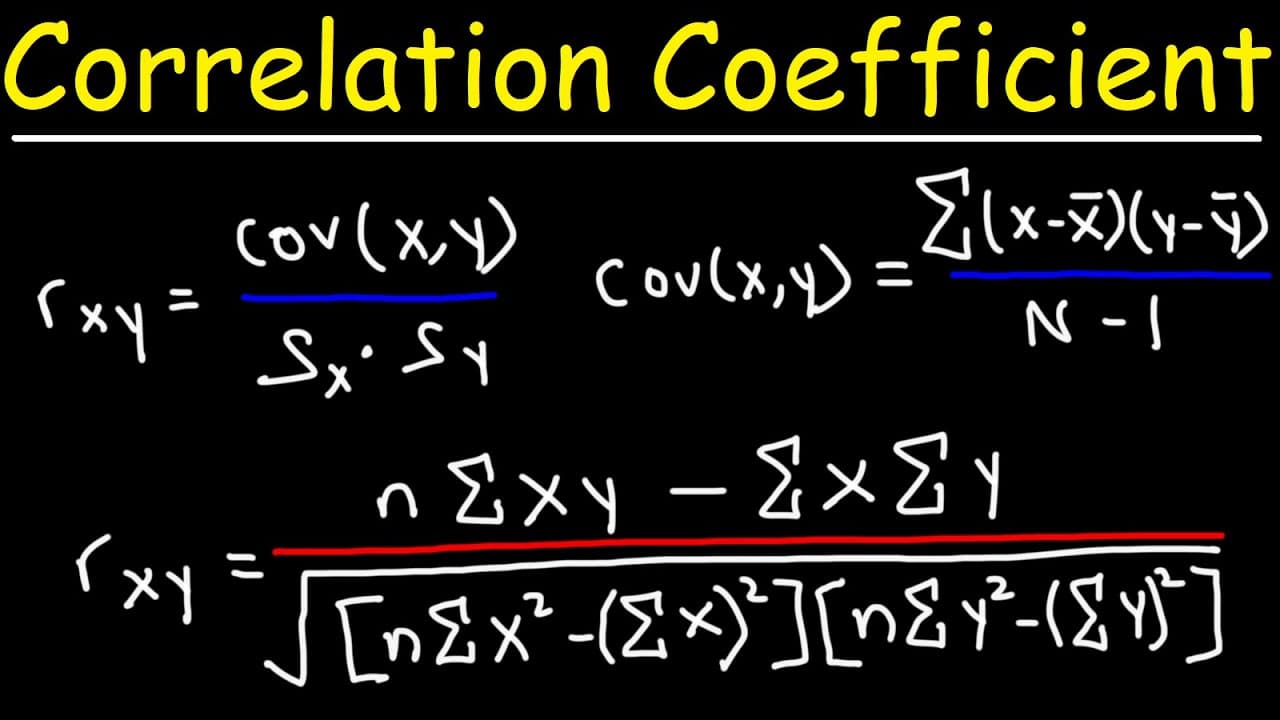
To calculate the correlation coefficient, use the formula: correlation coefficient = covariance(X, Y) / (standard deviation(X) * standard deviation(Y)). This can be done using two formulas: one based on covariance and the other on the sums of products. Both methods will yield the same result, confirming the relationship between variables X and Y.
Transcript
in this lesson we're going to talk about how to calculate the correlation coefficient using covariance and we'll also confirm the answer with another formula so here's how we can calculate the coefficient the correlation coefficient of the two variables X and Y it's equal to the covariance of X and Y divid by the standard deviation of x * the stand... Read More
Key Insights
- 🍹 There are two formulas to calculate the correlation coefficient, one using covariance and the other using the sums of products.
- 🚰 Tables can be created to calculate the covariance, sample standard deviations, and correlation coefficient.
- 📶 The correlation coefficient measures the strength and direction of the linear relationship between two variables.
- 🍹 Covariance is calculated by summing the products of the differences between X and the mean of X, and Y and the mean of Y.
- ❓ Sample standard deviations provide insights into the variability or spread of the data.
- 🧡 The correlation coefficient ranges from -1 to 1, indicating different levels of relationship strength and direction.
- 🫚 Calculations involve using formulas, sums, differences, and square roots.
Install to Summarize YouTube Videos and Get Transcripts
Explore YouTube Video Summarizer or Get YouTube Transcript Extractor
Questions & Answers
Q: What is the correlation coefficient?
The correlation coefficient measures the strength and direction of the linear relationship between two variables. It ranges from -1 to 1, where -1 indicates a perfect negative relationship, 0 indicates no relationship, and 1 indicates a perfect positive relationship.
Q: How is the covariance calculated?
Covariance is calculated by summing the products of the differences between each X value and the mean of X, and each Y value and the mean of Y. This sum is then divided by (n-1), where n is the number of data points.
Q: What is the purpose of calculating the sample standard deviations?
The sample standard deviations indicate the variability or spread of the data for X and Y. They are used in the formula to calculate the correlation coefficient and provide additional insights into the data.
Q: Can the correlation coefficient be negative?
Yes, the correlation coefficient can be negative, indicating a negative relationship between the variables. This means that as one variable increases, the other decreases, and vice versa.
Summary & Key Takeaways
-
The correlation coefficient of variables X and Y can be calculated using the covariance of X and Y divided by the standard deviation of X multiplied by the standard deviation of Y.
-
There are two formulas to calculate the correlation coefficient, one using covariance and the other using the sums of products.
-
By creating tables and performing calculations, the covariance, sample standard deviations, and correlation coefficient can be determined.
Read in Other Languages (beta)
Share This Summary 📚
Summarize YouTube Videos and Get Video Transcripts with 1-Click
Try YouTube Summary with ChatGPT & Claude or YouTube Transcript Generator
Explore More Summaries from The Organic Chemistry Tutor 📚



Summarize YouTube Videos and Get Video Transcripts with 1-Click
Try YouTube Summary with ChatGPT & Claude or YouTube Transcript Generator