The Treasures of Trappist-1 | Space Time
TL;DR
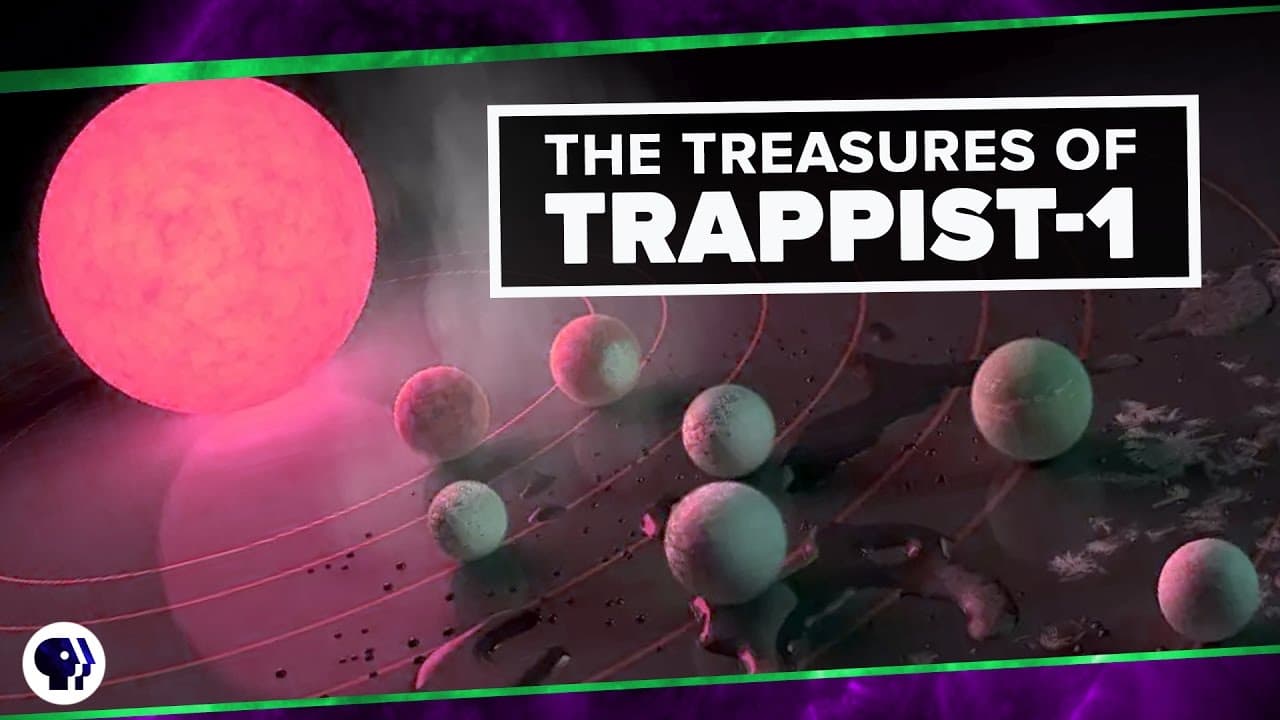
Seven Earth-like planets found around TRAPPIST-1, potential for life.
Transcript
NARRATOR: This episode is supported by LegalZoom. Last week in a NASA press release, we learned about an amazing new discovery. A nearby red dwarf star was discovered to have not one, but seven Earth-like planets, and any of them may be capable of supporting life. [MUSIC PLAYING] The TRAPPIST-1 planetary system was discovered by Dr. Michael Gillon ... Read More
Key Insights
- The TRAPPIST-1 system contains seven Earth-like planets, discovered using the transit method, with potential for liquid water.
- Located 39.5 light-years away in the constellation Aquarius, TRAPPIST-1 is an ultra-cool dwarf star with a significantly lower temperature than our sun.
- All seven planets orbit very close to TRAPPIST-1, with years ranging from 1.5 days to 3 weeks, and are likely tidally locked.
- Three of the planets are in the star's habitable zone, where liquid water could exist, though climate modeling suggests potential Venus-like conditions.
- The planets' proximity to the star exposes them to stellar activity, posing risks to their atmospheres and potential habitability.
- Future spectroscopy from the James Webb Space Telescope may provide insights into the planets' atmospheres and potential signs of life.
- Tidal forces could cause significant heating and volcanic activity on the inner planets, affecting their habitability.
- The discovery suggests Earth-sized planets may be common around M dwarf stars, increasing the potential for life-supporting planets.
Install to Summarize YouTube Videos and Get Transcripts
Explore YouTube Video Summarizer or Get YouTube Transcript Extractor
Questions & Answers
Q: What is the significance of the TRAPPIST-1 discovery?
The discovery of the TRAPPIST-1 system is significant because it contains seven Earth-like planets, three of which are in the habitable zone where liquid water could exist. This finding suggests Earth-sized planets may be common around M dwarf stars, increasing the potential for life-supporting planets in the galaxy.
Q: How were the TRAPPIST-1 planets discovered?
The TRAPPIST-1 planets were discovered using the transit method. This involves observing the dimming of the central star as planets pass in front of it. Initial discoveries were made using the TRAPPIST telescope, with further observations by the Spitzer Space Telescope revealing additional planets.
Q: What challenges do the TRAPPIST-1 planets face regarding habitability?
The TRAPPIST-1 planets face several challenges regarding habitability. Their proximity to the host star exposes them to intense stellar activity, which can erode atmospheres. Tidal locking may result in extreme temperature differences, and tidal forces could cause significant heating and volcanic activity, especially on the inner planets.
Q: What role does the James Webb Space Telescope play in studying TRAPPIST-1?
The James Webb Space Telescope is expected to play a crucial role in studying the TRAPPIST-1 system by providing detailed spectroscopy of the planets' atmospheres. This could reveal their compositions and potentially identify chemical signatures indicative of biological activity, offering insights into their habitability.
Q: Why are the TRAPPIST-1 planets likely tidally locked?
The TRAPPIST-1 planets are likely tidally locked due to their close proximity to the host star. This means one side of each planet always faces the star, while the other remains in darkness. Tidal locking can result in extreme temperature differences between the two sides, affecting habitability.
Q: How do tidal forces affect the TRAPPIST-1 planets?
Tidal forces in the TRAPPIST-1 system can cause significant heating, especially on the inner planets. This is due to the gravitational interactions between the planets and their host star. Such forces could lead to increased volcanic activity and affect the planets' surface conditions and habitability.
Q: What is the habitable zone, and why is it important for TRAPPIST-1?
The habitable zone is the region around a star where conditions are right for liquid water to exist on a planet's surface. For TRAPPIST-1, three planets lie within this zone, making them potential candidates for supporting life. The habitable zone's location depends on the star's intensity and atmospheric conditions.
Q: What potential does the TRAPPIST-1 discovery hold for future research?
The TRAPPIST-1 discovery holds significant potential for future research into exoplanet atmospheres and the conditions required for life. With Earth-sized planets in the habitable zone, the system offers a unique opportunity to study the factors that influence habitability and the prevalence of life-supporting planets in the galaxy.
Summary & Key Takeaways
-
The TRAPPIST-1 system, located 39.5 light-years away, contains seven Earth-like planets, discovered via the transit method. These planets orbit an ultra-cool dwarf star, with three in the habitable zone, potentially supporting liquid water. The planets are likely tidally locked, and their atmospheres are subject to stellar activity.
-
Three of the TRAPPIST-1 planets lie within the habitable zone, but climate modeling suggests they might have Venus-like conditions. The system's proximity to its star exposes the planets to stellar activity, which could affect their atmospheres and habitability. Future observations may reveal atmospheric compositions.
-
The TRAPPIST-1 planets' close orbits result in tidal locking and potential tidal heating, especially on the inner planets. This discovery indicates that Earth-sized planets are common around M dwarf stars, increasing the number of potential life-supporting planets in the galaxy.
Read in Other Languages (beta)
Share This Summary 📚
Summarize YouTube Videos and Get Video Transcripts with 1-Click
Try YouTube Summary with ChatGPT & Claude or YouTube Transcript Generator
Explore More Summaries from PBS Space Time 📚






Summarize YouTube Videos and Get Video Transcripts with 1-Click
Try YouTube Summary with ChatGPT & Claude or YouTube Transcript Generator