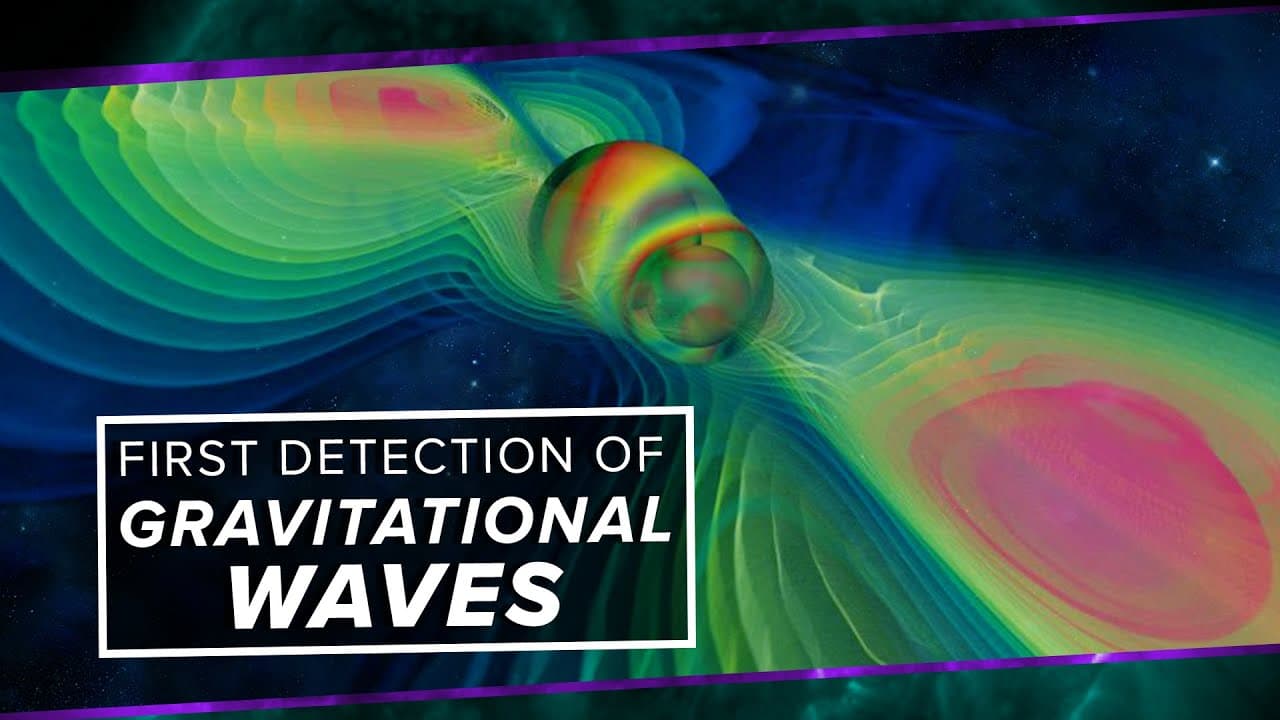
LIGO's First Detection of Gravitational Waves!
TL;DR
LIGO's detection confirms Einstein's gravitational waves prediction.
Transcript
[MUSIC PLAYING] Some incredibly exciting news today. Gravitational waves have been directly detected for the very first time. The Advanced LIGO Observatory has seen the spacetime ripples caused by black holes at the moment of merger. The existence of these waves is the last major prediction of Einstein's theory of general relativity to be directly ... Read More
Key Insights
- The Advanced LIGO Observatory has directly detected gravitational waves, confirming a major prediction of Einstein's theory of general relativity.
- Gravitational waves are ripples in spacetime caused by massive objects like black holes and neutron stars orbiting closely.
- LIGO's enhanced sensitivity, improved tenfold, allowed the detection of these waves almost immediately after being switched on.
- The detection of gravitational waves opens a new window for observing the universe, marking the beginning of gravitational wave astronomy.
- Gravitational waves carry information about black hole mergers, including the strange warping of space near the event horizon.
- Future observations with LIGO and other telescopes could reveal new mysteries and test the limits of general relativity.
- The upcoming eLISA mission will explore lower frequency gravitational waves, potentially observing supermassive black hole mergers.
- LIGO's findings support the continued exploration of gravitational wave phenomena, promising new insights into cosmic events.
Install to Summarize YouTube Videos and Get Transcripts
Explore YouTube Video Summarizer or Get YouTube Transcript Extractor
Questions & Answers
Q: What is the significance of LIGO's detection of gravitational waves?
LIGO's detection of gravitational waves is significant because it confirms a major prediction of Einstein's theory of general relativity, which had remained unverified for a century. This discovery opens up a new field of gravitational wave astronomy, allowing scientists to observe cosmic events and test the limits of our understanding of gravity and spacetime.
Q: How does LIGO detect gravitational waves?
LIGO detects gravitational waves by using laser interferometry to measure tiny changes in the distance between mirrors placed kilometers apart. As gravitational waves pass through, they cause the mirrors to move slightly, creating a detectable signal. LIGO's enhanced sensitivity allows it to detect these minute changes, confirming the presence of gravitational waves.
Q: What are the sources of gravitational waves detected by LIGO?
The gravitational waves detected by LIGO primarily originate from the mergers of stellar mass black holes and neutron stars. These cosmic events involve massive objects orbiting closely, producing strong gravitational waves as they spiral towards each other. LIGO's sensitivity allows it to detect these waves from vast distances, even billions of light-years away.
Q: What future developments are expected in gravitational wave astronomy?
Future developments in gravitational wave astronomy include the launch of the eLISA mission, which will explore lower frequency gravitational waves, potentially observing supermassive black hole mergers. Additionally, combining gravitational wave data with electromagnetic observations will enhance our understanding of cosmic phenomena, revealing new insights into the universe's most extreme environments.
Q: How do gravitational waves confirm Einstein's theory of general relativity?
Gravitational waves confirm Einstein's theory of general relativity by providing direct evidence of the ripples in spacetime predicted by the theory. The observation of these waves from black hole mergers aligns with Einstein's predictions, validating the theory's accuracy in describing the behavior of gravity in extreme conditions and further supporting its foundational role in modern physics.
Q: What information do gravitational waves carry about black hole mergers?
Gravitational waves carry information about the dynamics of black hole mergers, including the masses and spins of the merging black holes. They also provide insights into the warping of spacetime near the event horizon, offering a unique perspective on the physics of black holes and the extreme gravitational environments in which these cosmic events occur.
Q: Why is the detection of gravitational waves considered a new window on the universe?
The detection of gravitational waves is considered a new window on the universe because it allows scientists to observe cosmic events that are invisible through traditional electromagnetic observations. Gravitational waves provide a unique tool for exploring the universe's most extreme environments, offering new insights into phenomena such as black hole mergers and the fundamental nature of gravity.
Q: What challenges remain in the study of gravitational waves?
Challenges in the study of gravitational waves include improving the sensitivity and range of detection instruments, such as LIGO and future missions like eLISA, to observe a broader spectrum of gravitational wave sources. Additionally, interpreting the data requires sophisticated models and simulations to accurately describe the complex dynamics of cosmic events, pushing the limits of current astrophysical theories.
Summary & Key Takeaways
-
The Advanced LIGO Observatory has achieved a groundbreaking scientific milestone by directly detecting gravitational waves. These waves, predicted by Einstein's theory of general relativity, are ripples in spacetime caused by massive objects such as black holes and neutron stars. LIGO's enhanced sensitivity allowed for this historic observation, opening a new era in astronomy.
-
Gravitational waves offer a novel way to observe the universe, providing insights into cosmic events like black hole mergers. The detection confirms Einstein's predictions and supports the validity of general relativity. LIGO's findings promise to enhance our understanding of extreme gravitational environments and may reveal new cosmic mysteries.
-
Future missions like eLISA will extend gravitational wave observations to lower frequencies, potentially revealing phenomena such as supermassive black hole mergers. LIGO's detection marks the beginning of gravitational wave astronomy, offering a fresh perspective on the universe and the potential for groundbreaking discoveries in the field of astrophysics.
Read in Other Languages (beta)
Share This Summary 📚
Summarize YouTube Videos and Get Video Transcripts with 1-Click
Try YouTube Summary with ChatGPT & Claude or YouTube Transcript Generator
Explore More Summaries from PBS Space Time 📚
Summarize YouTube Videos and Get Video Transcripts with 1-Click
Try YouTube Summary with ChatGPT & Claude or YouTube Transcript Generator