How Vacuum Decay Would Destroy The Universe
TL;DR
Vacuum decay could rewrite the universe's laws of physics.
Transcript
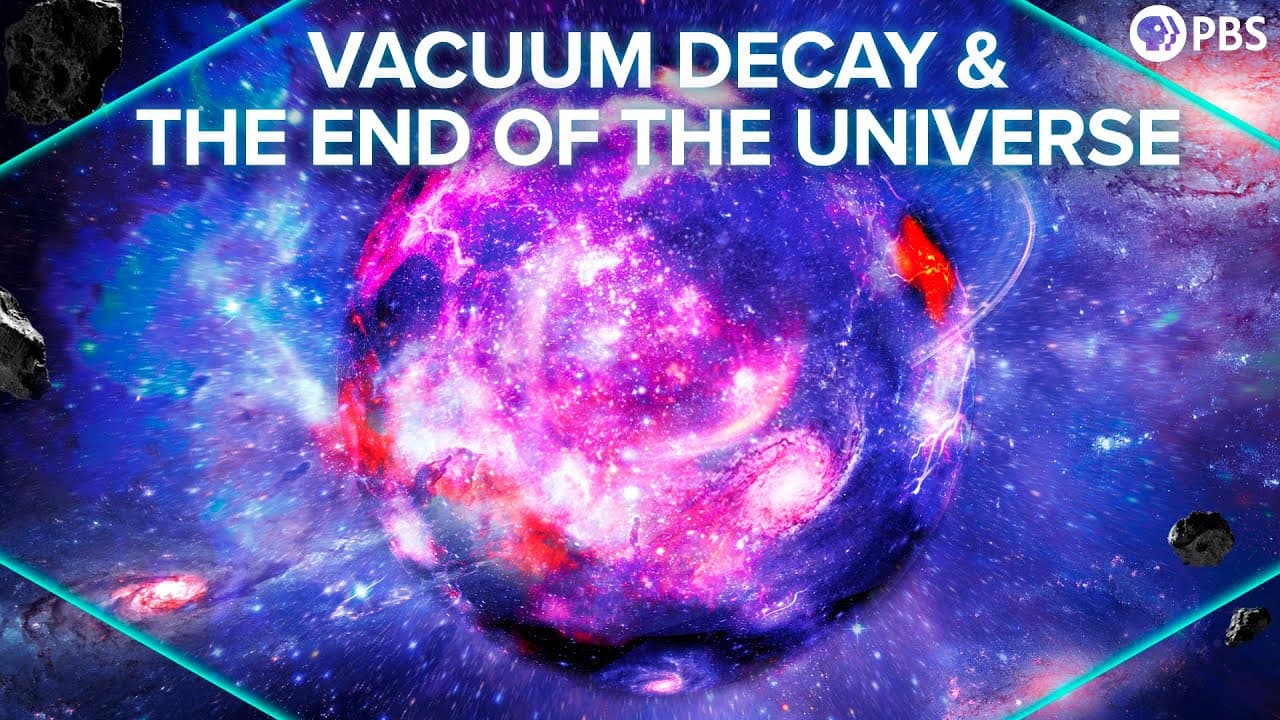
The universe is going to end. But of all the possible ends of the universe vacuum decay would have to be the most thorough - because it could totally rewrite the laws of physics. Today I hope to help you understand exactly how terrified you should be. It seems pretty lucky that the universe is how it is. Its just the right size, has just the ri... Read More
Key Insights
- Vacuum decay is a potential end-of-the-universe scenario where the laws of physics could be rewritten, resulting in catastrophic consequences.
- The universe's habitability is largely defined by quantum fields, which if altered, could prevent the existence of familiar structures like atoms and galaxies.
- Vacuum decay resembles a bubble of annihilation expanding at light speed, altering quantum fields as it passes.
- The Higgs field's minimum energy state is non-zero, potentially leading to multiple minima and metastable states, raising the possibility of vacuum decay.
- Quantum tunneling could cause the Higgs field to shift to a true vacuum state, triggering a bubble that expands and transforms the universe.
- The energy released during vacuum decay would fill the expanding bubble with energetic particles, disrupting the masses of elementary particles and preventing life and structure as we know it.
- Although the probability of vacuum decay occurring is low, it remains a theoretical possibility, with timescales ranging from the universe's current age to vastly longer periods.
- Accelerating cosmic expansion could protect us by distancing us from any vacuum decay bubbles, ensuring safety if the event occurs beyond several billion light years.
Install to Summarize YouTube Videos and Get Transcripts
Explore YouTube Video Summarizer or Get YouTube Transcript Extractor
Questions & Answers
Q: What is vacuum decay and why is it significant?
Vacuum decay is a hypothetical scenario where a bubble of lower-energy true vacuum forms within the universe's false vacuum state. This bubble expands at light speed, altering the quantum fields and potentially rewriting the laws of physics. It is significant because it represents a thorough and catastrophic end to the universe as we know it, affecting all structures and life forms.
Q: How does the Higgs field contribute to the possibility of vacuum decay?
The Higgs field has a non-zero minimum energy state, which can lead to multiple minima or metastable states. If the universe resides in a false vacuum state, a quantum tunneling event could shift the Higgs field to a true vacuum state, triggering vacuum decay. This process would create a bubble that expands, altering the universe's quantum fields and potentially leading to its destruction.
Q: What role does quantum tunneling play in vacuum decay?
Quantum tunneling allows the Higgs field to shift from a false vacuum state to a true vacuum state without requiring extreme energy conditions. This spontaneous transition can initiate vacuum decay by creating a bubble of true vacuum that expands at light speed, altering the universe's quantum fields and potentially leading to catastrophic consequences for all structures and life forms.
Q: What are the potential consequences of vacuum decay for the universe?
Vacuum decay would release energy, filling the expanding bubble with energetic particles. This would disrupt the masses of elementary particles and prevent the formation of structures like stars and galaxies. The alteration of quantum fields could rewrite the laws of physics, making life and structure as we know it impossible, and potentially leading to the universe's destruction.
Q: How likely is vacuum decay to occur in the universe?
The likelihood of vacuum decay occurring is low, with physicists estimating a range of timescales from the universe's current age to vastly longer periods. While the probability of a vacuum decay bubble forming is small, it remains a theoretical possibility. However, cosmic expansion could protect us by distancing us from any vacuum decay bubbles that may form.
Q: What factors could prevent vacuum decay from affecting us?
Accelerating cosmic expansion could prevent vacuum decay from affecting us by distancing us from any bubbles that might form. If a vacuum decay event occurs beyond several billion light years, the universe's expansion would move us away from it faster than the bubble can grow. Additionally, the low probability of a bubble forming within our observable universe provides some reassurance.
Q: Could human activities trigger vacuum decay?
While there was some concern that particle colliders like the LHC might nucleate a vacuum decay bubble, this fear was unfounded. Earth is constantly bombarded by cosmic rays with much higher energy than the LHC can produce, and no annihilation has occurred. Therefore, human activities are unlikely to trigger vacuum decay, given the natural high-energy events that occur without consequence.
Q: What would happen if vacuum decay occurred within our cosmic horizon?
If vacuum decay occurred within our cosmic horizon, we would not see it coming, as no light can outpace the expanding bubble to warn us. The event would happen without warning, with one moment everything appearing normal and the next moment the universe undergoing a catastrophic phase transition. However, the probability of this occurring within our observable universe is extremely low.
Summary & Key Takeaways
-
Vacuum decay is a theoretical end-of-universe scenario where quantum fields undergo a phase transition, potentially rewriting the laws of physics. The Higgs field, with its non-zero minimum energy state, plays a crucial role in this process, which could have catastrophic consequences for the universe.
-
The universe's habitability depends on quantum fields that, if altered, could prevent the formation of atoms and galaxies. Vacuum decay involves a bubble of annihilation expanding at light speed, altering these fields, and potentially leading to the universe's destruction.
-
The probability of vacuum decay occurring is low, but it remains a theoretical possibility. Cosmic expansion could protect us by distancing us from any vacuum decay bubbles, ensuring safety if the event occurs beyond several billion light years, although it would happen without warning.
Read in Other Languages (beta)
Share This Summary 📚
Summarize YouTube Videos and Get Video Transcripts with 1-Click
Try YouTube Summary with ChatGPT & Claude or YouTube Transcript Generator
Explore More Summaries from PBS Space Time 📚
Summarize YouTube Videos and Get Video Transcripts with 1-Click
Try YouTube Summary with ChatGPT & Claude or YouTube Transcript Generator