What Is the Normal Distribution and How to Use It?
TL;DR
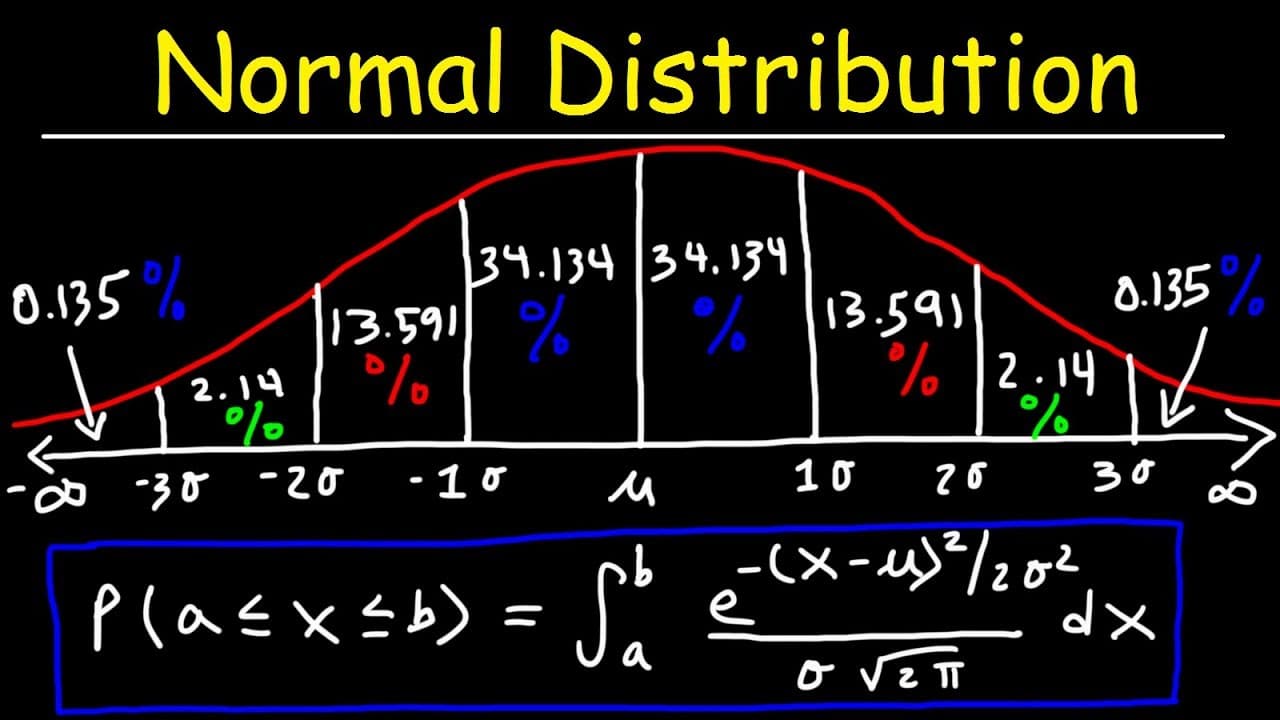
The normal distribution, or bell curve, represents the probability of events within certain intervals based on a mean and standard deviation. It follows the 68-95-99.7 rule, indicating that approximately 68% of data falls within one standard deviation, 95% within two, and 99.7% within three. Understanding this distribution is crucial for calculating probabilities in statistics.
Transcript
in this video we're gonna talk about the normal distribution or the bell-shaped curve so let's begin by drawing a picture of that curve and it's gonna look something like that now right in the middle we have the population mean represented by the Greek letter mu and to the right of that one stand deviation away we have the Greek letter Sigma and th... Read More
Key Insights
- 🫑 The normal distribution curve is a bell-shaped curve that represents the probability of events occurring within different intervals.
- ❓ The area under the curve represents the probability, with specific percentages associated with different standard deviation intervals.
- 📏 The 68-95-99.7 rule provides approximate percentages for events occurring within one, two, and three standard deviations from the mean.
Install to Summarize YouTube Videos and Get Transcripts
Explore YouTube Video Summarizer or Get YouTube Transcript Extractor
Questions & Answers
Q: What does the area under the normal distribution curve represent?
The area under the curve represents the probability of an event happening between two points. It is a way to quantify the likelihood of certain outcomes.
Q: How can we calculate the probability of an event happening between the mean and the first standard deviation?
Using the 68-95-99.7 rule, we know that within one standard deviation of the mean, there is a 68.26% chance that an event will happen in this region. This can be divided by two to give the probability between the mean and the first standard deviation on each side.
Q: What is the significance of the numbers 68, 95, and 99.7 in the 68-95-99.7 rule?
These numbers represent the approximate percentages of events that fall within one, two, and three standard deviations from the mean in a normal distribution curve.
Q: How can the normal distribution curve be used to solve problems?
The normal distribution curve can be used to calculate probabilities and determine the likelihood of specific events occurring within a given range. It is commonly used in statistical analysis and hypothesis testing.
Summary & Key Takeaways
-
The normal distribution curve, also known as the bell-shaped curve, represents the probability of an event happening between different points.
-
The area under the curve represents the probability, with specific percentages associated with different standard deviation intervals from the mean.
-
Calculating probabilities within specific intervals can be done using the 68-95-99.7 rule, which provides approximate percentages for different standard deviation intervals.
Read in Other Languages (beta)
Share This Summary 📚
Summarize YouTube Videos and Get Video Transcripts with 1-Click
Try YouTube Summary with ChatGPT & Claude or YouTube Transcript Generator
Explore More Summaries from The Organic Chemistry Tutor 📚



Summarize YouTube Videos and Get Video Transcripts with 1-Click
Try YouTube Summary with ChatGPT & Claude or YouTube Transcript Generator